
Ethereum Classic's Long-Term Price Potential: Scarcity, Resilience, and the Olympia Upgrade
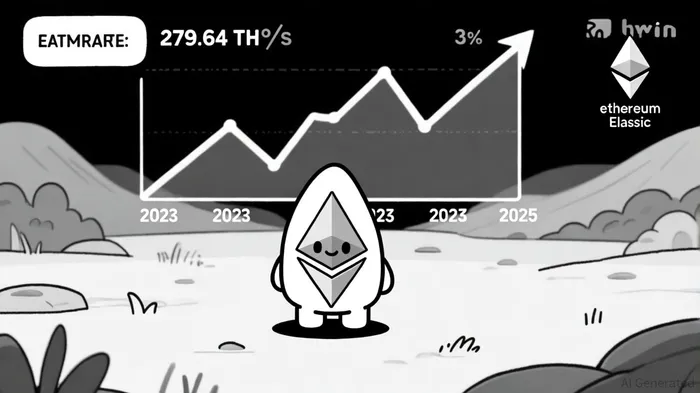
Ethereum Classic (ETC) occupies a unique niche in the blockchain ecosystem as a Proof-of-Work (PoW) chain that has preserved Ethereum's original codebase while embracing innovation through upgrades like the upcoming Olympia Upgrade. For investors, understanding ETC's long-term price potential requires analyzing two critical pillars: blockchain scarcity and network resilience.
Blockchain Scarcity: A Deflationary Shift Amid PoW Constraints
ETC's total supply is capped at 210.7 million tokens, with a circulating supply of approximately 153.44 million as of 2025[1]. While its annual inflation rate of 4.42% (6.21 million new tokens) remains higher than Ethereum's post-Merge 0.43%, the Olympia Upgrade introduces structural reforms that could reduce supply growth over time. By redirecting the BASEFEE from EIP-1559 into an on-chain treasury instead of burning it, the upgrade creates a deflationary mechanism that indirectly limits supply expansion[2]. This contrasts with Ethereum's burn model, which directly reduces circulating supply.
The treasury, governed by a decentralized autonomous organization (DAO), allows ETCETC-- holders to vote on funding proposals for development and infrastructure[3]. This shift toward community-driven governance aligns with ETC's core values of decentralization while addressing historical challenges in securing sustainable funding. Analysts suggest that this model could reduce ETC's inflationary pressure by incentivizing long-term network participation[4].
Network Resilience: Hashrate, Security, and the Olympia Upgrade
ETC's network hashrate currently stands at 279.64 TH/s, though discrepancies in sources (ranging from 129.19 TH/s to 280.04 TH/s) highlight the need for standardized metrics[5]. A higher hashrate correlates with stronger security, as it increases the computational effort required for 51% attacks—a historical vulnerability for ETC[6]. The Olympia Upgrade aims to bolster resilience by redirecting BASEFEE to fund infrastructure improvements, potentially attracting more miners and developers to the network[7].
The upgrade's phased rollout—scheduled for mainnet activation by late 2026—reflects a cautious approach to protocol changes[8]. By integrating immutable smart contracts and transparent governance, the upgrade mitigates risks of centralization and misuse, addressing past criticisms of ETC's security track record[9]. However, challenges remain: ETC's relatively low DApp activity and ESG concerns tied to PoW could hinder adoption in a market increasingly prioritizing sustainability[10].
Price Potential: Balancing Scarcity and Resilience
Price predictions for ETC vary widely. In 2025, bearish scenarios project a floor of $26, while bullish forecasts reach $55, with an average of $40.50[11]. Looking further ahead, analysts speculate ETC could hit $158.75 by 2030, contingent on broader blockchain adoption and successful execution of the Olympia Upgrade[12]. These projections hinge on the upgrade's ability to:
1. Enhance scarcity through deflationary treasury mechanisms.
2. Strengthen security by incentivizing miner participation and infrastructure development.
3. Attract developers with a transparent, community-driven funding model.
Critically, ETC's success will depend on its capacity to compete with both PoW chains (e.g., Bitcoin) and PoS alternatives (e.g., Ethereum). The Olympia Upgrade's focus on decentralized governance and protocol-level funding positions ETC as a potential “sovereign DeFi layer” for PoW assets[13], a narrative that could drive institutional interest.
Conclusion: A Calculated Bet on PoW's Future
Ethereum Classic's long-term price potential rests on its ability to balance scarcity and resilience in a rapidly evolving market. While its PoW model and ESG challenges present headwinds, the Olympia Upgrade offers a compelling roadmap for addressing these issues through innovation. For investors, the key variables will be the successful activation of the upgrade, hashrate stability, and adoption of the DAO governance model. If ETC can solidify its position as a sustainable, decentralized smart contract platform, its price trajectory may reflect the growing demand for PoW-based value propositions in the years ahead.






Comentarios
Aún no hay comentarios