
Ethereum's On-Chain Growth vs. Price Divergence: A Case for Long-Term Optimism
Ethereum's journey from 2023 to 2025 has been defined by a striking divergence between its on-chain fundamentals and short-term price action. While network activity has surged to unprecedented levels-marked by record-breaking active addresses, transaction volumes, and staking adoption-ETH's price has lagged behind the pace of these developments. This disconnect, however, does not signal a failure of the network but rather a misalignment between speculative market behavior and the compounding value of Ethereum's infrastructure. For long-term investors, the data paints a compelling case for optimism, rooted in the network's ability to scale, innovate, and attract institutional capital.
On-Chain Growth: A Network at Its Peak
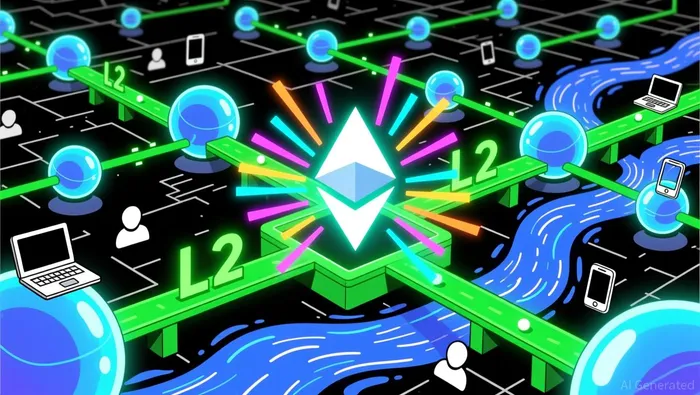
Ethereum's on-chain metrics in 2025 reflect a maturing ecosystem. Daily active addresses have surpassed 275 million, a figure that dwarfs the 1 million peak observed in 2023 and underscores widespread adoption across decentralized finance (DeFi), non-fungible tokens (NFTs), and layer-2 (L2) solutions according to data. Meanwhile, the network processes over 1 million transactions per day on the mainnet, with L2s handling 58–65% of total volume. This shift to L2s has alleviated congestion, enabling EthereumETH-- to maintain robust activity without sacrificing user experience.
Gas fees, once a barrier to adoption, have plummeted to $0.30–$0.33 per transaction, a 95% reduction from the $100+ peaks of 2021. This transformation is largely attributable to the Dencun upgrade, which optimized data availability, and the proliferation of L2s like Arbitrum and zkSync Era according to statistics. The result is a network that balances throughput with affordability-a critical factor for sustaining growth in both retail and institutional use cases.
Staking and Institutional Adoption: A New Equilibrium
Ethereum's staking ecosystem has emerged as a cornerstone of its value proposition. By June 2025, over 35 million ETH-nearly 30% of the total supply-was locked in staking contracts, effectively reducing circulating liquidity and creating upward pressure on price. This surge was amplified by the Pectra upgrade in May 2025, which introduced EIPs like EIP-7251 and EIP-7691 to enhance validator flexibility and scalability. Validator balance caps were raised, and withdrawal operations streamlined, encouraging large holders to consolidate stakes and further reduce market liquidity.
Institutional participation has also accelerated. The launch of Ethereum spot ETFs in July 2024 injects $9.8 billion in net inflows by June 2025, signaling growing confidence in Ethereum as an asset class. These products, coupled with regulated staking solutions, have provided institutional investors with yield-generating opportunities while reinforcing Ethereum's role as a foundational pillar of the crypto economy.
Price Divergence: A Matter of Timing, Not Fundamentals
Despite these fundamentals, Ethereum's price has not fully capitalized on its progress. As of late 2025, price forecasts range from $3,500–$4,000 to speculative targets above $8,500. This divergence reflects short-term market dynamics-such as macroeconomic uncertainty and regulatory ambiguity-that often overshadow long-term value creation. However, historical patterns suggest that Ethereum's price eventually aligns with its on-chain momentum. For instance, surges in staking deposits and L2 transaction volumes have repeatedly preceded ETH price breakouts, indicating a lagging but consistent correlation.
Moreover, Ethereum's reduced circulating supply-due to staking and burn mechanics-creates a structural tailwind for price appreciation. With 30% of ETH supply now staked and Layer 2 networks absorbing much of the transaction load, the network's scarcity profile and utility are increasingly decoupled from speculative trading.
Conclusion: The Case for Long-Term Optimism
Ethereum's 2023–2025 trajectory demonstrates that on-chain growth and price action operate on different timelines. While the market may underprice Ethereum's innovations in the short term, the compounding effects of staking adoption, L2 scalability, and institutional inflows are building a resilient foundation for long-term value. For investors, the key takeaway is clear: Ethereum's fundamentals are not just outpacing price action-they are redefining the metrics by which the network's success should be measured.
As the crypto ecosystem matures, Ethereum's role as a scalable, secure, and staking-driven platform will likely cement its dominance. Those who recognize this divergence today may find themselves positioned to benefit from the inevitable convergence of fundamentals and price in the years ahead.







Comentarios
Aún no hay comentarios