
Ethereum On-Chain Activity as a Leading Indicator for Institutional Involvement
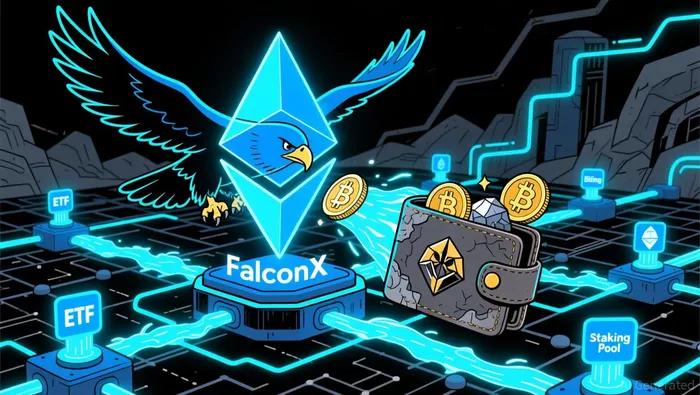
The recent transfer of 16,693 ETH (approximately $50.1 million) from FalconX to a newly identified Bitmine-linked wallet has ignited significant discussion within the blockchain analytics community. This transaction, which occurred in late November 2025, underscores a broader trend of institutional capital inflows into EthereumETH--, signaling renewed confidence in the network's infrastructure and long-term value proposition. By dissecting this event alongside Ethereum's on-chain activity patterns, we can better understand how institutional actors are shaping the cryptocurrency's trajectory.
FalconX and Bitmine: A Case Study in Institutional Accumulation
The transfer to the Bitmine wallet-identified by its address prefix 0x5664-has been closely monitored by platforms like Lookonchain, which flagged the transaction as part of Bitmine's ongoing accumulation strategy. According to blockchain analytics, this single transaction increased Bitmine's Ethereum holdings to over 3.5 million ETH, representing roughly 3% of the cryptocurrency's circulating supply. Bitmine has publicly framed this acquisition as part of its "Strategic ETH Reserve" program, a move that aligns with its broader vision to establish a "Made in America Validator Network" (MAVAN) in 2026, which would allow the firm to stake its holdings and generate recurring yield.
This activity is not isolated. FalconX, a prime broker in the crypto space, has emerged as a key conduit for institutional-grade Ethereum transactions. The firm's role in facilitating large-scale transfers highlights its position as a bridge between traditional finance and decentralized markets. As stated by Tom Lee, a prominent figure associated with Bitmine, the firm's continued Ethereum purchases reflect a strategic bet on the asset's utility and scarcity.
Ethereum's Q4 2025 Institutional Momentum
The FalconX/Bitmine transaction must be contextualized within Ethereum's broader institutional adoption narrative. In Q4 2025, the network experienced a surge in on-chain activity, driven by record ETF inflows and a shift in large holder behavior. Data from blockchain analytics firm BraveNewCoin indicates that U.S. spot ETH ETFs recorded a $92.28 million net inflow on November 24 alone, with BlackRock's ETHA fund leading the charge. This momentum was further amplified by the filing of a staked ETH ETF by BlackRock, which could redefine how institutional investors access yield-generating crypto assets.
Technical indicators also suggest a favorable environment for accumulation. Ethereum's MVRV Z-Score-a metric measuring the ratio of realized value to market value dropped to 0.29 in late November, signaling potential undervaluation and attracting large holders. This aligns with on-chain data showing that investors holding over 10,000 ETH were actively accumulating, while retail exposure declined. Meanwhile, Ethereum's price stabilized around $3,030, supported by ETF inflows and improving technical indicators, with some analysts forecasting a potential move toward $6,000 if the upward trend continues.
Institutional Adoption and Ethereum's Infrastructure Edge
Ethereum's appeal to institutional investors is not merely speculative. The network's role as the backbone of programmable money and tokenized assets-coupled with regulatory clarity in the U.S.-has solidified its position as a foundational infrastructure asset. By Q3 2025, staking participation had reached 29.4% of the total supply, with corporate treasuries and ETFs collectively holding over 10 million ETH. This institutional footprint is further reinforced by Ethereum's upcoming Fusaka upgrade, scheduled for late 2025 to enhance scalability and reduce fee volatility.
The FalconX/Bitmine transaction exemplifies how institutional actors are leveraging Ethereum's unique properties. For instance, Bitmine's decision to stake its holdings through MAVAN mirrors traditional capital allocation strategies, where liquidity and yield are prioritized. This approach contrasts with earlier crypto market dynamics, where volatility and speculative trading dominated.
Conclusion: On-Chain Activity as a Leading Indicator
Ethereum's on-chain activity in Q4 2025 paints a clear picture: institutional capital is increasingly viewing the network as a strategic asset. The FalconX/Bitmine transfer, alongside ETF inflows and staking adoption, demonstrates that large-scale investors are not only accumulating Ethereum but also integrating it into long-term capital management frameworks. As the Fusaka upgrade and regulatory developments unfold, Ethereum's institutional adoption is poised to accelerate, further cementing its role as a cornerstone of the digital asset ecosystem.
For investors, the takeaway is clear: on-chain activity-particularly large, well-sourced transfers-serves as a leading indicator of institutional sentiment. In a market where liquidity and confidence are paramount, Ethereum's Q4 2025 trends suggest that the network is entering a new phase of institutional maturation.







Comentarios
Aún no hay comentarios