
Ethereum's On-Chain Activity: Decoding Whale Behavior and Market Cycles
In the fast-paced world of cryptocurrency, on-chain data has emerged as a critical tool for deciphering market cycles. For EthereumETH-- (ETH), the behavior of large holders-often referred to as "whales"-provides a unique lens through which to analyze investor sentiment and anticipate price movements. Recent on-chain activity suggests that Ethereum is navigating a complex interplay between institutional accumulation, technical indicators, and shifting market dynamics.
Whale Accumulation and Market Cycles
According to a Cryptonews analysis, whale wallets holding between 1,000 to 10,000 ETH added over 871,000 ETH in a single day in June 2025, marking the highest net inflow of the year. This surge in accumulation aligns with historical patterns observed during bullish cycles, where whales move large volumes from exchanges into long-term wallets, reducing liquidity and signaling confidence in future price appreciation, as noted in a Currency Analytics report. For instance, between September 25 and September 27, 2025, 431,018 ETH-valued at approximately $1.73 billion-was transferred from exchanges like Kraken and Galaxy Digital into 16 different wallets, reinforcing a narrative of long-term accumulation, according to a OneSafe analysis.
Such behavior is not isolated. Data from CryptoQuant indicates that wallets holding 10,000 to 100,000 ETH added over 450,000 ETH in a single week, reflecting strong institutional and retail confidence in Ethereum's long-term value proposition, as reported by Analytics Insight. These movements are particularly significant because they often precede major price inflections, as whales act as both market participants and sentiment barometers.
Institutional Participation and Supply Dynamics
Institutional demand has further amplified Ethereum's bullish narrative. BlackRock and Fidelity have collectively purchased $356.4 million in ETH since April 2025, with fund holdings doubling to 6.5 million ETH, as noted by Cryptonews. This institutional interest, combined with increased staking, has driven Ethereum's staked supply to an all-time high of 36.15 million ETH, reducing circulating supply and creating natural bullish pressure, according to the same Cryptonews analysis.
The impact of these moves is compounded by Ethereum's deflationary mechanisms, such as EIP-1559 and tokenized staking. As a report from The Currency Analytics highlighted, Ethereum's dwindling exchange reserves-now at multi-year lows-suggest a reduced supply environment, which could act as a buffer against price declines. This dynamic is critical for understanding Ethereum's resilience amid macroeconomic headwinds.
Technical Analysis and Price Projections
From a technical perspective, Ethereum's price trajectory has been shaped by key resistance and support levels. As of September 2025, ETH is consolidating within a range of $2,480 to $2,750, with a critical rising trendline and Fibonacci retracement levels shaping potential breakout scenarios, as discussed by Cryptonews. Analysts at Analytics Insight note that a breakout above $2,750 could open the door to $3,068 and $3,525, with long-term projections reaching as high as $5,800 by year-end 2025.
However, Ethereum faces challenges. The ETH/BTC ratio has declined to multi-year lows, indicating waning relative strength against BitcoinBTC--, a trend OneSafe also highlighted. Additionally, on-chain indicators like the Realized Price-to-Liveliness Ratio (RPLR) and Net Unrealized Profit/Loss (NUPL) have historically signaled market tops. In 2025, these metrics suggested that Ethereum's bull run had already ended, with the price failing to break previous all-time highs and crossing below key bullish thresholds, according to a CCN analysis.
Market Sentiment and Fundamentals
Despite these technical hurdles, Ethereum's fundamentals remain robust. The approval of spot ETH ETFs has brought sustained institutional capital into the market, while the upcoming Pectra upgrade is expected to enhance network efficiency and scalability, trends covered by Cryptonews. These developments, coupled with Ethereum's dominance in DeFi-where 76% of new users engage in DeFi as their first transaction-underscore its role as a foundational layer for decentralized finance, as reported by The Currency Analytics.
Yet, challenges persist. Ethereum ranks third in USDTUSDT-- transfer volume, trailing behind TronTRX-- and BNBBNB-- Chain due to higher fees and slower transactions, a dynamic The Currency Analytics also noted. This highlights the need for continued innovation in scaling solutions to maintain Ethereum's competitive edge.
Conclusion
Ethereum's market dynamics in 2023–2025 have been driven by a confluence of whale accumulation, institutional participation, and favorable technical and fundamental developments. While on-chain data suggests a reduced supply environment and strong long-term confidence, the path to $5,800 remains contingent on breaking key resistance levels and maintaining institutional support. For investors, monitoring whale activity and institutional flows-alongside technical indicators-will be critical for navigating Ethereum's next phase. 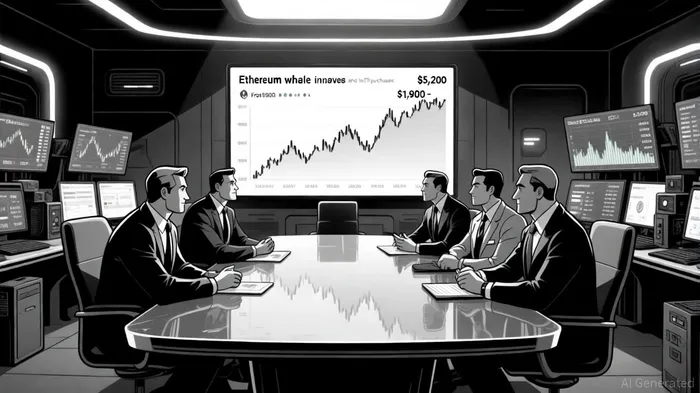






Comentarios
Aún no hay comentarios