
Ethereum's Bullish Divergence: Whale Accumulation vs. Retail Selling
Ethereum's on-chain activity in Q3 2025 has revealed a striking divergence between whale accumulation and retail selling, signaling potential short-to-medium-term price strength. According to Bitget, whale and shark wallets (holding 100–10,000 ETH) accumulated over 934,240 ETH-valued at approximately $3.15 billion-within a three-week period, while retail investors sold a net 1,041 ETH during the same week. This pattern, where large holders increase positions while smaller investors exit, is a classic precursor to market rallies.
Whale Accumulation: A Structural Shift
Whale activity has intensified, with large wallets holding 10,000–100,000 ETH adding over 800,000 ETH between mid-October and early December 2025. This surge aligns with historical trends observed during Ethereum's 2020–2022 cycles, where whales consistently bought during consolidation phases while retail investors exited near local bottoms as reported by Cryptometer. For instance, in late April 2025, EthereumETH-- whales added 7.6 million ETH, a move that coincided with an 8% price gain in 24 hours.
The structural shift is further underscored by declining exchange reserves. As noted by BraveNewCoin, ETH on exchanges now accounts for just 8.6% of the total supply, indicating a shift toward private wallets and staking mechanisms. This tightening supply dynamic, combined with growing institutional demand-evidenced by U.S. spot ETH ETF inflows exceeding $9.6 billion in Q3 2025-creates a "coiled spring" scenario where high buying power is poised to chase limited ETH availability as highlighted by Bitget.
Retail Selling and Market Psychology
Retail selling has historically preceded deeper corrections in Ethereum cycles. Data from Yellow.com highlights that wallets holding less than 0.1 ETH dumped around 1,041 ETH in a single week, reflecting a reactive approach to volatility. However, this behavior contrasts with whale accumulation, which often stabilizes supply and sets the stage for rebounds. For example, during Ethereum's 2023–2024 consolidation phase, retail outflows were offset by whale inflows, creating a "speculative divergence" that ultimately led to a breakout.
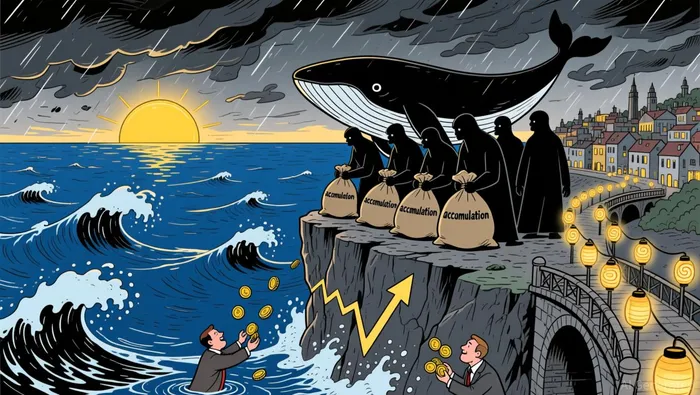
The psychological divide is further amplified by divergent on-chain metrics. While Bitcoin's STH-Realized Cap approached levels seen in previous bull cycles, Ethereum's showed minimal movement, suggesting weaker retail inflows as analyzed by Glassnode. This divergence mirrors Ethereum's 2017 and 2021 bull markets, where new address creation surged to levels comparable to recent weeks-256,817 new Ethereum addresses in a single day-indicating growing participation in DeFi and tokenized assets.
Historical Precedents and Technical Indicators
Ethereum's current trajectory echoes patterns from prior bull markets. In 2017 and 2021, the asset consolidated for extended periods before breaking above key resistance levels. For instance, Ethereum spent 1.4 years consolidating in 2023–2024, facing two rejections at critical resistance before staging a potential breakout as detailed in FastBull. The current price structure shows similar dynamics, with strong support levels holding firm and buyers accumulating ahead of expected volatility as detailed in FastBull.
Technical indicators also reinforce the bullish case. The MVRV (Market Value to Realized Value) ratio and whale accumulation metrics suggest growing confidence among long-term holders as reported by Bitget. If Ethereum breaks through the $4,100–$4,250 resistance zone, analysts project it could test $5,000–$6,000 as projected by Bitget.
Conclusion
Ethereum's on-chain divergence-whale accumulation versus retail selling-has historically served as a leading indicator of price action. With structural shifts in supply, institutional inflows, and technical alignment, the asset appears poised for a potential breakout. Investors should monitor key resistance levels and on-chain metrics like MVRV and whale activity to gauge the likelihood of a sustained rally.






Comentarios
Aún no hay comentarios