
Ethereum's Bullish Case for $10,000: Technical Breakouts, Supply Dynamics, and Institutional Tailwinds
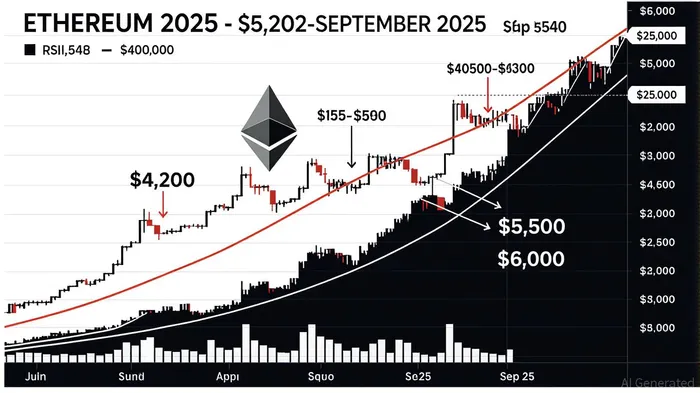
Ethereum (ETH) is at a pivotal juncture. After trading in an ascending channel since July 2025, the asset is now testing a critical resistance zone between $4,600 and $5,000—a level that, if breached, could catalyze a multi-month rally toward $10,000 and beyond. This analysis unpacks the technical, supply-side, and institutional forces aligning to create a compelling long-term investment case, while identifying strategic entry points for patient investors.
Technical Breakouts: A Path to $5,000 and Beyond
Ethereum’s price action has been textbook bullish in recent months. According to a report by BraveNewCoin, ETH has been consolidating within an ascending channel since July, with key support at $4,200 and resistance at $4,800–$5,000 [1]. The RSI remains neutral, and BollingerBINI-- Bands are tightening, signaling a potential volatility expansion as the market prepares for a directional move [1].
A decisive break above $5,000 would not only validate the bullish thesis but also unlock a pathPATH-- toward $5,500 and $6,000 [1]. Historical patterns suggest that such a breakout could trigger a self-fulfilling prophecy: institutional buyers, retail momentum, and algorithmic trading strategies all tend to amplify price trends once key levels are breached. For long-term investors, this creates a binary scenario: either EthereumETH-- remains range-bound, or it surges into a new bull phase.
Supply Dynamics: The Deflationary Tailwind
Ethereum’s supply-side fundamentals are increasingly favorable. As of August 2025, approximately 35.7 million ETH—nearly 30% of the total circulating supply—is staked, driven by both retail and institutional participation [1]. This “supply vacuum” has tightened liquidity, creating upward price pressure. Meanwhile, EIP-1559 burns have removed 45,300 ETH in Q2 2025 alone, contributing to a net annualized inflation rate of 0.7% [5].
The deflationary narrative is further amplified by Ethereum’s Layer-2 ecosystem. With 60% of transactions now handled by rollups like Arbitrum and Base, gas fees have plummeted, indirectly supporting burn rates by maintaining network activity [1]. Data from Messari’s Q2 2025 report shows that Ethereum’s 30-day annualized inflation rate has fallen to 0.7%, the lowest since the transition to proof-of-stake [5]. For investors, this means Ethereum’s scarcity is no longer a theoretical concept—it’s a structural reality.
Institutional Tailwinds: ETFs, Treasuries, and Regulatory Clarity
The SEC’s 2025 ruling classifying Ethereum as a commodity has been a game-changer. As stated by Bitget, this decision normalized ETH as a corporate treasury asset, with companies now accumulating ETH at a pace exceeding net issuance since mid-2025 [4]. Ethereum ETFs, meanwhile, have attracted $10.2 billion in assets under management by June 2025, with inflows outpacing outflows by a 3:1 margin [5].
Institutional adoption is no longer speculative—it’s a macroeconomic force. Ethereum now underpins 50% of the world’s stablecoin market and hosts thousands of decentralized applications, cementing its role as the infrastructure layer for digital finance [4]. Analysts project that staking rates could surpass 40% of total supply by 2026, further tightening liquidity and amplifying price elasticity [1].
Strategic Entry Points for Long-Term Investors
For investors seeking to capitalize on Ethereum’s bullish trajectory, timing is critical. Here are three strategic entry points:
- Breakout Confirmation: A close above $5,000 would signal institutional validation of the bull case. Investors could allocate a portion of their capital here, given the high probability of a follow-through move toward $6,000.
- Pullback to Support: If Ethereum consolidates near $4,200, this level offers a high-probability entry for long-term buyers. The ascending channel’s lower boundary has held multiple times, suggesting strong demand at this price.
- Post-ETF Inflows: Ethereum ETFs are expected to continue attracting inflows, particularly if the Federal Reserve maintains a neutral rate policy. Investors could use ETF inflow data as a proxy for institutional demand, entering during periods of sustained buying.
Conclusion: A $10,000 Target is Within Reach
Ethereum’s confluence of technical momentum, deflationary supply dynamics, and institutional adoption creates a robust foundation for a $10,000 target. While short-term corrections are possible, the broader macroeconomic environment—favorable regulatory clarity, rising liquidity, and expanding utility—positions ETH as a must-own asset for long-term investors.
By entering at key support levels or post-breakout, investors can align themselves with a market that is not just speculative but structurally sound. As the crypto market evolves, Ethereum’s role as the “digital gold” of decentralized finance is becoming increasingly undeniable.
Source:
[1] Ethereum (ETH) Price Prediction: Can a $5000 Breakout Lead ETH to $15000 Long-Term Target [https://bravenewcoin.com/insights/ethereum-eth-price-prediction-can-a-5000-breakout-lead-eth-to-15000-long-term-target]
[2] Ethereum's Supply Dynamics and Staking Surge [https://www.bitget.com/news/detail/12560604936998]
[3] State of Ethereum Q2 2025 [https://messari.io/report/state-of-ethereum-q2-2025]
[4] Ethereum (ETH): The Smart Contract Titan's Roadmap to 2025 [https://www.thestandard.io/blog/ethereum-eth-the-smart-contract-titans-roadmap-to-2025-9]
[5] Ethereum's Undervalued Treasury Play: A $7500+ Case [https://www.bitget.com/news/detail/12560604935260]






Comentarios
Aún no hay comentarios