
Ethereum as the Next Bitcoin: Is $4,000 the Threshold for a Generational Wealth Opportunity?
Strategic Entry Points: Bitcoin's Historical Blueprint
Bitcoin's 2017 bull run began with a strategic entry point around $800, fueled by the activation of SegWit (a network upgrade) and early institutional curiosity. By December 2017, it had surged to nearly $20,000, driven by a correction-reaction-expansion pattern. Similarly, Bitcoin's 2020 breakout followed a prolonged consolidation phase, with institutional investors like Fidelity and BlackRock quietly accumulating during the March 2020 crash. The price then broke above a long-term descending trendline, surging past $60,000 by late 2020, according to a Coinotag analysis.
These cycles were underpinned by three pillars:
1. Network Upgrades: SegWit in 2017 and the halving event in 2020 improved Bitcoin's scalability and scarcity.
2. Institutional Adoption: ETF inflows, custody solutions, and macro fund allocations signaled trust in the asset class.
3. Technical Breakouts: Price patterns, such as trendline breaches and volume spikes, validated bullish momentum, as noted in the Coinotag analysis.
Ethereum's 2025 Parallels: A New Expansion Phase
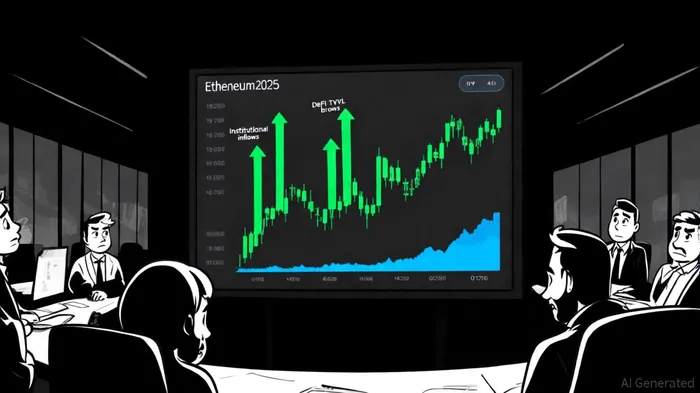
Ethereum's current price action near $3,896 in October 2025 mirrors Bitcoin's 2020 breakout. After a correction phase from 2021 to 2023-marked by lower highs and DeFi stagnation-the network has entered a reaction phase. Daily transactions now exceed 1.2 million, and total value locked (TVL) in DeFi has risen 8% week-over-week, according to a Crypto.news article. Crucially, Ethereum has broken through a long-term descending trendline, stabilizing in the $3,800–$4,000 range, as discussed in the Coinotag analysis.
The $4,000 threshold is not just a number-it represents a psychological and technical milestone. If Ethereum reclaims $4,500, it could target $4,800–$5,000 by year-end, driven by:
- Institutional Accumulation: BlackRock and Fidelity have injected $101.7 million into Ethereum ETFs in October 2025, according to a Coinotag article.
- Layer-2 Adoption: Scalability solutions like ArbitrumARB-- and Optimism are reducing gas fees, attracting retail and enterprise users.
- Disinflationary Dynamics: Post-Merge, Ethereum's issuance rate has declined, creating scarcity akin to Bitcoin's halving events, as reported by Crypto.news.
Institutional Timelines: From BitcoinBTC-- to Ethereum
Bitcoin's 2020 bull run was preceded by institutional entry in late 2019, with firms like Grayscale and MicroStrategy building multi-billion-dollar positions, as discussed above. Today, Ethereum is following a similar playbook. Binance, for example, has reportedly purchased millions of ETH per minute in October 2025, signaling strategic positioning, according to a CryptoFront report. This mirrors BlackRock's 2019 Bitcoin accumulation ahead of the 2020 surge.
The Ethereum/Bitcoin ratio, currently at 0.0357, is projected to rise to 0.06 by year-end, indicating a shift in market dynamics, according to TheCoinrise projection. This ratio reflects Ethereum's growing utility as a platform for decentralized finance and smart contracts, contrasting with Bitcoin's role as digital gold.
Risks and Realities
While the parallels to Bitcoin's past cycles are compelling, Ethereum faces unique challenges. A drop below $3,700 could trigger a pullback to $3,300–$3,400, particularly if DeFi growth slows, as reported by Crypto.news. Regulatory uncertainty-despite recent improvements-remains a wildcard. However, the surge in spot ETF inflows and Layer-2 adoption suggests that Ethereum's fundamentals are robust enough to withstand short-term volatility.
Conclusion: A Generational Opportunity?
Ethereum's $4,000 threshold is more than a price level-it is a confluence of technical, institutional, and network-level catalysts. By drawing parallels to Bitcoin's 2020 breakout, we see a pattern: corrections consolidate, trendlines break, and institutional capital flows in. If Ethereum replicates this cycle, the $4,500–$5,000 range could become the new floor for a multi-year bull run. For investors, the question is not whether Ethereum will reach $4,000, but whether they are positioned to capitalize on what comes next.






Comentarios
Aún no hay comentarios