
Ethereum Accumulation Trends and the Rise of Layer-1 and Layer-2 AI-Driven Tokens
The EthereumETH-- ecosystem is undergoing a transformative phase in 2025, driven by advancements in Layer-1 and Layer-2 infrastructure and the integration of artificial intelligence (AI). As institutional and retail investors increasingly allocate capital to Ethereum-based projects, a parallel narrative is emerging: the rise of AI-native tokens like Ozak AI (OZ), which are redefining the value proposition of blockchain technology. This article examines Ethereum's infrastructure evolution, the strategic advantages of Layer-2 solutions, and the disruptive potential of AI-driven tokens, offering a roadmap for investors seeking high-growth opportunities in this dynamic landscape.
Ethereum's Infrastructure Evolution: A Foundation for AI Integration
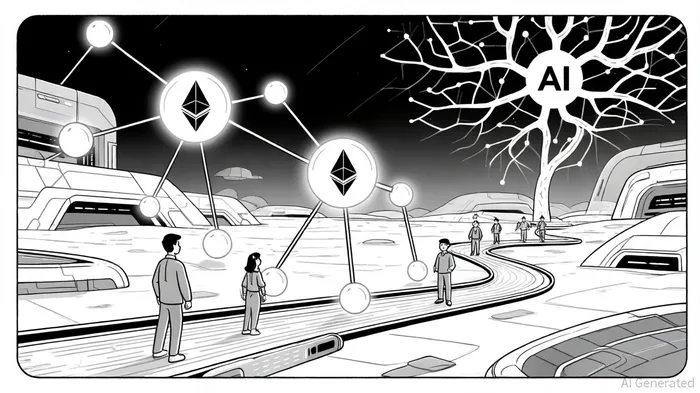
Ethereum's 2025 restructuring has positioned it as a critical settlement layer for AI-driven applications. The Ethereum Foundation's dAI Team, led by research scientist Davide Crapis, is spearheading efforts to enable autonomous AI agents to conduct payments and coordinate actions without intermediaries, after the foundation launched an AI team. Central to this initiative is the ERC-8004 standard, which introduces identity verification and reputation systems for AI agents, fostering trustless collaboration. These developments align with Ethereum's broader mission to maintain neutrality, verifiability, and censorship resistance while adapting to the demands of the "machine economy."
The Pectra upgrade, activated in May 2025, further solidifies Ethereum's scalability and security, with features like increased validator balance limits and enhanced execution layer capabilities. However, Ethereum's growth trajectory remains constrained by volatility and regulatory uncertainties, with analysts projecting a 3–4× return by 2025, according to Currency Analytics. This conservative outlook contrasts sharply with the explosive potential of AI-native tokens, which are leveraging Ethereum's infrastructure to create new value propositions.
Layer-2 Solutions: Scalability and Fragmentation Challenges
Layer-2 solutions like Optimism, Arbitrum, Base, and zkSync Era have become the backbone of Ethereum's scalability, processing billions of transactions weekly and supporting decentralized finance (DeFi), gaming, and social dApps, as noted in a CoinBrain analysis. For instance, Optimism's Superchain initiative has driven 750K daily active wallets and $4.2 billion in TVL, while zkSyncZK-- Era's 411 million weekly transactions highlight its efficiency, according to a Gate report.
However, the proliferation of Layer-2 networks has introduced fragmentation and liquidity dispersion, forcing users to bridge assets across multiple chains, according to The Coinomist. This complexity creates an opening for AI-native tokens like Ozak AI, which integrate predictive analytics and decentralized infrastructure to streamline decision-making and automate workflows.
Ozak AI: A High-Growth Alternative to Traditional Layer-1 Blockchains
Ozak AI has emerged as a disruptive force in 2025, combining AI-driven analytics with decentralized infrastructure to deliver real-time financial insights and automation. The project's Prediction Agents (PAs) and Ozak Stream Network (OSN) enable ultra-fast data ingestion and customized AI-powered predictions, distinguishing it from traditional Layer-1 blockchains like Ethereum, as explored in an Analytics Insight piece.
Ozak AI's presale has raised over $3.55 million, with 929 million $OZ tokens sold at an entry price of $0.012, and analysts project a potential 1000× return if the token reaches $1.00 at full launch, according to the allocation strategy. Strategic partnerships with platforms like Dex3, Pyth Network, and SINT further enhance its utility, enabling real-time financial data aggregation, liquidity solutions, and cross-chain automation, as detailed by Republic World.
Compared to Ethereum's projected 3–4× return, Ozak AI's AI-driven functionality-such as quantum-proof wallets and decentralized data vaults-creates intrinsic value beyond speculative trading, according to FinanceFeeds. This positions it as a compelling option for investors seeking exponential growth in a market where Ethereum's returns are increasingly seen as conservative.
Strategic Entry Points: Balancing Ethereum's Stability and Ozak AI's Potential
For investors, the key lies in balancing Ethereum's foundational role with the high-growth potential of AI-native tokens. Ethereum's institutional adoption, deflationary tokenomics, and ongoing upgrades make it a stable long-term asset, as discussed in Analytics Insight. However, the integration of AI into Ethereum's infrastructure-via projects like Ozak AI-offers a dual opportunity: leveraging Ethereum's scalability while capitalizing on AI-driven innovation.
A strategic allocation strategy might prioritize 40% Ethereum for its stability, 20% BNB for cross-chain exposure, and 40% Ozak AI for high-growth potential. This approach mitigates risk while aligning with the 2025 trend of AI-native blockchain adoption.
Conclusion: The Future of AI-Driven Blockchain Investment
Ethereum's infrastructure evolution and the rise of AI-native tokens like Ozak AI signal a paradigm shift in blockchain investment. While Ethereum remains the bedrock of decentralized finance, AI-driven projects are redefining scalability, automation, and value creation. For investors, the path forward lies in strategic entry into high-growth tokens that leverage Ethereum's ecosystem while pioneering AI integration. As the 2025 market matures, those who align with this dual narrative will be best positioned to capitalize on the next wave of blockchain innovation.






Comentarios
Aún no hay comentarios