
Ethereum's 4% Surge on September 28, 2025: Institutional Adoption and Network Upgrades Fuel Momentum
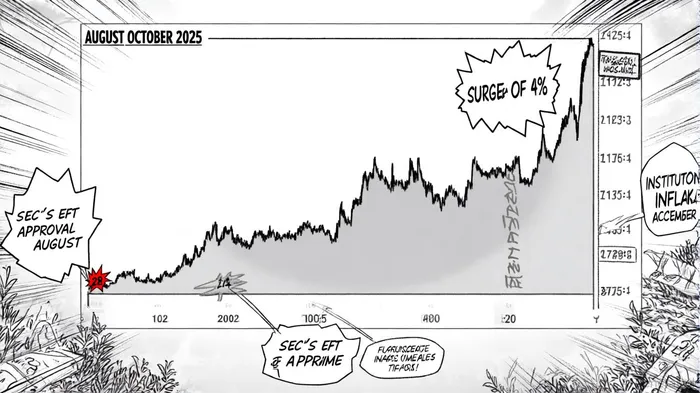
Ethereum's 4% price surge on September 28, 2025, marked a pivotal moment in the cryptocurrency's journey toward mainstream adoption. Trading near $4,533, the move was driven by a confluence of institutional confidence and technical advancements, signaling a maturing ecosystem poised to outpace competitors. This analysis unpacks the dual forces-regulatory clarity, institutional inflows, and network upgrades-that catalyzed Ethereum's momentum.
Institutional Adoption: A New Era of Legitimacy
The U.S. Securities and Exchange Commission's (SEC) approval of spot EthereumETH-- ETFs in August 2025 served as a watershed moment, according to a MetaCryptoDesk report. This regulatory green light allowed traditional investors to access Ethereum through familiar, regulated vehicles, bridging the gap between Wall Street and crypto markets. Major asset managers like BlackRockBLK-- and Fidelity swiftly capitalized, launching ETH ETF products that channeled $33 billion in inflows during the quarter, according to an OnTheNode analysis. These institutions executed direct acquisitions of 154.2 million and 202.2 million ETH, respectively, reducing the circulating supply and creating a supply-side tailwind, the OnTheNode analysis found.
The impact was immediate. Ethereum's price surged over 18% in 24 hours post-approval, reaching $4,100 for the first time in three years, the MetaCryptoDesk report noted. This trend accelerated in September, with robust ETF inflows and whale accumulation further reinforcing demand. On-chain data revealed $1.6 billion in ETH purchases by large holders, alongside exchange outflows exceeding $622 million-a clear sign of long-term positioning, the OnTheNode analysis reported.
Network Upgrades: Scaling for the Future
While institutional demand provided the spark, Ethereum's technical roadmap ensured the fire burned. The Fusaka upgrade, scheduled for December 3, 2025, is a cornerstone of the network's 2025 roadmap, according to a CryptoNews report. This upgrade introduces Peer Data Availability Sampling (PeerDAS), a breakthrough that reduces the data burden on validators by enabling sampling of smaller data fragments rather than full datasets, as the CryptoNews report explains. This innovation lowers bandwidth and storage requirements, making Ethereum more accessible to a broader range of nodes and enhancing network security.
Fusaka also expands Ethereum's blob capacity, starting at 6/9 blobs per block and scaling to 14/21. This directly benefits LayerLAYER-- 2 (L2) solutions like Coinbase's Base and Worldcoin's World Chain, which account for 60% of L2 data submissions, the CryptoNews report adds. By reducing transaction costs and increasing throughput, the upgrade positions Ethereum as the most scalable base layer for decentralized applications (dApps). Developer-centric improvements, such as higher gas limits and expanded smart contract size limits, further streamline application development, as explained in a Crypto.com guide.
The Pectra upgrade in May 2025 laid the groundwork, improving validator efficiency and slashing L2 costs, the CryptoNews report noted. Together, these upgrades create a flywheel effect: lower costs attract more users and developers, which in turn drives network value.
Market Implications: A Bullish Outlook
Analysts project that Ethereum's momentum could carry it beyond $5,500 by mid-October, fueled by sustained institutional inflows and the anticipation of Fusaka, the OnTheNode analysis suggests. The SEC's introduction of generic listing standards for commodity-based crypto ETFs in August 2025 has also streamlined approvals for altcoins like SolanaSOL-- and XRPXRP--, but Ethereum remains the dominant beneficiary due to its first-mover advantage and robust infrastructure, the MetaCryptoDesk report observed.
Technical indicators reinforce the bullish case. Ethereum found strong support at $4,500 and faced resistance near $4,650, with daily trading volumes hitting $42 billion-a sign of deep liquidity and institutional participation, the OnTheNode analysis reported. The CLARITY and GENIUS Acts, which provided regulatory clarity, further solidified investor confidence, ensuring a steady flow of capital into the ecosystem, according to the OnTheNode analysis.
While technical indicators reinforce the bullish case, historical backtesting of Ethereum's support level at $4,500 from 2022 to 2025 reveals an average excess return of approximately 0.23% over 10 and 30 days, with a win rate hovering around 49–53%. However, these returns are not statistically significant, indicating the support level offers at best a weak short-term edge, the OnTheNode analysis found.
Conclusion: A Catalyst for Long-Term Growth
Ethereum's 4% surge on September 28, 2025, was not an isolated event but a symptom of a broader transformation. Institutional adoption, driven by ETF approvals and regulatory clarity, has unlocked a new class of capital, while network upgrades like Fusaka are future-proofing the blockchain for mass adoption. As the December 3 launch date approaches, Ethereum's ability to balance scalability with security will likely cement its position as the leading smart contract platform. For investors, the combination of these factors presents a compelling case for continued growth in the final quarter of 2025.







Comentarios
Aún no hay comentarios