
Ethereum's $4,400 Breakout Threshold: A Gateway to $8,000–$10,000 in 2025–2026
Technical Drivers: A Triangle of Accumulation and Institutional Confidence
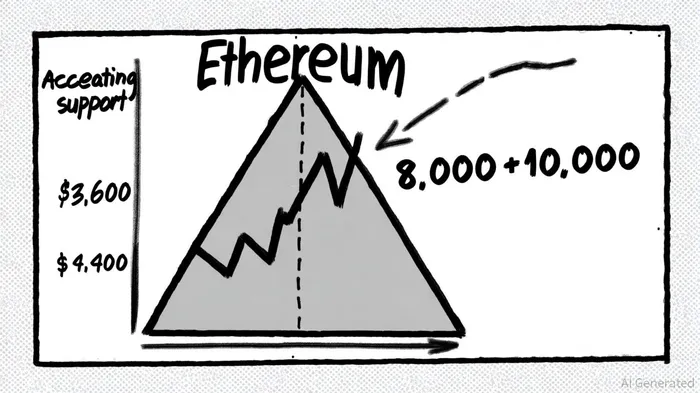
Ethereum's price action over the past four years has formed a symmetrical triangle pattern, oscillating between $1,000 and $4,000. This consolidation phase, characterized by higher lows and stable network growth, reflects a period of accumulation by both retail and institutional participants, according to a Coinotag analysis. The current price of $4,132 sits near the critical support level of $4,133 on hourly charts, with a break below this level risking a test of the $4,100 floor, per a Coinotag update. However, the broader technical narrative suggests a bullish bias.
Key indicators paint a mixed but cautiously optimistic picture. The Relative Strength Index (RSI) at 48.64 signals neutral sentiment, while the Moving Average Convergence Divergence (MACD) at -23.93 hints at short-term bearish momentum, as shown in the Investing.com technicals. Yet, the Average Directional Index (ADX) and Williams %R both favor a strong directional trend, and the Stochastic RSI at 100 indicates an overbought condition-a potential precursor to a breakout (the same Investing.com technicals highlight these measures). Crucially, Ethereum's price is nearing the apex of the triangle, with resistance clustered around $4,400–$4,550 and ascending support from the $3,600 area, according to a Coinedition analysis. A confirmed close above $4,400 would validate the pattern and likely trigger a rally toward $8,000–$10,000, mirroring historical bull cycles, as noted in the Coinotag analysis.
Institutional activity further reinforces this thesis. On October 28, 2025, EthereumETH-- ETFs recorded a net inflow of $246 million, with BlackRock's iShares Ethereum Trust contributing $76.4 million alone, per Coinedition's coverage. Derivatives data also reveals a 46% surge in options volume to $1.63 billion, and a long-to-short ratio of 2.57, signaling aggressive bullish positioning, as detailed by Coinotag. Meanwhile, institutional investment firm The Ether Machine added 150,000 ETH to its holdings, pushing its total to nearly 500,000 ETH ($2.19 billion), according to a BraveNewCoin report.
Fundamental Drivers: Network Upgrades, Adoption, and Macroeconomic Tailwinds
Ethereum's fundamentals are equally robust. The Merge and Shanghai upgrades have reduced its circulating supply by 1.5% annually, creating a deflationary dynamic akin to Bitcoin's halving events, as discussed in an Analytics Insight piece. Staking participation now exceeds 30% of the total supply, with Total Value Locked (TVL) at $86.98 billion, underscoring the network's resilience (the Coinotag analysis also highlights these metrics). Adoption metrics also show progress: user-held ETH balances increased by 85,000 ETH in the past year, reaching 1.765 million ETH, according to an OKX reserve report.
Macroeconomic factors are equally favorable. Standard Chartered Bank has upgraded its Ethereum price forecast to $7,500 by year-end 2025, citing growing demand for stablecoins and tokenized assets on the Ethereum network (reported in the Analytics Insight piece). Regulatory clarity, including the approval of Ethereum ETFs and clearer staking guidelines, has attracted institutional capital and enhanced investor confidence (also discussed in the Analytics Insight piece). Meanwhile, Ethereum's expanding use cases in DeFi, NFTs, and tokenized real-world assets continue to drive gas fee demand and network activity, as noted in the same Analytics Insight coverage.
The Ethereum Foundation's recent launch of an institutional portal further underscores its ambition to attract mainstream capital. By emphasizing the network's reliability, privacy, and scalability, the portal positions Ethereum as a cornerstone for global financial infrastructure, according to Coinotag coverage.
Risks and Counterarguments
While the bullish case is strong, risks persist. Regulatory shifts, global economic instability, and competition with BitcoinBTC-- for institutional allocations could dampen Ethereum's ascent (as the Analytics Insight piece cautions). Additionally, South Korea's trading data highlights Ethereum's vulnerability to altcoin competition, as XRPXRP-- recently outpaced it in trading volume on local exchanges (noted in the Analytics Insight coverage). However, these risks are largely external and do not negate Ethereum's intrinsic strengths.
Conclusion: A Multi-Year Bull Market in the Making
Ethereum's $4,400 threshold is more than a technical level-it is a symbolic gateway to a new phase of growth. The convergence of a consolidating price pattern, institutional inflows, and robust fundamentals creates a compelling case for a breakout toward $8,000–$10,000. Investors who recognize this inflection point may find themselves positioned for one of the most significant bull runs in crypto history.






Comentarios
Aún no hay comentarios