
Ethereum's $3K Breakout: A Catalyst for Institutional Adoption and the 'World Computer' Vision
Ethereum's journey to the $3,000 price level in late 2025 has become a focal point for investors, developers, and institutions alike. This milestone is not just a number-it represents a confluence of technological maturation, regulatory clarity, and institutional validation. As EthereumETH-- continues its evolution into the "World Computer," the interplay between price dynamics, scalability upgrades, and institutional adoption is reshaping the crypto landscape.
The Technological Catalysts: Pectra and Fusaka
Ethereum's recent upgrades, particularly the Pectra (May 2025) and Fusaka (December 2025) hard forks, have laid the groundwork for a more scalable and efficient network. The Pectra upgrade integrated the Prague execution layer and Electra consensus layer, optimizing staking mechanics and reducing validator overhead. By increasing the maximum effective balance of validators from 32 to 2,048 ETH, solo stakers can now compound rewards without managing multiple validator keys, democratizing participation.
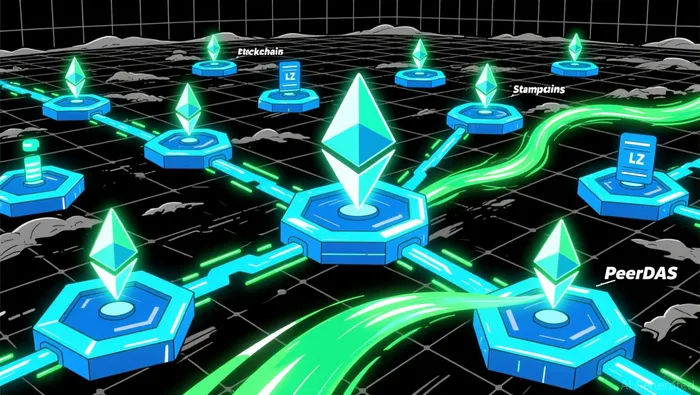
The Fusaka upgrade, meanwhile, introduced PeerDAS (Peer Data Availability Sampling), a breakthrough that allows nodes to verify only a fraction of the data, slashing bandwidth requirements by up to 95%. This innovation, coupled with a doubled gas limit to 60 million, has enabled Layer-2 (L2) solutions like ArbitrumARB-- and Base to process transactions at near-zero costs, reinforcing Ethereum's role as the backbone of decentralized finance (DeFi) and real-world asset (RWA) tokenization.
Institutional Adoption: From Hesitation to Commitment
Institutional adoption has accelerated in 2025, driven by regulatory clarity and Ethereum's improved ESG profile. The U.S. Securities and Exchange Commission's (SEC) classification of ETH as a commodity in late 2025 removed a major barrier, enabling firms like Goldman Sachs and Jane Street to accumulate 43% of circulating ETH shares. This shift has transformed Ethereum from a speculative asset into a strategic reserve for institutional portfolios.
Moreover, Ethereum-based ETFs and ETPs have processed over $40 billion in weekly trading volume, signaling robust liquidity. The network's transition to proof-of-stake (PoS)-which reduced energy consumption by 99.95%-has further aligned Ethereum with global ESG standards, attracting capital from ESG-focused funds.
Price Dynamics: $3K as a Psychological and Technical Threshold
Ethereum's price action in late 2025 has been volatile, trading in a $2,900–$3,100 range despite record smart contract deployments (8.7 million in Q4 2025). This dissonance between technical progress and price highlights a critical insight: while Ethereum's infrastructure is maturing, market sentiment remains cautious.
However, the $3,000 level is a pivotal psychological threshold. A breakout above this level could trigger a self-reinforcing cycle of adoption. For instance, the Fusaka upgrade's 95% reduction in L2 fees has already driven a 40% increase in daily active users on Ethereum-based platforms. If Ethereum sustains above $3,000, it could unlock further institutional inflows, as seen in 2025 when Bit Digital and SharpLink Gaming added 150,000 ETH to their holdings.
Conversely, a breakdown below $3,000 risks reigniting bearish sentiment, with technical indicators suggesting a potential slide to $2,760. Yet, even in a bearish scenario, Ethereum's deflationary mechanisms-such as EIP-1559's transaction fee burning-create a floor by reducing supply over time.
Strategic Investment Timing: The 2026–2030 Outlook
For investors, timing is everything. Ethereum's roadmap through 2026 includes the Cancun and Danksharding upgrades, which will further enhance scalability and reduce L1 costs. These upgrades, combined with a projected $100 billion total value locked (TVL) in DeFi by mid-2026, position Ethereum to outperform altcoins in a bull market.
Long-term projections are equally compelling. Analysts at InteractiveCrypto suggest Ethereum could reach $15,000 by 2030, assuming continued institutional adoption and successful scaling. This trajectory hinges on Ethereum's ability to maintain its first-mover advantage in the "World Computer" vision-a decentralized infrastructure for global applications, from DeFi to AI-driven smart contracts.
Conclusion: A $3 Trillion Opportunity
Ethereum's $3K breakout is more than a price target-it's a catalyst for institutional adoption and the realization of the "World Computer" vision. The Pectra and Fusaka upgrades have fortified Ethereum's infrastructure, while regulatory clarity and ESG alignment have unlocked institutional capital. For investors, the key is to balance short-term volatility with long-term fundamentals. As Ethereum transitions from a speculative asset to a foundational technology, the $3K level represents both a test of market confidence and a gateway to a $3 trillion market cap by 2028.






Comentarios
Aún no hay comentarios