
Ethereum's $3,000 Support: A Critical Juncture for Crypto Bulls
Technical Analysis: A Battle for $3,000
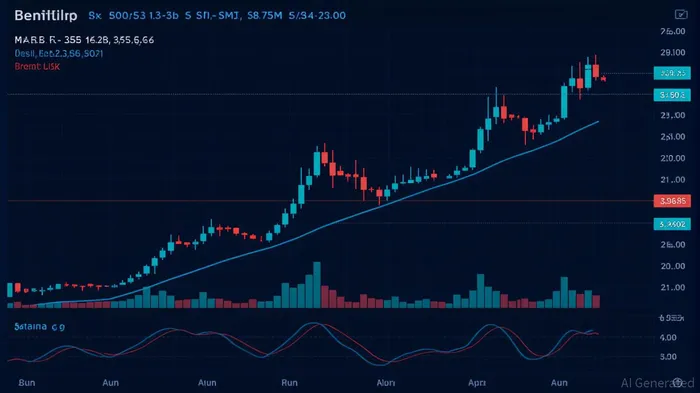
Ethereum's recent price behavior near $3,000 underscores a tug-of-war between buyers and sellers. On the daily chart, the asset remains below key exponential moving averages (EMAs), with the 20-day EMA at ~$3,005 and the 50-day EMA near $3,160 acting as significant hurdles for upward momentum according to technical analysis. The Relative Strength Index (RSI) hovers in the low-to-mid 40s, reflecting weak momentum and a consolidation phase following a sharp selloff according to market data. While short-term charts show modest recovery signs-such as higher lows and a shift in the Supertrend indicator-the $2,950–$2,980 band continues to cap intraday gains according to technical indicators.
A decisive breakout above $3,000 with strong volume would be necessary to tilt short-term momentum in favor of bulls. Conversely, a breakdown below $2,800 could trigger deeper corrections, potentially testing the $2,787 level according to market analysis. The 50-day EMA at $3,160 remains a critical psychological threshold; reclaiming this level could unlock upside toward $3,300–$3,390 according to technical analysis.
Macroeconomic Sentiment: Risk-On Appetite and Institutional Confidence
Ethereum's performance is increasingly tied to broader macroeconomic conditions. In 2025, the asset has shown heightened sensitivity to inflation trends, interest rate expectations, and institutional investment flows. During periods of global economic uncertainty-such as ambiguous Fed policy or geopolitical tensions-investors have shifted away from risk-on assets like crypto, exacerbating Ethereum's volatility according to market research. However, Q3 2025 saw a reversal in this trend, with EthereumETH-- surging 65% and attracting $10.04 billion in net inflows via spot ETFs, outpacing Bitcoin's $8.75 billion. This surge reflects growing institutional confidence in Ethereum as a diversification tool and a high-yield asset, bolstered by regulatory clarity and infrastructure upgrades like the GENIUS Act and Dencun according to market analysis.
Staking yields, currently around 3.8% annually, further reinforce Ethereum's appeal as an inflation hedge according to market data. Meanwhile, the Fusaka upgrade in December 2025-introducing PeerDAS and larger block limits-has improved network scalability and reduced LayerLAYER-- 2 (L2) transaction costs by up to 95%. These advancements align with institutional demand for efficient, scalable blockchain solutions, positioning Ethereum as a cornerstone of on-chain finance.
Market Psychology and Retail Participation
Retail investor sentiment is closely tied to the $3,000 level, which serves as both a technical support zone and a max-pain point in the options market. With $27 billion in notional value tied to Ethereum derivatives, the price is likely to remain pinned near this level in the short term according to market analysis. Retail buyers have shown resilience above $2,850, repeatedly defending the $3,000 threshold according to market data. This psychological weight is amplified by Ethereum's role as a core DeFi and settlement layer, making it a critical pivot in risk-on portfolio allocations according to technical analysis.
However, mixed on-chain signals persist. While active Ethereum addresses have rebounded and the MVRV Z-Score (0.29) suggests accumulation, stagnant new address growth and elevated leverage ratios (0.72–0.76) highlight fragility in positioning according to market data. The Ethereum Coinbase Premium Index remains at -0.08, indicating weak structural bid from US-based participants and ongoing selling pressure according to market analysis.
Strategic Implications: Entry or Exit?
The $3,000 support level represents a strategic inflection point. For bulls, a sustained close above $3,160 could validate a bullish case, unlocking upside toward $3,300–$3,390 according to technical analysis. Institutional activity, including Tom Lee's Bitmine accumulating 64,622 ETH and 43% of circulating ETH held by major institutions, underscores long-term positioning according to market data. Meanwhile, the Fusaka upgrade's focus on scalability and affordability aligns with growing demand for blockchain-based solutions, potentially driving further adoption according to market analysis.
Conversely, a breakdown below $2,800 could reignite bearish momentum, particularly if macroeconomic conditions deteriorate or leveraged positions unwind. The path of least resistance appears to be a choppy range, with volatility likely to intensify ahead of options expiries and the Fusaka upgrade's full implementation according to market analysis.
Conclusion
Ethereum's $3,000 support level is more than a technical benchmark-it is a barometer of broader market confidence in digital assets. While technical indicators and institutional interest suggest a favorable setup for bulls, macroeconomic uncertainties and fragile retail positioning necessitate caution. For investors, the key lies in monitoring Ethereum's ability to reclaim the 50-day EMA and sustain momentum above $3,160. If successful, this could mark the beginning of a new bullish phase; if not, it may signal a deeper correction. In either case, the $3,000 level will remain a critical juncture for crypto bulls in the months ahead.






Comentarios
Aún no hay comentarios