
Ethereum's 2026 Upgrade Roadmap and Its Impact on DeFi Growth
Ethereum's 2026 upgrade roadmap represents a pivotal inflection point for the blockchain's evolution, with strategic infrastructure developments poised to catalyze institutional adoption and DeFi growth. The two-phase rollout-Glamsterdam (mid-2026) and Heze-Bogota (late 2026)-targets scalability, decentralization, and censorship resistance, addressing long-standing bottlenecks while aligning with the broader shift toward institutional-grade infrastructure. For investors, this roadmap underscores Ethereum's potential to solidify its dominance in the smart contract ecosystem and attract capital from traditional finance.
Strategic Infrastructure: Scaling for the Future
The Glamsterdam upgrade introduces parallel transaction processing, increased gas limits, and ZK proof verification, aiming to push Ethereum's throughput to 10,000 transactions per second (TPS) on LayerLAYER-- 1 and hundreds of thousands on Layer 2 according to MEXC. By enabling parallel execution, the network can process multiple transactions simultaneously, reducing congestion and lowering gasGAS-- fees-a critical factor for DeFi user retention. Additionally, Block-Level Access Lists (BALs) and Enshrined Proposer-Builder Separation (ePBS) will mitigate centralization risks by distributing block-building power among validators, fostering a more equitable ecosystem.
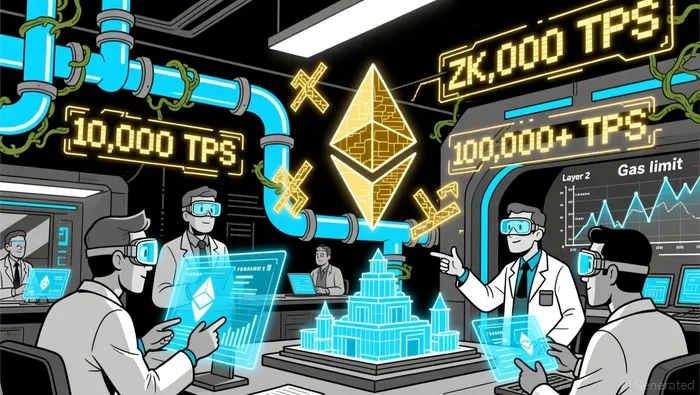
The Heze-Bogota upgrade further refines these gains with Fork-Choice Inclusion Lists (FOCIL), which empower validator groups to enforce transaction inclusion, curbing censorship risks. Privacy enhancements and Verkle Trees-a data structure that compresses node storage requirements-will also reduce operational costs for node runners, democratizing participation and reinforcing decentralization. Collectively, these upgrades position EthereumETH-- to handle 72 blobs per block, accelerating Layer 2 scalability and enabling seamless integration with on-chain AI agents and tokenized real-world assets (RWAs) according to Longbridge.
Institutional Adoption: A Catalyst for Growth
Ethereum's 2026 roadmap is not merely technical but also strategic, designed to align with institutional demands for regulatory clarity and robust infrastructure. The CLARITY Act in the U.S. and similar global regulatory frameworks are expected to legitimize Ethereum as a mainstream asset, with analysts projecting $28.6 billion in ETF assets offering staking yields and $180 billion in tokenized RWAs by 2026. Institutional interest is further bolstered by Ethereum's role in corporate treasury optimization and the proliferation of exchange-traded products, as highlighted in the 2026 Digital Asset Outlook according to Grayscale.
Institutional capital inflows are already evident: Ethereum's total value locked (TVL) is forecast to surge 10× in 2026, driven by stablecoin activity and sovereign wealth fund participation. Analyst Chris MacDonald notes that these upgrades could propel Ethereum's price above $5,000, citing the strengthening long-term investment case. Meanwhile, Layer 2 solutions-handling 92% of transaction fees in 2025 and 1.9 million daily transactions-are becoming the backbone of institutional-grade DeFi, with a projected $47 billion ecosystem by 2026 according to Bitget.
DeFi's Next Frontier: Throughput, Decentralization, and Utility
For DeFi, the 2026 upgrades promise transformative outcomes. Verkle Trees and parallel processing will reduce gas fees by up to 50%, making microtransactions viable for retail and institutional users. This cost efficiency, combined with 10k TPS on Layer 1 and hundreds of thousands on Layer 2, will enable DeFi protocols to scale without compromising security or decentralization according to MEXC.
Expert insights reinforce this optimism. Joseph Lubin, co-founder of Ethereum, asserts that "the world economy will be built on Ethereum," emphasizing its role in tokenized assets and decentralized finance according to CryptoRank. Vitalik Buterin has similarly highlighted the importance of maintaining scalability, security, and decentralization-a triad that the 2026 roadmap addresses through incremental, non-disruptive upgrades according to CryptoRank.
Investment Implications
Ethereum's 2026 roadmap is a masterclass in strategic infrastructure development. By prioritizing scalability and decentralization, the upgrades directly address institutional pain points-high fees, regulatory ambiguity, and centralization risks-while unlocking new use cases for DeFi. For investors, this translates to a $500B–$1T TVL projection for DeFi by 2026 according to Bitget, alongside a $180 billion tokenized RWA market and $47 billion Layer 2 ecosystem according to Bitget.
The key takeaway is clear: Ethereum is not just adapting to the future of finance-it is architecting it. As institutional capital flows into a more efficient, censorship-resistant, and scalable network, Ethereum's dominance in the smart contract space is set to accelerate, making it a cornerstone of the decentralized economy.







Comentarios
Aún no hay comentarios