
Ethereum's 2025 Repricing: A Misunderstood Opportunity in a Maturing Crypto Market
The EthereumETH-- price correction of 2025 has sparked widespread skepticism, with ETH shedding 12% year-to-date, plummeting from $3,336 in January to $2,930 by mid-December according to the forecast. However, beneath the bearish headlines lies a story of fundamental resilience. Ethereum's network metrics-transaction volumes, gas efficiency, and Total Value Locked (TVL)-paint a picture of a maturing ecosystem that is outpacing traditional financial infrastructure and adapting to macroeconomic headwinds. For investors, this repricing may represent a mispriced opportunity rather than a systemic failure.
Network Usage: Surpassing Traditional Payment Systems
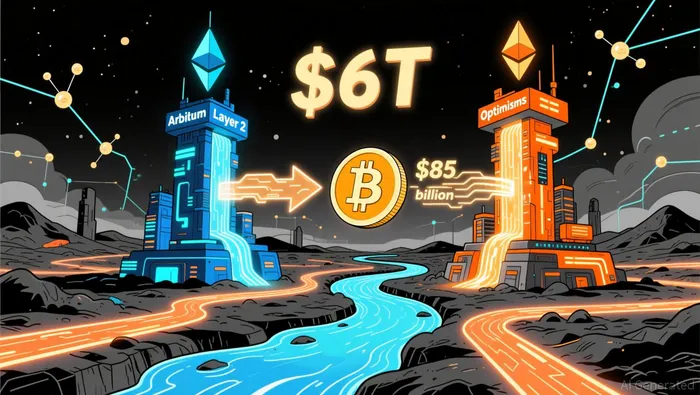
Ethereum's Q4 2025 data reveals a network that is not just surviving but thriving. Stablecoin transfer volume on Ethereum approached $6 trillion in the quarter, surpassing Visa and Mastercard in settlement value. Daily stablecoin transfers hit $85 billion, driven by Layer 2 solutions like Arbitrum and Optimism which handle 58%–65% of Ethereum's transaction volume. This shift to L2s has kept mainnet fees minimal while enabling Ethereum to capture 60% of global stablecoin activity according to the report.
On-chain data further underscores this growth: Ethereum processed 1.56 million transactions on December 15, 2025-a 30% increase from the prior day and a 30% rise year-over-year according to the chart. Smart contract interactions now account for 62% of daily transactions according to the report, reflecting deepening adoption in DeFi, tokenized real-world assets (RWAs), and enterprise workflows.
Gas Fees and Scalability: A 95% Efficiency Leap
Ethereum's gas fee reduction is one of its most underrated achievements. Average transaction fees now hover around $0.30–$0.33, a ~95% drop from early 2024 levels. This is largely due to the Dencun upgrade, which optimized data throughput for L2 rollups and slashed costs. LayerLAYER-- 2 networks like zkSyncZK-- Era and ArbitrumARB-- frequently offer fees under $0.10, with some transactions costing as little as $0.03 according to the data.
The Pectra upgrade in May 2025 further solidified this progress, introducing account abstraction and boosting transaction throughput. These upgrades have made Ethereum accessible to retail users and scalable for institutional applications, positioning it as the dominant programmable settlement layer for the next decade.
TVL and DeFi: A $100 Billion Ecosystem
Ethereum's DeFi sector remains a cornerstone of its value proposition. As of November 2025, TVL in Ethereum DeFi stood at $69.026 billion, with L2 TVL growing 36.7% year-over-year to $43.3 billion. Protocols like UniswapUNI-- and AaveAAVE-- drive 25% of daily transaction volume according to the report, while Ethereum's TVL accounts for 49% of the entire DeFi sector according to the analysis.
Looking ahead, L2 TVL is projected to surpass Ethereum L1 by Q3 2026, reaching $150 billion. This trend aligns with Ethereum's long-term vision: a modular blockchain where L1 serves as a secure settlement layer, and L2s handle application-specific scaling.
Macroeconomic Headwinds and Institutional Dynamics
November 2025 was a challenging month for Ethereum, with a 22.23% price decline driven by the U.S. government shutdown and a broader correction in tech and AI stocks. Ethereum ETFs also saw outflows of over $1.4 billion according to the report, reflecting weakened institutional demand. However, these macro-driven selloffs have not dented Ethereum's fundamentals. TVL in DeFi actually increased during the price correction, and active addresses grew 15% year-over-year to 520,000 according to the data.
The Bybit hack in Q1 2025-a $1.5 billion loss-also highlighted the risks of centralized custody but inadvertently accelerated adoption of Ethereum's decentralized alternatives. This resilience underscores Ethereum's role as a hedge against systemic fragility in traditional finance.
Future Outlook: A $2.5 Trillion RWA Market
Ethereum's long-term potential lies in its ability to tokenize real-world assets. By 2028, it is projected to settle 25% of global tokenized RWAs, valued at $2.5 trillion. Cross-border settlement costs could drop by 90% by 2032 according to the projection, further cementing Ethereum's role in global finance.
For investors, the current price correction offers a chance to buy into a network with a $86.04 billion TVL, 4,200 active dApps according to the report, and a 28% staking participation rate (33.6 million ETH staked) according to the data. While macroeconomic risks persist, Ethereum's fundamentals are stronger than ever.
Conclusion: A Misunderstood Opportunity
Ethereum's 2025 repricing is not a collapse-it is a recalibration. The network's ability to process 12.5 million daily transactions, reduce fees by 95%, and grow TVL amid a bear market demonstrates its maturation as a global infrastructure layer. For investors with a multi-year horizon, this is a chance to participate in a platform that is redefining finance, commerce, and enterprise workflows.
As the crypto market evolves, Ethereum's dominance in stablecoin settlements, DeFi, and RWAs will likely drive a re-rating in its value. The question is not whether Ethereum can recover-it is how quickly it will outpace its critics.







Comentarios
Aún no hay comentarios