
Ethereum's 2025 Price Decline: Navigating Macro Volatility and Unlocking Entry Opportunities
Ethereum's price decline in 2025 has sparked intense debate among investors, analysts, and developers. While macroeconomic headwinds and competitive pressures have dominated the narrative, the cryptocurrency's underlying fundamentals and strategic catalysts suggest a nuanced outlook. This analysis dissects the drivers of Ethereum's recent underperformance and identifies potential entry points for investors willing to navigate the volatility.
Macroeconomic Headwinds: A Perfect Storm for Risk-Assets
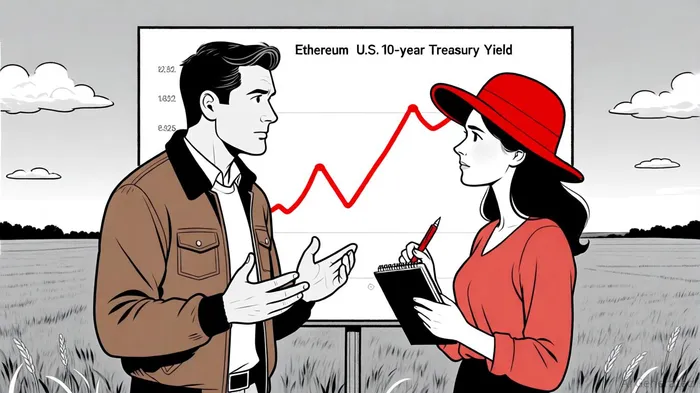
The broader crypto market has been battered by a confluence of macroeconomic factors, with EthereumETH-- bearing the brunt. Rising U.S. Treasury yields, a direct response to inflationary pressures exacerbated by global trade policies, have created a risk-averse environment. Historical data underscores the sensitivity of Ethereum to these shifts: a one-percentage-point increase in the 10-year Treasury yield has historically correlated with a 28% decline in ETH's price [1]. This inverse relationship reflects the asset's exposure to liquidity-driven markets, where higher yields reduce the present value of future cash flows and dampen speculative demand.
Inflationary fears, compounded by geopolitical tensions and supply chain disruptions, have further compressed risk-asset valuations. Ethereum, as a high-beta asset, has struggled to maintain its premium against safer alternatives like gold and U.S. Treasuries. The Federal Reserve's tightening cycle, though expected to pause in late 2025, has left a lingering shadow over investor sentiment, with many institutions adopting a wait-and-see approach [2].
Competitive Pressures: The Rise of Faster Blockchains
Ethereum's decline is not solely a macroeconomic story. The emergence of high-performance blockchains like SolanaSOL-- and XRPXRP-- has intensified competition. Solana, in particular, has outpaced Ethereum in developer adoption and market capitalization, recording an 83% year-on-year growth in 2025 [3]. XRP's price surged by 249% during the same period, driven by its utility in cross-border payments and regulatory clarity [3]. These rivals have capitalized on Ethereum's structural challenges, including its slower transaction speeds and higher gas fees, to attract developers and users.
Ethereum's leadership vacuum and declining developer activity have further eroded its competitive edge. Active developers on the Ethereum ecosystem dropped by 17% in 2024, a stark contrast to the agility of Solana's community [3]. This stagnation has left Ethereum lagging in innovation, particularly in the race to adopt Layer-2 scaling solutions and enterprise-grade infrastructure.
Structural Challenges: Decentralization vs. Adaptability
Ethereum's insistence on strict decentralization, while a core tenet of its philosophy, has hindered its ability to form strategic alliances or engage proactively with regulators. Competitors like XRP have leveraged their regulatory flexibility to secure partnerships with financial institutions, a critical advantage in a market increasingly scrutinized by governments [3]. This divergence in governance models has created a rift between Ethereum's ideological purists and pragmatists seeking real-world adoption.
Catalysts for Optimism: ETF Inflows and Upgrades
Despite these headwinds, Ethereum has not been without tailwinds. The approval of spot Ethereum ETFs in mid-2025 marked a watershed moment, injecting $29.64 billion in institutional capital by September 2025 [4]. These inflows, driven by firms like BlackRock and Fidelity, have provided a floor for Ethereum's price, even as broader market conditions remain volatile. The ETFs' success has also normalized crypto as an asset class, with the U.S. Department of Labor's recent decision to allow 401(k) allocations to include crypto further broadening its appeal [5].
Technological upgrades offer another ray of hope. The Pectra upgrade, implemented in early 2025, enhanced Ethereum's scalability and finality, while the upcoming Fusaka upgrade in late 2025 promises to further reduce transaction costs and improve throughput [6]. These upgrades, coupled with Ethereum's dominance in decentralized finance (DeFi)—with $104.418 billion in Total Value Locked—reinforce its foundational role in the digital economy [5].
Technical Analysis: A Mixed Picture for Entry Points
Ethereum's technical indicators present a complex landscape for investors. As of late September 2025, the RSI hovers near 59–61, suggesting neutral-to-bullish momentum, while the MACD line crossing above the signal line signals short-term upward potential [7]. Historical backtesting of a MACD Golden Cross strategy—buying ETH upon the crossover and holding for 30 trading days—reveals a 54.9% win ratio across 52 events from 2022 to 2025, with an average return of +5.93% (outperforming the benchmark by +2.84%) [8]. Notably, the strongest relative edge emerged between days 23–28 post-signal, suggesting that extending the holding period beyond 30 days might optimize returns.
For risk-tolerant investors, Ethereum's current price level offers a compelling entry point. The asset is trading near key support levels, with on-chain data indicating significant accumulation by institutional players. If the Fusaka upgrade delivers on its promises, Ethereum could see a technical breakout, targeting $5,500 by mid-October [6]. However, caution is warranted, as elevated liquid supply and rising Binance reserves suggest potential short-term selling pressure [6].
Conclusion: A Balancing Act for Investors
Ethereum's 2025 price decline is a product of macroeconomic turbulence, competitive pressures, and structural challenges. Yet, its institutional adoption, technological upgrades, and foundational role in DeFi position it as a long-term play for investors with a multi-year horizon. While the path to recovery may be bumpy, the confluence of ETF inflows, regulatory clarity, and network upgrades suggests that Ethereum's bearish trend could reverse in the coming months. For those willing to navigate the volatility, the current price environment offers a unique opportunity to participate in one of crypto's most transformative ecosystems.






Comentarios
Aún no hay comentarios