
Ethereum's 2025 Breakthrough and Its Implications for Long-Term Institutional Adoption
Ethereum's 2025 has marked a pivotal turning point in its evolution, driven by a combination of technical scalability breakthroughs and a reinforced ideological commitment to decentralization. These advancements have not only addressed long-standing limitations but also positioned EthereumETH-- as a critical infrastructure for institutional capital, real-world assets (RWAs), and global financial innovation. This analysis explores how Ethereum's 2025 upgrades-specifically the Pectra and Fusaka protocol changes-have catalyzed institutional adoption, while its governance and security frameworks have solidified its role as a foundational layer for decentralized finance (DeFi) and tokenized markets.
Technical Scalability: Pectra and Fusaka as Catalysts
Ethereum's 2025 roadmap was defined by two major protocol upgrades: Pectra (May 2025) and Fusaka (December 2025). These upgrades introduced a suite of Ethereum Improvement Proposals (EIPs) that collectively enhanced scalability, staking efficiency, and data availability.
The Pectra upgrade focused on streamlining validator operations and improving user experience. Key changes included doubling the number of blobs per block (EIP-7691), increasing the validator effective balance cap from 32 ETH to 2,048 ETH (EIP-7251), and enabling faster withdrawals for stakers. These adjustments reduced operational overhead for institutional participants and made staking more accessible, contributing to Ethereum's growing appeal as a yield-generating asset. Additionally, EIP-7702 introduced account abstraction, allowing regular Ethereum accounts to interact with smart contracts more flexibly, a feature critical for institutional-grade applications.
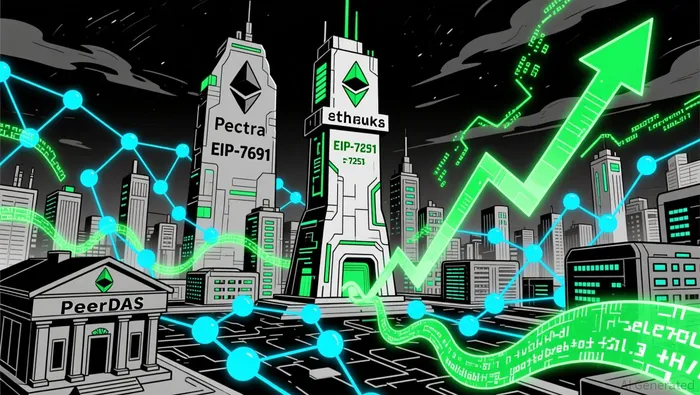
The Fusaka upgrade further solidified Ethereum's scalability by introducing PeerDAS (Peer Data Availability Sampling), a mechanism that enables nodes to verify data availability without downloading full rollup data. This innovation increased blob capacity by up to eight times, reducing Layer 2 (L2) data fees by 40–60% and enabling rollups like ArbitrumARB-- and Base to process over 3,780 user operations per second. Fusaka also introduced Blob Parameter Only (BPO) forks, allowing dynamic adjustments to data capacity without full network upgrades, ensuring Ethereum remains adaptable to growing demand.
These technical advancements have transformed Ethereum into a high-throughput, low-cost platform capable of supporting institutional-scale applications. As noted by a report from Amina Group, "Fusaka's data efficiency and PeerDAS implementation position Ethereum as a scalable infrastructure for tokenized assets and enterprise-grade DeFi, bridging the gap between blockchain and traditional finance."
Institutional Adoption: From Treasuries to Tokenized Assets
Ethereum's technical progress has been mirrored by a surge in institutional adoption. By late 2025, corporate treasuries and ETFs collectively held over 10 million ETH, valued at , a dramatic increase from under 116,000 ETH at the end of 2024. This shift reflects a strategic allocation of capital to Ethereum, driven by its role as the dominant smart contract platform and its proof-of-stake (PoS) yield opportunities (3–4% annually).
Institutional interest has also been fueled by Ethereum's dominance in stablecoin infrastructure and tokenized RWAs. The network hosts $67 billion in USDT and $35 billion in USDC, making it the backbone of global stablecoin transactions. Meanwhile, tokenized assets on Ethereum-ranging from U.S. Treasury bills to real estate- in 2025. Major institutions like BlackRock, Deutsche Bank, and Sony have leveraged Ethereum's L2s to build applications in gaming, finance, and entertainment.
The approval of spot Ethereum ETFs in the U.S. further accelerated adoption, with net inflows frequently surpassing those of Bitcoin ETFs. This regulatory clarity, combined with Ethereum's technical upgrades, has created a flywheel effect: improved scalability attracts more institutional capital, which in turn drives demand for Ethereum-based infrastructure.
Ideological Positioning: Governance, Decentralization, and Security
Ethereum's success in 2025 is not solely technical but also ideological. Vitalik Buterin has emphasized that Ethereum has overcome the -the long-standing challenge of balancing scalability, security, and decentralization-through innovations like PeerDAS and ZK-EVMs. These solutions enable Ethereum to maintain decentralization while scaling, a critical factor for institutional trust.
Governance has also evolved to accommodate Ethereum's growing complexity. Buterin outlined a vision for Ethereum to become capable of supporting diverse applications, including financial services and identity systems. This governance model prioritizes resilience and independence, ensuring that applications can operate even if original developers exit the ecosystem.
Security remains a cornerstone of Ethereum's appeal. The transition to PoS, combined with ZK-EVMs and data availability sampling, has enhanced the network's security profile. Institutions have further integrated Ethereum into their risk management frameworks, leveraging its compliance-friendly infrastructure for tokenized assets and on-chain settlements.
Implications for Long-Term Adoption
Ethereum's 2025 breakthroughs have set the stage for sustained institutional adoption. The Glamsterdam upgrade (planned for 2026) will introduce enshrined proposer-builder separation (ePBS) and block-level access lists, further improving decentralization and operational efficiency. Looking ahead, the Verge and Splurge phases aim to implement Verkle trees (reducing storage requirements) and refine user experiences, positioning Ethereum as a global settlement layer capable of handling millions of transactions per second via L2s.
For investors, Ethereum's dual focus on technical scalability and ideological resilience offers a compelling case. As institutional capital continues to flow into tokenized assets, DeFi, and staking, Ethereum's role as a foundational infrastructure will only strengthen. However, challenges remain, including cross-jurisdictional regulatory alignment and operational risks in smart contract execution.
Conclusion
Ethereum's 2025 has been a year of transformation, marked by technical innovation, institutional validation, and ideological clarity. The Pectra and Fusaka upgrades have unlocked new possibilities for scalability and data efficiency, while Ethereum's governance and security frameworks have solidified its appeal to institutional actors. As the network progresses toward its 2026 and 2030 roadmaps, Ethereum is not just a blockchain-it is becoming the backbone of a decentralized financial ecosystem. For long-term investors, the question is no longer whether Ethereum can scale, but how quickly institutions will embrace its vision.






Comentarios
Aún no hay comentarios