
Ethereum's 2025-2026 Gas Limit and Cost Repricing Strategy: A Blueprint for Scalability and Investment Resilience
The Pectra Upgrade: A Catalyst for Blob Throughput and L2 Efficiency
The Pectra upgrade, deployed on May 7, 2025, marked a critical milestone by doubling Ethereum's blob throughput capacity. This enhancement directly reduced Layer 2 (L2) gas fees by up to 100x, easing congestion on the mainnet and enabling faster, cheaper transactions for users according to reports. By prioritizing rollup-centric scaling, EthereumETH-- has shifted from a generalized computation model to one optimized for high-throughput data availability, aligning with the industry's growing reliance on L2 solutions like ArbitrumARB-- and Optimism as research shows.
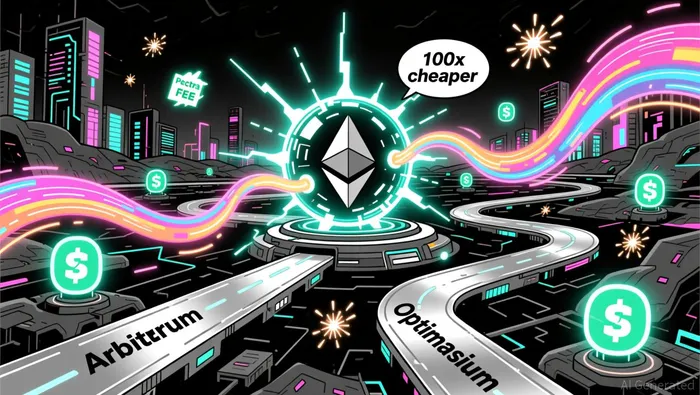 For investors, this means Ethereum's value proposition is no longer solely tied to its native token (ETH) but to its role as a settlement and security layer for a broader ecosystem. The reduction in L2 fees has already spurred adoption, with institutional players increasingly leveraging Ethereum's infrastructure for tokenized assets and cross-chain bridges.
Fusaka and PeerDAS: Flexible Scaling for a Dynamic Market
Scheduled for December 3, 2025, the Fusaka upgrade introduces PeerDAS (Peer-to-Peer Data Availability Sampling), a decentralized alternative to centralized data availability solutions. This innovation allows for more flexible blob count increases between major upgrades, enabling Ethereum to adapt to L2 demand without waiting for coordinated hard forks according to the Ethereum roadmap. Such agility is crucial in a market where user behavior and application requirements evolve rapidly.
Additionally, Fusaka's proposed gas limit cap of 16.7M per transaction and a default gas limit increase to ~60M (from 45M) aim to balance throughput with resistance to denial-of-service (DoS) attacks as data indicates. These adjustments ensure that Ethereum can scale without compromising security-a key concern for institutional investors evaluating long-term risk.
Cost Optimization Strategies: From User Behavior to Protocol-Level Innovations
Ethereum's cost repricing strategy extends beyond protocol upgrades. Users can now reduce fees by transacting during off-peak hours, batching transactions, and utilizing smart contract wallets with gas payment flexibility according to reports. Meanwhile, institutional partnerships and L2 adoption have created a "fee arbitrage" effect, where high-cost mainnet transactions are increasingly offloaded to cheaper, secure L2s as research shows.
The Ethereum Foundation's strategic reallocation of funding to curated grants for L1 scalability and developer tools has further accelerated these trends. Initiatives like the Pectra and Fusaka upgrades have already driven a 53% reduction in gas fees, according to a report by the Ethereum Foundation. This cost efficiency not only attracts retail users but also lowers the barrier to entry for developers building on Ethereum, fostering innovation and compounding network effects.
Institutional Confidence and the Supply Vacuum Narrative
Ethereum's transition to Proof-of-Stake (PoS) in 2022 laid the groundwork for these optimizations by reducing energy consumption by 99.9% and stabilizing gas fee patterns according to industry analysis. Today, over 30% of Ethereum's supply is staked, with $17.6 billion in staked treasuries creating a "supply vacuum" that supports price appreciation according to market data. This dynamic is amplified by Ethereum's role as a settlement layer for tokenized assets, where demand for ETHETH-- as a medium of exchange and collateral continues to rise.
Investment Implications: Scalability as a Competitive Moat
For investors, Ethereum's 2025-2026 roadmap underscores its ability to maintain a first-mover advantage in the blockchain space. The combination of protocol-level scalability (via Pectra and Fusaka), cost optimization (through L2s and user behavior), and institutional adoption creates a flywheel effect: lower fees drive adoption, which in turn drives demand for Ethereum's security and settlement capabilities.
Critically, these upgrades are not speculative-they are backed by measurable outcomes. The 53% gas fee reduction post-Pectra and the 100x L2 efficiency gains demonstrate that Ethereum's roadmap is delivering on its promises. As the network transitions to a more rollup-centric model, its value capture potential will increasingly align with the growth of the broader Web3 ecosystem.
Conclusion: A Network Optimized for the Future
Ethereum's 2025-2026 gas limit and cost repricing strategy is more than a technical upgrade-it's a strategic repositioning. By prioritizing scalability, security, and user experience, Ethereum is not only addressing its historical pain points but also setting a new standard for blockchain infrastructure. For investors, this translates to a robust, defensible asset with a clear path to long-term value creation. As the Fusaka upgrade approaches and the ecosystem continues to innovate, Ethereum's dominance in the smart contract space appears more secure than ever.







Comentarios
Aún no hay comentarios