
Ethereum's 20% Dip and the $1B Whale Bet: A Contrarian Case for Reentry
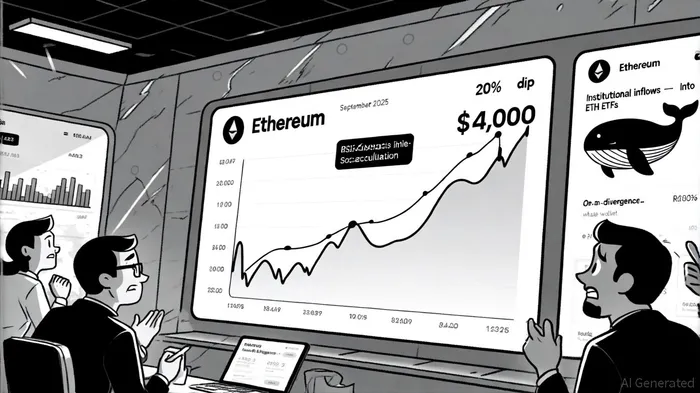
Ethereum's 20% price correction in September 2025 has sparked intense debate among investors. While the dip to $4,000 near the month's end triggered panic, on-chain data and macroeconomic divergence suggest a compelling contrarian case for reentry. This analysis synthesizes whale behavior, technical indicators, and macroeconomic shifts to argue that Ethereum's fundamentals remain robust despite short-term volatility.
Whale Activity: A Tale of Two Sides
The most striking on-chain signal during the dip was a $1 billion long position opened by a whale on Kraken, signaling confidence in Ethereum's rebound potential[1]. This contrasts with the offloading of 90,000 ETH by large holders over 48 hours, reflecting profit-taking amid heightened volatility[2]. However, the accumulation of 105,977 ETH by a new wallet (0x8eEa) over four days—valued at $397 million—demonstrates strategic buying by institutional or sophisticated investors[5]. Such behavior aligns with historical patterns where whales accumulate during dips, often preceding price recoveries.
Macroeconomic Divergence: Fed Cuts and Risk-On Sentiment
The September 17, 2025, Federal Reserve rate cut (25 basis points) created a favorable backdrop for risk assets. With the federal funds rate now at 4.00%–4.25%, the opportunity cost of holding non-yielding assets like EthereumETH-- declined, incentivizing speculative flows[3]. This dovish pivot coincided with Ethereum's price dip, creating a divergence between macroeconomic optimism and on-chain bearishness. While global markets grappled with inflation concerns and geopolitical tensions, Ethereum ETFs saw record inflows—$33 billion in Q3 2025—driven by institutional demand[4].
Technical Divergence: Oversold Conditions and Structural Strength
Ethereum's technical indicators tell a nuanced story. The RSI (Relative Strength Index) dipped to 32 hourly and 47 weekly, suggesting oversold conditions and weakening bearish momentum[5]. Meanwhile, the Commodity Channel Index (CCI) had previously signaled overbought conditions before the correction, indicating a potential correction was overdue[2]. The divergence between price action and RSI—a classic bearish signal—has now reversed, with RSI showing signs of bottoming. Additionally, the accumulation of stablecoins (e.g., $11 billion in USDTUSDT-- on Ethereum) suggests “dry powder” is being hoarded for future buying opportunities[5].
Historical data on RSI-oversold signals (RSI < 30) reveals a mixed picture for long-term holding strategies. While signals generated a ~58-63% win rate in the first 5–10 trading days, the advantage diminished sharply beyond two weeks. By 30 days, average excess returns relative to a buy-and-hold approach became negligible[5]. This underscores the importance of timing and risk management when acting on technical signals.
Structural Tailwinds: Staking, Upgrades, and Network Scarcity
Ethereum's transition to Proof of Stake and the rise of liquid staking derivatives have fundamentally altered its supply dynamics. Over 15% of circulating ETH is now staked or locked in derivatives, reducing freely tradable supply and creating deflationary pressure[4]. This scarcity model, combined with the upcoming Fusaka upgrade in December 2025—which promises scalability improvements—positions Ethereum for long-term value accrual. Analysts project the upgrade could drive Ethereum to $5,500 by mid-2026, assuming macroeconomic conditions remain stable[3].
Contrarian Thesis: Reentry at a Structural Discount
While the 20% dip has rattled short-term sentiment, the interplay of whale accumulation, macroeconomic tailwinds, and structural upgrades suggests Ethereum is undervalued. The $1B whale bet on Kraken, coupled with 0x8eEa's $397 million accumulation, indicates that large players view the dip as a buying opportunity. Meanwhile, the Fed's rate cut has reduced the cost of capital for risk assets, and Ethereum's ETF inflows underscore institutional confidence.
Critics may point to Binance's rising reserves and short-term selling pressure as red flags[4], but these signals are often cyclical and do not negate Ethereum's long-term fundamentals. For investors with a 6–12 month horizon, the current price represents a compelling entry point, particularly if the Fusaka upgrade is successfully implemented.






Comentarios
Aún no hay comentarios