
Ethereum's 2.2M Daily Transactions: A Network Surge with Real-World Implications for ETH Price and Blockchain Adoption
In late 2025, Ethereum's network activity reached unprecedented levels, with daily transactions surging to 2.2 million-a-record high that underscores a pivotal moment in the blockchain's evolution. This surge, driven by a confluence of technological upgrades, institutional adoption, and real-world asset (RWA) tokenization, raises critical questions: Does this sustained on-chain activity signal a fundamental shift in Ethereum's utility? And what does it mean for its long-term investment potential?
Network Upgrades and Scalability: The Foundation of Growth
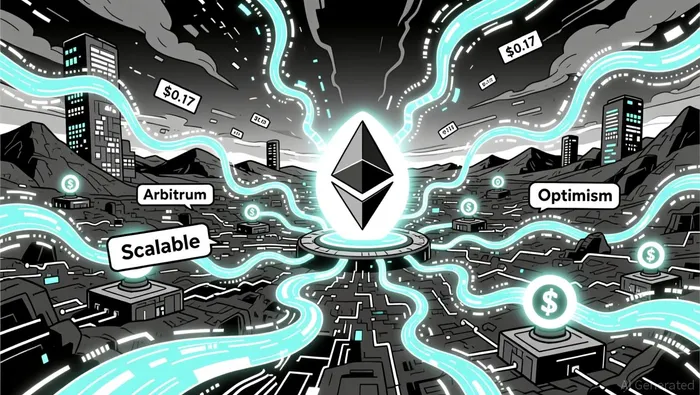
Ethereum's ability to process over 2.2 million transactions per day is not accidental but the result of strategic protocol upgrades. According to reports, the Dencun hard fork in March 2024 and the Pectra upgrades in 2025 significantly enhanced scalability, reducing data costs and improving finality times. These upgrades, coupled with the deployment of Layer-2 (L2) solutions like ArbitrumARB-- and Optimism, enabled the network to scale transaction throughput to over 70 transactions per second. Crucially, average gas fees plummeted to $0.17 per transaction in December 2025, a stark contrast to the $200+ fees seen in 2022. This cost efficiency has democratized access, attracting both retail users and enterprises.
The surge in smart contract deployments-8.7 million in Q4 2025-further highlights Ethereum's expanding utility. These contracts underpin decentralized finance (DeFi), NFT marketplaces, and RWA tokenization, signaling a shift from speculative use cases to practical, real-world applications. As Vitalik Buterin noted, EthereumETH-- has become "increasingly easy to build on," with developers leveraging L1 and L2 innovations to create scalable solutions.
Real-World Adoption: Bridging TradFi and DeFi
Ethereum's growth is not confined to on-chain metrics. Institutional adoption has surged, particularly after the approval of U.S. spot ETFs in July 2024. This development injected billions into Ethereum, with major financial players like BlackRock and HSBC leveraging the blockchain for RWA tokenization. For instance, BlackRock's BUIDL fund tokenized $5.6 billion in U.S. Treasuries, while HSBC's Orion platform reduced post-trade reconciliation efforts by 60%. These initiatives demonstrate Ethereum's role in bridging traditional finance (TradFi) and DeFi, enabling programmable, transparent, and efficient asset management.
The RWA market itself is booming. By 2025, Ethereum's RWA total value locked (TVL) reached $14 billion, with tokenized assets-including stablecoins and corporate bonds-exceeding $60 billion. This growth is supported by regulatory frameworks like the EU's MiCA and the SEC's asset-token rules, which provide clarity for institutions. Meanwhile, innovations like zero-knowledge proofs and AI-enhanced tokenization are addressing privacy and security concerns, further legitimizing Ethereum as a backbone for global finance.
Market Dynamics: Divergence Between Activity and Price
Despite robust on-chain activity, Ethereum's price in Q4 2025 fell nearly 27.6% to $3,000, creating a divergence between usage and valuation. This disconnect can be attributed to macroeconomic headwinds, including U.S. Treasury yield fluctuations and broader crypto market volatility. However, on-chain data suggests underlying strength: large holders have been accumulating during price dips, and stake demand has surged, with 890,000 ETH queued for staking.
Analysts remain cautiously optimistic. While Ethereum faces competition from faster blockchains like SolanaSOL--, its ecosystem advantages-such as a 53% market share in RWA TVL and a mature developer community-position it for long-term growth. Projections for 2026 range from $6,000 to $8,500, with bullish forecasts reaching $10,000 by 2030 under favorable conditions.
Risks and Challenges: A Path Forward
Ethereum's trajectory is not without risks. Security vulnerabilities, such as the $1.5 billion Bybit bridge hack in early 2025, highlight the need for robust infrastructure. Regulatory uncertainty, particularly in the U.S. regarding staking, also poses challenges. Additionally, the network must continue innovating to maintain its edge against rivals. Upcoming upgrades like Glamsterdam and Hegota aim to address these issues, but execution will be critical.
Conclusion: A Fundamental Shift in Utility
Ethereum's 2.2 million daily transactions represent more than a technical milestone-they signal a fundamental shift in the blockchain's utility. By combining scalability, institutional adoption, and RWA tokenization, Ethereum is evolving from a speculative asset into a foundational infrastructure for global finance. While price volatility remains a concern, the network's growing real-world applications and ecosystem resilience suggest a compelling long-term investment case. For investors, the key will be monitoring the success of upcoming upgrades, macroeconomic trends, and the pace of institutional adoption.






Comentarios
Aún no hay comentarios