
Ethereum's $13B Institutional Holdings and Their Implications for Altcoin Market Dynamics
Ethereum's $13B Institutional Holdings and Their Implications for Altcoin Market Dynamics
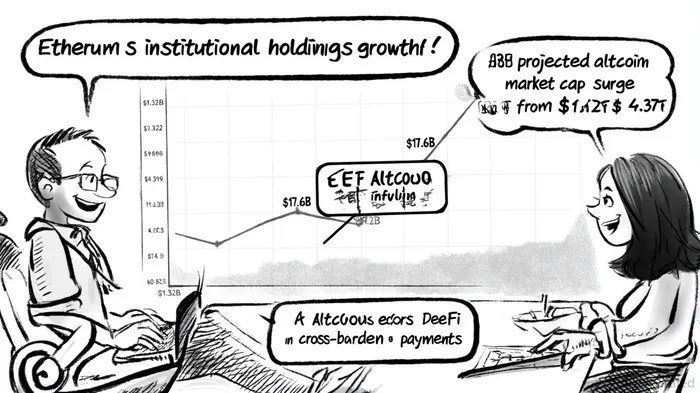
In 2025, EthereumETH-- has emerged as a cornerstone of institutional crypto portfolios, with corporate and ETF-driven accumulation pushing its institutional holdings to $13 billion. This surge reflects a broader shift in capital reallocation, as investors seek yield, utility, and diversification in a post-Ethereum dominance era. The implications for altcoin market dynamics are profound, reshaping risk profiles and unlocking new opportunities for innovation-driven assets.
Ethereum's Institutional Adoption: A New Benchmark
According to a CoinEngineer report, Ethereum's institutional treasuries now hold 4.1 million ETH, valued at $17.6 billion, with 69 entities participating in this accumulation. U.S.-based spot Ethereum ETFs alone control 6.7 million ETH, representing 5.5% of the total supply. This institutional embrace is fueled by Ethereum's deflationary model, staking yields, and the Pectra and Dencun upgrades, which enhanced scalability and reduced gas fees, according to a CoinPedia analysis.
A Gate Research analysis underscores that Ethereum's institutional adoption has driven over $2 billion in net capital inflows, reinforcing its dominance in ecosystem development, as highlighted by a The Currency Analytics report. Meanwhile, the Coinbase 2025 Institutional Investor Survey reveals that 59% of surveyed investors plan to allocate over 5% of their assets under management to digital assets, with Ethereum as a primary target. This trend is further amplified by regulated ETFs, which have normalized crypto as a mainstream asset class.
Capital Reallocation: From BitcoinBTC-- to Ethereum and Altcoins
Ethereum's institutional success has triggered a significant reallocation of capital away from Bitcoin and into altcoins. As noted by CoinPedia, Bitcoin's dominance has fallen below 59%, while the TOTAL3 index (excluding Bitcoin and Ethereum) is forming a bullish "Cup & Handle" pattern, signaling a potential $4.37 trillion altcoin market cap-a 290% increase from current levels.
This shift is evident in ETF flows: Ethereum ETFs attracted $12 billion in Q2 2025 alone, surpassing Bitcoin's inflows. OKX analysis highlights that Ethereum's ETF-driven demand created a supply squeeze, with inflows exceeding newly issued ETH by a factor of 10. This dynamic has spilled over into altcoins, particularly those with strong utility ties to Ethereum's ecosystem.
Altcoin Dynamics: Beneficiaries of Ethereum's Ecosystem
Institutional diversification strategies are increasingly targeting altcoins that offer complementary value to Ethereum. For instance:
- XRPXRP-- has gained traction as a cross-border payment solution, leveraging regulatory clarity and cost efficiency.
- AVAXAVAX-- benefits from Ethereum VirtualCYBER-- Machine (EVM) compatibility and low-cost infrastructure, with a 65% price correlation to Ethereum's total value locked (TVL).
- MAGACOIN FINANCE, a DeFi protocol, saw 300% TVL growth in Q3 2025, driven by multi-chain liquidity pools and institutional-grade risk tools.
Solana (SOL) and CardanoADA-- (ADA) are also rising stars. Solana's TVL reached $12.1 billion, supported by its scalability and institutional ETF applications. Cardano's fractal price pattern and rising open interest suggest growing institutional interest. These projects exemplify how Ethereum's dominance is catalyzing innovation in niche sectors, from decentralized exchanges (DEXs) to tokenized real-world assets (RWAs).
Risk Diversification: Balancing Yield and Volatility
While Ethereum's institutional adoption reduces reliance on Bitcoin, it introduces new risks. The Currency Analytics report warns that Ethereum's staking yields have compressed from 5% to under 3%, pushing investors toward high-yield altcoins and DeFi protocols. However, this strategy exposes portfolios to volatility, as seen in August 2025, when a 15% Ethereum price correction triggered $4.7 billion in liquidations.
Institutional investors are mitigating these risks by diversifying into altcoins with distinct use cases. For example, XRP's regulatory clarity and MAGACOIN FINANCE's deflationary tokenomics offer non-correlated returns. Additionally, ESG-focused altcoins using energy-efficient consensus mechanisms are gaining traction.
Conclusion: Navigating the Post-Ethereum Era
Ethereum's $13 billion institutional holdings signal a maturing crypto market, where capital reallocation and diversification are key themes. While Ethereum remains a dominant force, its ecosystem is fostering a new wave of altcoins that address scalability, interoperability, and real-world utility. Investors must balance Ethereum's stability with the innovation and yield potential of altcoins, while remaining mindful of macroeconomic shifts and regulatory risks.
As the TOTAL3 index hints at a $4.37 trillion altcoin market cap, the post-Ethereum era is not a zero-sum game but a landscape of strategic opportunities for those who align their portfolios with both foundational and emerging assets.






Comentarios
Aún no hay comentarios