
Ethereum's $10K Ascent: Structural Dynamics in the Post-ETF Era
The EthereumETH-- network stands at a pivotal inflection point in 2025, driven by a confluence of structural demand, regulatory clarity, and technological innovation. With the U.S. SEC's approval of Ethereum ETFs in May 2024 and subsequent inflows exceeding $12.1 billion in assets under management by July 2025[1], the cryptocurrency has transitioned from speculative asset to institutional-grade infrastructure. This shift, coupled with deflationary supply dynamics, DeFi renaissance, and macroeconomic tailwinds, positions Ethereum as a compelling candidate to breach $10,000 by 2026.
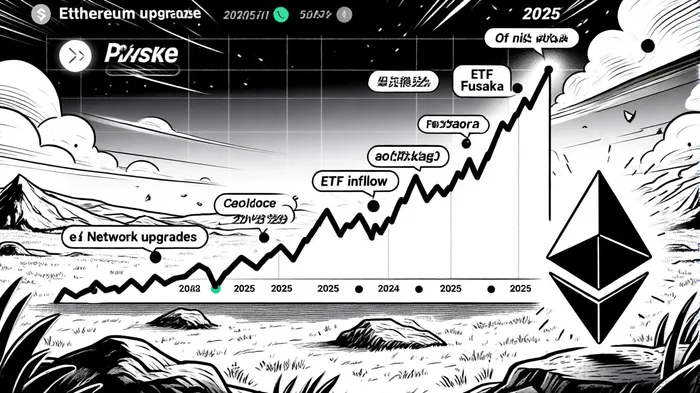
ETF-Driven Structural Demand: A New Paradigm
The approval of Ethereum ETFs marked a watershed moment, unlocking $4 billion in institutional inflows in August 2025 alone[2]. These products, including BlackRock's ETHA with $5.6 billion in AUM, have not only diversified Ethereum's investor base but also tightened liquidity by reducing exchange-held ETHETH-- supply[1]. While short-term volatility-such as $505 million in ETF outflows during September's market turbulence-remains a risk[3], the long-term structural advantages are undeniable. Analysts project Ethereum's price to range between $4,000 and $6,000 in 2025, with a potential breakout above $3,500 contingent on sustained ETF inflows[3].
The SEC's recent adoption of generic listing standards for spot crypto ETFs further amplifies this trend, enabling faster launches of Ethereum-based products and reducing regulatory friction[4]. However, the prohibition of staking within ETFs-a restriction requiring future regulatory approval-highlights lingering institutional barriers[4]. Despite this, the broader approval of in-kind creation and redemption for crypto ETPs has already enhanced market efficiency, lowering costs for investors[5].
On-Chain Resurgence and DeFi Renaissance
Ethereum's on-chain metrics underscore its growing utility. Daily active addresses surged to 600,000 in 2025, nearing all-time highs, while transactions hit 1.8 million in August-close to the 2021 peak[1]. Total Value Locked (TVL) in DeFi spiked to $97 billion mid-2025, with Ethereum accounting for 63% of the global $123.6 billion TVL total[2]. Projects like Lido ($23 billion TVL), Aave ($19 billion TVL), and EigenLayerEIGEN-- have redefined asset utility, enabling liquid staking and restaking mechanisms that bridge yield generation with network security[5].
Layer-2 solutions such as ArbitrumARB--, Optimism, and Coinbase's Base ($5.45 billion TVL) have further scaled Ethereum's infrastructure, reducing gas costs and enhancing accessibility[2]. The Spectra upgrade in May 2025 and the upcoming Fusaka upgrade in November 2026-set to increase gas limits 5x-will cement Ethereum's role as the backbone of Web3[5].
Macroeconomic Tailwinds and Deflationary Dynamics
Ethereum's price trajectory is inextricably linked to macroeconomic forces. The Federal Reserve's anticipated rate cuts in 2026 will reduce the opportunity cost of holding non-yielding assets, incentivizing capital flows into Ethereum's yield-generating ecosystem[6]. Historical correlations show a 35% Ethereum price increase following a 1-percentage-point drop in U.S. Treasury yields[6].
Structurally, Ethereum's deflationary mechanisms-EIP-1559's fee burning and PoS's reduced issuance-have created a net supply contraction. Over 28–31% of ETH is staked, with 31.1% of staked ETH in liquid staking derivatives[7]. While staking yields have declined to under 3% due to network saturation[8], innovations like liquid restaking tokens (LRTs) and loop staking are mitigating this by amplifying capital efficiency[8].
Risks and Counterarguments
Critics highlight Ethereum's competition from SolanaSOL-- and CardanoADA--, which offer faster transaction speeds and lower fees[6]. Regulatory uncertainty-particularly around staking and DeFi-also poses risks, as adverse rulings could disrupt institutional demand[6]. Macroeconomic headwinds, such as prolonged high interest rates or global instability, may dampen risk appetite. However, Ethereum's first-mover advantage, robust developer ecosystem, and ongoing upgrades like Fusaka provide a durable moat[5].
Conclusion: A $10K Future?
Ethereum's path to $10,000 hinges on its ability to sustain institutional adoption, capitalize on deflationary supply dynamics, and execute its roadmap of upgrades. While short-term volatility and competition remain risks, the confluence of ETF-driven demand, DeFi innovation, and macroeconomic tailwinds creates a compelling case for long-term appreciation. As the SEC's regulatory stance evolves and global adoption accelerates, Ethereum's role as a foundational asset in the digital economy is poised to justify valuations far beyond current levels.





Comentarios
Aún no hay comentarios