
Ether's Volatility Amid Macroeconomic Shocks and Recovery Patterns: Tactical Entry Points in a Geopolitical Climate
The Paradox of Ether's Volatility: Stability Amid Surge
Ether's price volatility in 2025 has defied conventional market logic. By July, the 30-day annualized volatility of ETHETH-- had plummeted to 52.76%, the lowest since November 2024, even as its price surged over 60% from $2,400 to $3,900, according to Forbes. This counterintuitive dynamic was driven by a confluence of regulatory clarity and institutional adoption. The U.S. SEC's guidance on exchange-traded product applications and the passage of the GENIUS Act provided a legal framework for stablecoins and ETPs, reducing uncertainty for investors, according to a Grayscale report. Simultaneously, U.S.-listed spot ETH ETPs attracted $5.4 billion in net inflows, signaling growing institutional confidence, as reported by Upstanding Hackers.
Geopolitical Shocks and the October 2025 Crash
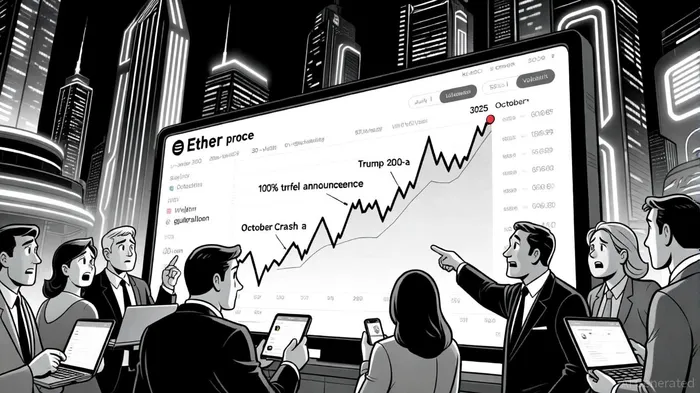
The fragile equilibrium shattered in October 2025. A 100% tariff on Chinese software imports, announced by former President Trump, triggered a global liquidity crisis. BitcoinBTC-- plummeted 12% in a single day, while Ether faced a 6% pullback as traders unwound long positions in EthereumETH-- futures, reducing open interest by $1.7 billion, according to Forbes. The crash was exacerbated by a whale selling 24,000 BTC, triggering $1.65 billion in liquidations and de-pegging stablecoins, as documented in an OpenTools article. This event underscored the systemic risks of leveraged positions in a market already strained by geopolitical tensions and macroeconomic headwinds.
Recovery Patterns: Institutional Demand and On-Chain Resilience
Despite the October turmoil, Ethereum's recovery trajectory revealed structural strengths. By mid-October, the price reclaimed $4,200, supported by a 9-year low in exchange-held ETH supply and a 47% surge in DEX volume to $33.9 billion, according to CoinCentral. Institutional demand, particularly from spot ETFs, absorbed pressure from the validator exit queue-where $10 billion in ETH awaited withdrawal, as reported by CryptoNews. ETF inflows alone reached $621.4 million in October, stabilizing the market, according to Cointribune. Additionally, Ethereum's staking ecosystem, with 29.36% of its supply locked up, further constrained circulating supply, creating upward price pressure, according to Cointelegraph.
Tactical Entry Points: Navigating Uncertainty
For investors seeking tactical entry points, three factors emerge as critical:
1. Regulatory Catalysts: The SEC's continued clarification of ETP frameworks and stablecoin regulations could drive volatility compression, as seen in July, according to Beyond the Hype.
2. On-Chain Metrics: A drop in exchange supply and rising DEX activity signal institutional accumulation and reduced selling pressure.
3. Geopolitical Contingencies: While events like Trump's tariffs create short-term panic, they also present buying opportunities for long-term holders, provided liquidity risks are mitigated.
Conclusion: A Market in Transition
Ether's 2025 volatility profile reflects a maturing asset class. While geopolitical shocks and macroeconomic headwinds remain, Ethereum's institutional adoption, regulatory progress, and on-chain resilience have created a foundation for recovery. Investors who monitor these dynamics-particularly regulatory developments and validator exit queues-can identify tactical entry points amid uncertainty. As the market stabilizes, the interplay between macroeconomic shocks and structural demand will likely define Ether's path forward.






Comentarios
Aún no hay comentarios