
Ether's Path to Resurgence: Strategic Entry Points and Institutional Accumulation Signal a Stronger Bull Case
The crypto market's recent turbulence, marked by a historic flash crash in late September 2025, has created a pivotal inflection point for Ether (ETH). While the 20.7% plunge to $3,750 initially triggered panic, the subsequent stabilization and recovery to $4,100 within days reveal a resilient market structure. For investors, this volatility has not only exposed critical support levels but also unlocked strategic entry points, particularly as institutional actors continue to accumulate ETHETH-- at scale.
Technical Resilience: A Foundation for Rebound
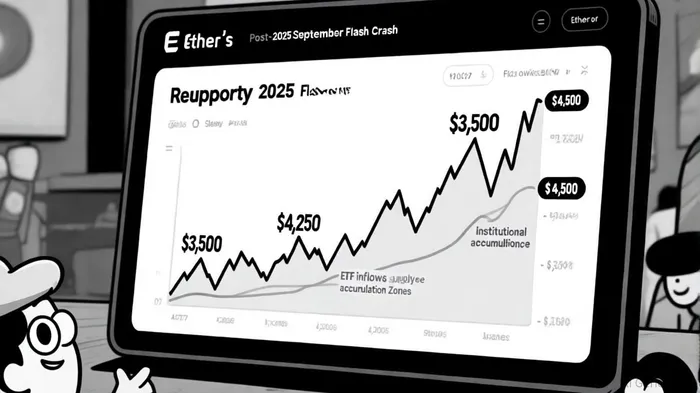
Ether's post-crash technical indicators paint a cautiously optimistic picture. The 200-day EMA remains intact, acting as a dynamic floor to prevent further depreciation below $3,500, according to a BlockNews price analysis. This level, if defended, could catalyze a short-term rally toward $3,900 or $4,100. However, a breakdown below $3,500 would expose deeper vulnerabilities, potentially dragging ETH to $3,100 or even $2,600, as the same BlockNews analysis notes.
Mid-September data underscores ETH's resilience. The $4,250 support zone, reinforced by the 20-day and 50-day EMAs at $4,347 and $4,088 respectively, has become a critical battleground, as highlighted in a CoinEdition report. Analysts draw parallels to Bitcoin's 2020 correction cycle, where a 25%-30% dip was followed by a robust recovery. If ETH mirrors this pattern, a correction to $3,500–$3,700 could set the stage for a rally toward $10,000 by early 2026, per Cache256 intelligence.
Derivatives markets also signal structural strength. Perpetual futures funding rates hit -14%, reflecting unsustainable short-term bearish pressure, a dynamic discussed in the BlockNews piece. Meanwhile, monthly futures regained a 5% premium over spot prices, indicating that the market is not oversaturated with pessimism but rather grappling with distortions in perpetual contracts. These dynamics suggest that ETH's $4,500 resistance level is within reach as volatility normalizes.
Institutional Accumulation: A Game-Changer
The most compelling narrative post-crash is the surge in institutional accumulation. Entities like BitMine Immersion and SharpLink Gaming have added 255,000 ETH to their holdings, while BlackRock's ETH ETF (ETHA) now holds 4.1 million ETH-3.4% of the total supply, according to the Cache256 intelligence cited above. U.S. spot ETFs collectively hold 6.7 million ETH, or 5.5% of the supply, as institutional investors view dips near $2,100 as strategic entry points, based on Cointelegraph data.
On-chain data corroborates this trend. Exchange-held ETH has plummeted to 15.28 million, a nine-year low, according to an ETHNews on-chain analysis. Accumulation addresses-wallets with no outbound transactions-now hold 30 million ETH, signaling long-term confidence, and the ETHNews on-chain analysis also highlights a $127.7 million figure in NFT sales in September. This reduction in circulating supply, coupled with Ethereum's growing utility in DeFi and NFTs, strengthens the case for a supply-driven price rebound.
However, short-term ETF outflows complicate the narrative. U.S. spot ETH ETFs recorded $787.6 million in net outflows in early September, with Fidelity's FETH and Bitwise's ETHW accounting for $135.3 million, as previously reported by Cache256. This capital rotation into BitcoinBTC-- ETFs highlights macroeconomic uncertainty but also underscores ETH's role as a secondary beneficiary of institutional capital reallocation.
Strategic Entry Points: Where to Buy the Dip
For investors, the post-crash environment offers multiple entry opportunities. Key levels to monitor include:
1. $4,100–$4,250: A short-term floor where buyers have already emerged, per Cointelegraph data.
2. $3,500–$3,700: A potential correction target aligned with historical patterns identified by Cache256.
3. $2,100: A deep-value entry point if macroeconomic conditions deteriorate further, as noted in the CoinEdition report.
Derivatives metrics also provide guidance. The $4,287 resistance level, confirmed by volume-based analysis and referenced in Cointelegraph coverage, represents a critical threshold for bulls. Meanwhile, the 4-hour chart's descending triangle pattern suggests a breakout is imminent, with the 200-day EMA as the final line of defense, according to a CCN analysis.
Broader Market Implications
Ether's recovery is not an isolated event. The broader crypto market is showing signs of stabilization, with ETH's relative strength contrasting against deeper altcoin corrections. This divergence highlights Ethereum's institutional backing and robust infrastructure, including scalable Layer-2 solutions and deep hedging markets discussed in the BlockNews price analysis. As ETF inflows resume and on-chain metrics improve, ETH's dominance could expand, further solidifying its role as the market's bellwether.
Conclusion
Ether's post-crash trajectory is a masterclass in market resilience. While short-term volatility persists, the confluence of technical strength, institutional accumulation, and on-chain fundamentals paints a bullish picture. For investors, the current environment offers a rare opportunity to buy into a market that is recalibrating for a stronger, more sustainable upcycle. As the saying goes in crypto: "The best time to plant a tree was 10 years ago. The second-best time is now."






Comentarios
Aún no hay comentarios