
Ether Machine's SEC Filing: A Strategic Move in the Evolving Crypto Infrastructure Sector
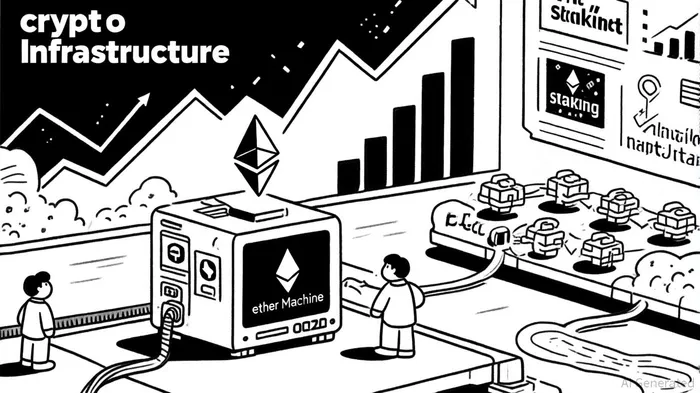
The recent SEC filing by The Ether Machine marks a pivotal moment in the maturation of the crypto infrastructure sector. As the company advances its plans to go public via a merger with Dynamix CorporationETHM--, a Nasdaq-listed SPAC, it positions itself as a unique vehicle for institutional-grade EthereumETH-- exposure. With over $2.5 billion in committed capital and a balance sheet holding 495,362 ETH (valued at $2.16 billion), The Ether Machine is poised to leverage Ethereum's growing institutional adoption and the expanding DeFi ecosystem to generate long-term, risk-adjusted returns [1].
Market Context: A Booming Crypto Infrastructure Sector
The global cryptocurrency market, valued at $5.74 billion in 2024, is projected to reach $17.52 billion by 2033, driven by institutional adoption, blockchain innovation, and DeFi expansion [2]. Ethereum, the second-largest cryptocurrency by market capitalization, has emerged as a cornerstone of this growth. Its staking industry alone is expected to see total value locked (TVL) exceed $200 billion by year-end 2025, fueled by liquid staking and restaking technologies that enhance liquidity while generating yield [3].
The Ether Machine's business model aligns closely with these trends. By staking over 90% of its ETH holdings on distributed infrastructure across multiple continents, the company optimizes validator efficiency while mitigating risks associated with centralized nodes [4]. This approach not only strengthens Ethereum's network security but also positions The Ether Machine to capitalize on the rising demand for institutional-grade yield generation.
Strategic Positioning: Active Yield vs. Passive Exposure
Unlike traditional Ethereum ETFs, which passively hold the asset, The Ether Machine emphasizes active yield generation through staking, restaking, and DeFi strategies. This distinction is critical in a market where Ethereum's programmable nature allows for dynamic capital allocation. For instance, the company's use of diverse Ethereum clients and bare-metal servers ensures robust validator performance, a competitive edge in an industry where technical execution directly impacts returns [5].
The company's leadership further reinforces its strategic positioning. Co-founders Andrew Keys and David Merin bring decades of experience in blockchain and institutional finance, having previously shaped initiatives at the Enterprise Ethereum Alliance and Consensys. Their expertise, combined with institutional backing from Kraken, Pantera Capital, and Blockchain.com, underscores The Ether Machine's credibility in a sector still grappling with regulatory and operational uncertainties [6].
Growth Potential: Leveraging Ethereum's Ecosystem
The Ether Machine's growth trajectory is closely tied to Ethereum's broader ecosystem. The upcoming Pectra upgrade in Q3 2025, which introduces smart account features and enhances network efficiency, is expected to further solidify Ethereum's dominance in the smart contract space [7]. Additionally, the proliferation of Layer-2 solutions like ArbitrumARB-- and OptimismOP-- is reducing gas fees and expanding Ethereum's utility, creating a fertile ground for The Ether Machine's infrastructure initiatives.
Financially, the company's $654 million in-kind investment from Blockchains founder Jeffrey Berns—valued at 150,000 ETH—has bolstered its capital base, enabling aggressive expansion in validator management and block-building services [8]. These services cater to both institutional clients and Ethereum-native projects, positioning The Ether Machine as a bridge between traditional finance and decentralized innovation.
Risks and Challenges
Despite its strengths, The Ether Machine faces headwinds. Regulatory scrutiny of crypto assets remains a wildcard, with the SEC's ongoing enforcement actions against digital assetDAAQ-- firms creating uncertainty. Additionally, macroeconomic factors such as rising U.S. Treasury yields could dampen risk-on sentiment, impacting Ethereum's price and, by extension, the company's balance sheet. Competition from emerging staking platforms and other SPACs in the crypto space also poses a challenge, though The Ether Machine's scale and governance framework with KPMG provide a buffer [9].
Conclusion: A Unique Value Proposition
The Ether Machine's SEC filing represents more than a capital-raising exercise—it is a strategic move to redefine institutional participation in Ethereum. By combining active yield generation, robust governance, and a commitment to Ethereum's infrastructure, the company is well-positioned to capture a significant share of the $17.52 billion crypto market by 2033. As the business combination with Dynamix Corporation nears completion (expected by Q4 2025), investors will be watching closely to see if The Ether Machine can deliver on its promise of generating alpha while advancing Ethereum's ecosystem.





Comentarios
Aún no hay comentarios