
Ethena's Strategic Position in the Evolving Stablecoin Market
The Dual-Model Advantage: Yield and Compliance in One Ecosystem
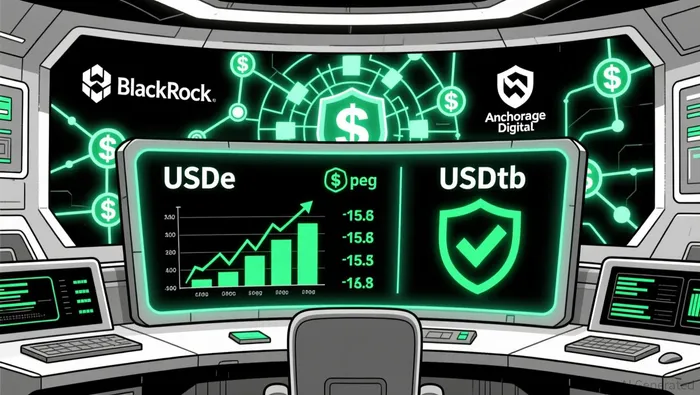
Ethena's core innovation lies in its dual-token architecture. USDe, a synthetic stablecoin, is maintained through dynamic hedging and derivatives trading, offering users exposure to yield-generating strategies. Meanwhile, USDtb, a reserve-backed stablecoin, is fully collateralized by real-world assets (RWAs) and issued by Anchorage Digital, a U.S.-regulated custodian Coinedition report. This duality allows Ethena to cater to two distinct but overlapping audiences: crypto-native users seeking high returns and institutional investors prioritizing transparency and regulatory safety.
According to a Coinedition report, USDe's market cap surged to $12.26 billion in July 2025, surpassing DAIDAI-- to claim the third-largest stablecoin position globally. This growth is driven by strategic partnerships, including a collaboration with JupiterJUP-- to replace $750 million of USDC in liquidity pools with JupUSD-a stablecoin initially backed by USDtb but expected to integrate USDe, as noted in the Coinedition report. Such moves highlight Ethena's ability to disrupt traditional stablecoin dominance by embedding itself into DeFi's yield-centric infrastructure.
Regulatory Compliance: Third-Party Audits and Institutional Trust
Ethena's compliance framework is a cornerstone of its strategy. The protocol employs weekly Proof of Reserves attestations, verified by third-party auditors like HT Digital and ChainlinkLINK--, while monthly custodian audits from Copper and Cobo reinforce transparency, according to a September 2025 governance update. These measures are critical in a post-FTX world where trust is scarce.
Institutional adoption further validates Ethena's credibility. Partnerships with BlackRock, Anchorage Digital, and Securitize have enabled USDtb to integrate with the USD Institutional Digital Liquidity Fund (BUIDL), allowing atomic swaps between USDtb and BUIDL for 24/7 institutional transactions, as detailed in a blog post. Additionally, USDtb's Treasury-backed structure ensures stable yields even during crypto downturns, a stark contrast to USDC's reliance on cash reserves, which face liquidity risks in volatile markets, according to the blog post.
Yield Generation: A Differentiator in a Low-Interest Environment
Ethena's synthetic model unlocks yield opportunities that traditional stablecoins cannot match. Staked USDe (sUSDe) currently offers an APY of 7.83%, attracting users in a low-interest-rate environment, according to the September 2025 governance update. This yield is generated through Ethena's proprietary hedging strategies and derivatives exposure, creating a flywheel effect: higher yields drive adoption, which in turn increases liquidity and market share.
While USDC's dominance in institutional finance remains unchallenged, its traditional model lacks the flexibility to offer competitive yields. Ethena's ability to balance compliance with innovation gives it a unique edge in markets where yield is a primary driver of user behavior.
Risks and Regulatory Scrutiny: The Path Forward
No analysis is complete without addressing risks. Ethena's synthetic model is inherently more volatile than USDC's cash-backed structure. A flash crash in October 2025 saw USDe briefly depeg to $0.65, exposing vulnerabilities in its hedging mechanisms, as noted in the Coinedition report. While the depeg was short-lived, it underscores the need for robust risk management.
Regulatory challenges also loom. The EU's MiCA framework and U.S. SEC scrutiny could force Ethena to adapt its compliance measures further. However, its partnerships with regulated custodians and proactive governance updates-such as listings on Kraken and Coinone-demonstrate a commitment to aligning with evolving standards, as described in the September 2025 governance update.
Conclusion: A Hybrid Future for Stablecoins
Ethena's dual-stablecoin strategy represents a bold reimagining of the stablecoin market. By combining the innovation of synthetic assets with the trust of institutional-grade compliance, Ethena is not merely competing with USDC-it is redefining the parameters of competition. While risks persist, its ability to generate yield, secure institutional partnerships, and adapt to regulatory demands positions it as a formidable contender in the regulated DeFi era. For investors, Ethena offers a compelling case: a stablecoin ecosystem that bridges the gap between DeFi's promise and TradFi's pragmatism.







Comentarios
Aún no hay comentarios