
Ethena's Strategic Position in the Evolving DeFi Ecosystem
The Foundation: Stablecoins as a Compounding Engine
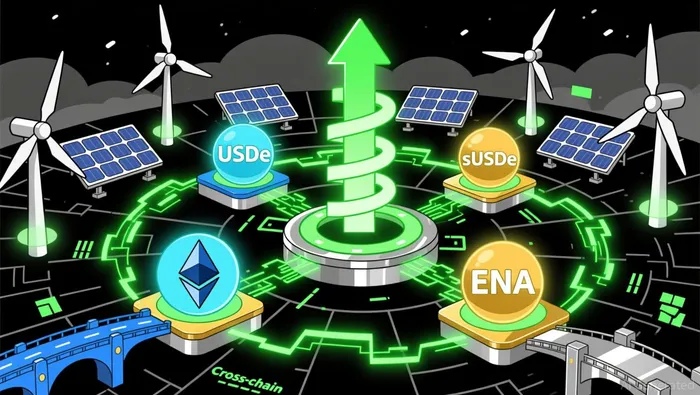
Ethena's synthetic stablecoins, USDeUSDe-- and sUSDe, form the backbone of its growth strategy. These tokens maintain a dollar peg by combining 50% spot crypto collateral (e.g., ETH, BTC) with 50% short positions in USDT-margined perpetual contracts, creating a delta-neutral structure. This mechanism generates yield through perpetual contract funding rates and staking rewards, enabling users to earn passive income while maintaining stable value. Since its launch in 2024, EthenaENA-- has secured over $14 billion in deposits, a testament to the demand for yield-generating stablecoins in a low-interest-rate environment.
A key catalyst for Ethena's expansion is its partnership with M2 Capital, a UAE-based investment firm that injected $20 million into Ethena's governance token, ENA. This collaboration bridges Middle Eastern capital with DeFi infrastructure, tapping into a region where digital asset adoption is accelerating. By integrating Ethena's products into M2 Global Wealth's offerings, the firm provides institutional-grade access to emerging markets, further broadening the user base for USDe and sUSDe.
Perpetual Contracts: Yield Generation and Risk Mitigation
Ethena's perpetual contracts strategy is both innovative and precarious. By facilitating short positions on centralized exchanges, Ethena helps reduce imbalances between long and short liquidity, earning funding rates in the process. For instance, a $5,000 investment in IOIO-- DeFi's yield contracts-a platform aligned with Ethena's ecosystem-can generate $75 daily over 20 days, illustrating the scalability of perpetual contract-based income. However, this model hinges on the stability of USDTUSDT--, which underpins the short positions. A hypothetical depeg of USDT to $0.80 could trigger a 20% collateral shortfall, exposing Ethena to systemic risks.
To mitigate such vulnerabilities, Ethena has diversified its hedging strategies, including cross-chain deposits on platforms like EulerEUL-- and Silo. These integrations allow users to collateralize USDe and sUSDe across 18 blockchains, with LayerZero's OVault enabling seamless staking from any chain. This cross-chain flexibility not only enhances liquidity but also distributes risk across multiple ecosystems, a critical advantage in volatile markets.
Tokenization: Bridging Traditional and Digital Finance
Tokenization is reshaping global financial infrastructure, and Ethena is at the forefront of this shift. The deployment of WBTC on Hedera, powered by LayerZeroZRO--, exemplifies Ethena's commitment to institutional-grade custody and transparency. By enabling Bitcoin liquidity to flow across chains, Ethena supports BTCFi (Bitcoin Finance) applications, from lending to derivatives, while maintaining compliance with regulatory standards.
Beyond DeFi, tokenization is gaining traction in traditional finance. Alibaba, for instance, is exploring tokenized stablecoin-like systems to streamline B2B transactions, while Franklin Templeton's Benji platform has expanded to the Canton Network, allowing institutional investors to tokenize money market funds as collateral. These developments underscore a broader trend: tokenization is no longer confined to crypto-native ecosystems but is becoming a cornerstone of global finance. Ethena's cross-chain integrations position it to benefit from this convergence, as enterprises seek interoperable solutions for asset management.
Strategic Convergence: Compounding Growth Through Synergy
Ethena's true strength lies in the synergy between its three pillars. Stablecoins provide a stable base for yield generation, perpetual contracts amplify returns through leverage, and tokenization enhances liquidity and accessibility. For example, sUSDe's cross-chain availability-now spanning 18 networks-enables users to stake their tokens on AvalancheAVAX-- via PendlePENDLE--, further compounding their earnings. This layered approach mirrors Alibaba's strategy of integrating tokenization with AI-driven commerce, where digital assets streamline cross-border payments.
However, Ethena's reliance on perpetual contracts and USDT introduces systemic risks. Prolonged negative funding rates or a USDT depeg could erode yields and destabilize USDe's peg. To address this, Ethena must continue diversifying its collateral and hedging mechanisms, potentially incorporating alternative stablecoins or over-collateralization strategies.
Conclusion: A High-Conviction Play in DeFi's Next Phase
Ethena's strategic position in the DeFi ecosystem is underpinned by its ability to harmonize innovation with institutional-grade infrastructure. With over $16 billion in combined TVL for USDe and USDtb, and growing partnerships in the Middle East and Asia, the platform is well-positioned to capitalize on the tokenization boom. Yet, its success will depend on navigating the inherent risks of perpetual contracts and maintaining the stability of its synthetic dollar model. For investors seeking exposure to the next wave of DeFi growth, Ethena represents a compelling, albeit high-conviction, opportunity.







Comentarios
Aún no hay comentarios