
Ethena's Declining Synthetic USDe Amid the Rise of Dollar-Backed Stablecoins: Tokenized Asset Disintermediation and Market Fragmentation
The stablecoin market in 2025 is undergoing a seismic shift. Ethena's synthetic dollar stablecoin, USDeUSDe--, once a beacon of innovation with a market cap exceeding $14.5 billion by September 2025, has faced a sharp decline, dropping to $8.5 billion in November 2025. This downturn coincides with the explosive growth of dollar-backed stablecoins and the accelerating disintermediation of traditional financial systems through tokenized assets. As the market fragments under regulatory and technological pressures, USDe's synthetic model faces existential challenges.
The Rise of Dollar-Backed Stablecoins and Market Fragmentation
The passage of the GENIUS Act in June 2025 has catalyzed a bifurcation in the stablecoin market. This legislation created a regulatory framework that distinguishes between GENIUS-compliant stablecoins-backed by U.S. Treasuries and other liquid assets-and non-compliant alternatives. The former now dominate cross-border payments and institutional use cases due to their perceived safety and efficiency. For instance, tokenized U.S. Treasuries have surged to $7.3 billion in assets under management by 2025, offering 24/7 trading and automated yield distribution. These innovations are displacing traditional stablecoins like USDe, which rely on complex hedging strategies rather than direct fiat collateral.
The fragmentation is further exacerbated by the global push for monetary sovereignty. Central banks and governments are increasingly wary of private stablecoins that bypass traditional financial intermediaries. As a report by Santander notes, the proliferation of dollar-backed stablecoins raises concerns about data control and the erosion of banking functions. This regulatory skepticism has driven demand toward tokenized assets that align with existing compliance frameworks, leaving synthetic stablecoins like USDe in a precarious position.
Tokenized Asset Disintermediation and USDe's Decline
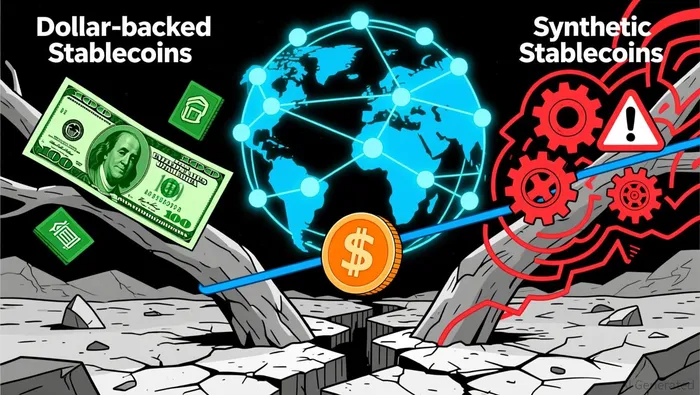
Tokenized assets are not just competing with USDe-they are redefining the financial infrastructure it relies on. The New York Fed has highlighted how tokenized investment funds are being used as collateral and margin requirements, reducing reliance on traditional banks. For example, tokenized U.S. Treasuries now offer institutional-grade access to fixed-income markets with programmable smart contracts, a feature USDe lacks. This disintermediation is particularly damaging to USDe's value proposition, which hinges on yield-generating mechanisms like delta-hedging and staking rewards.
The October 2025 liquidity crisis underscored this vulnerability. When USDe briefly depegged to $0.65, it exposed the fragility of its synthetic model during market stress. Meanwhile, tokenized assets-backed by U.S. Treasuries and held in institutional custodial solutions-remained stable. This contrast has eroded confidence in USDe, especially as yield compression on platforms like Aave forced leveraged positions to unwind, causing a 50% drop in total value locked (TVL).
Strategic Challenges and Ethena's Path Forward
Ethena's response to these headwinds has been twofold: expanding USDe's utility and pursuing regulatory alignment. The project has partnered with Nunchi to develop perpetual markets tied to yield benchmarks and integrated with JupiterJUP-- and SolanaSOL-- to diversify USDe's applications beyond DeFi yield strategies. However, these efforts face an uphill battle against the simplicity and regulatory clarity of dollar-backed stablecoins.
The launch of iUSDe-a stablecoin with transfer restrictions and a 20% APY highlights Ethena's attempt to differentiate itself. Yet, such high yields are unsustainable in a market increasingly dominated by low-cost, transparent alternatives. The broader supply of USDe has already contracted by 40% in November 2025, as traders shifted to tokenized assets with clearer risk profiles.
Conclusion: A Market in Transition
The decline of USDe is emblematic of a broader trend: the displacement of synthetic stablecoins by tokenized assets that align with regulatory and institutional demands. While Ethena's innovations in yield generation and DeFi integration remain impressive, they are no longer sufficient in a market where simplicity, transparency, and compliance reign supreme.
For investors, the lesson is clear: the future of stablecoins lies in tokenized assets that bridge the gap between decentralized finance and traditional systems. As the GENIUS Act reshapes the landscape, projects like EthenaENA-- must either adapt to this new reality or risk obsolescence. The rise of dollar-backed stablecoins is not just a regulatory shift-it is a structural reordering of the financial ecosystem.






Comentarios
Aún no hay comentarios