
U.S. Ethanol Market Dynamics: Assessing the Impact of Modest Production Gains on Inventory Trends and Export Prospects
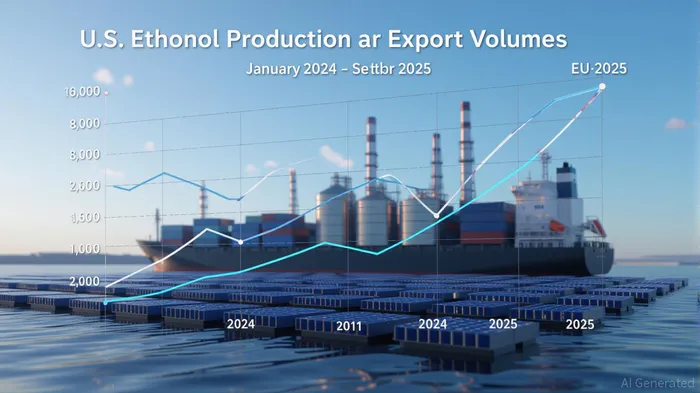
The U.S. ethanol market in 2025 is navigating a complex interplay of production, inventory, and export dynamics, offering both challenges and opportunities for energy traders and renewable fuel investors. With modest production gains, tightening inventories, and shifting export patterns, the sector demands a nuanced understanding of macroeconomic and geopolitical factors.
Production Gains and Their Constraints
U.S. ethanol production has seen a 4.73% monthly increase in July 2025, with annual growth of 1.28% compared to 2024 [1]. However, this growth is tempered by seasonal volatility, as evidenced by a 1% weekly decline in February 2024 [3]. Capacity utilization remains near historical averages, with plants operating at approximately 92% of their maximum output [1]. While these gains suggest resilience, they are not sufficient to offset structural headwinds such as aging infrastructure and regulatory uncertainty.
For traders, the key takeaway lies in the correlation between production and inventory levels. As of August 2025, ethanol stocks have tightened to 22.549 million barrels, a 139,000-barrel weekly decline and a 1.023-million-barrel annual drop [4]. This tightening is driven by a combination of reduced imports (down to 21,696 gallons in June 2025 [5]) and sustained domestic demand, particularly in the transportation sector.
Inventory Tightness and Strategic Implications
The narrowing inventory buffer has significant pricing implications. With ethanol stocks at their lowest since early January 2025 [4], the market is increasingly sensitive to supply shocks. For instance, a 1% production dip in early 2024 led to a 2% increase in stockpiles [3], but the current environment shows less flexibility. This dynamic creates a "cost-of-carry" risk for producers, where holding inventory becomes more expensive as storage costs and price volatility rise.
Investors should monitor the interplay between production and consumption. While the EIA notes that ethanol demand has "slipped" in some quarters [2], the Renewable Fuel Standard (RFS) and state-level blending mandates (e.g., California’s Low Carbon Fuel Standard) continue to underpin demand. This duality—modest production growth paired with constrained inventories—positions ethanol as a strategic asset for hedgers seeking to capitalize on short-term volatility.
Export Prospects and Geopolitical Drivers
Exports remain a critical growth vector for the U.S. ethanol industry. In June 2025, exports hit 184.2 million gallons, with Canada (65 million gallons), India (24 million gallons), and the Netherlands (18 million gallons) as top destinations [5]. However, July 2025 saw a 5% dip in exports, primarily due to a retreat in Indian demand [4]. Despite this, year-to-date exports through September 2025 have reached 1.23 billion gallons, a 15% increase from 2024 [4].
The long-term outlook for exports is mixed. While the U.S. projects an average of 95,000 barrels per day (b/d) in 2025 exports—down from 119,500 b/d in 2024 [5]—geopolitical tailwinds persist. Canada’s expanded ethanol blending mandates and India’s potential policy shifts (e.g., revisiting its ethanol blending target of 20%) could drive renewed demand. Meanwhile, the European Union’s Renewable Energy Directive III (RED III) is expected to boost imports of U.S. ethanol as EU producers face stricter sustainability criteria.
Strategic Positioning for Investors
For energy traders and renewable fuel investors, the ethanol market offers a unique blend of cyclical and structural opportunities. Here are three strategic considerations:
Inventory Arbitrage: With stocks at multi-month lows, traders may explore short-term arbitrage between ethanol futures and physical markets. The Chicago ethanol benchmark’s projected rise to 211 cents/gal in 2025 [5] suggests a favorable environment for long positions, particularly in the fourth quarter when seasonal demand peaks.
Export Hedging: Given the concentration of exports in Canada and the EU, investors should hedge against currency fluctuations and policy risks. For example, a 1% depreciation in the Canadian dollar could erode 3–5% of export margins [4].
Capacity Utilization Plays: Firms with high-capacity, low-cost production facilities (e.g., those leveraging corn ethanol or cellulosic technologies) are better positioned to capitalize on tight inventories. The USDA’s raised forecast for FY 2025 ethanol export values [3] underscores the importance of operational efficiency.
Conclusion
The U.S. ethanol market in 2025 is defined by a delicate balance between modest production gains and inventory constraints, with exports serving as both a buffer and a vulnerability. For traders, the key lies in leveraging short-term volatility through inventory arbitrage and hedging. For investors, the focus should be on firms with scalable production and diversified export portfolios. As global demand for low-carbon fuels intensifies, the ethanol sector’s strategic positioning will hinge on its ability to adapt to both domestic policy shifts and international market dynamics.
**Source:[1] US Fuel Ethanol Production - Real-Time & Historical Trends [https://ycharts.com/indicators/us_fuel_ethanol_production_btu][2] EIA Weekly Ethanol Report – Production and Demand Slip [https://growthenergy.org/eia-post/eia-weekly-ethanol-report-production-and-demand-slip-inventories-decline-sharply-august-1-2025/][3] EIA: Ethanol production down 1%, stocks up 2%, exports ... [https://ethanolproducer.com/articles/eia-ethanol-production-down-1-stocks-up-2-exports-down-55][4] U.S. ethanol stocks tightest since early January [https://www.brownfieldagnews.com/news/u-s-ethanol-stocks-tightest-since-early-january/][5] June U.S. Ethanol and Distillers Grains Exports Remain ... [https://ethanolrfa.org/media-and-news/category/trade-monitor/article/2025/08/june-u-s-ethanol-and-distillers-grains-exports-remain-strong-despite-market-fluctuations]







Comentarios
Aún no hay comentarios