
Ethane Sanctions and Hormuz Risks: Why Asian LNG Buyers Are Rerouting to Qatar and Australia
The U.S. government's June 2025 decision to impose licensing requirements on ethane exports to China has upended global energy markets, while tensions over the Strait of Hormuz have amplified fears of supply disruptions. Together, these developments are driving Asian buyers to diversify their liquefied natural gas (LNG) procurement away from Middle Eastern chokepoints, creating opportunities for suppliers like Qatar and Australia. For investors, this shift highlights the strategic importance of firms with infrastructure to capitalize on rerouted trade—and the risks of clinging to vulnerable supply chains.
The Ethane Export Crisis: A Catalyst for Change
The U.S. Bureau of Industry and Security's (BIS) licensing requirements for ethane exports to China—citing “military end-use risks”—have slashed U.S. ethane exports by 24% year-on-year. As of June 2025, nearly 25% of the global Very Large Ethane Carrier (VLEC) fleet is stranded off the U.S. Gulf Coast, with ethane prices plummeting 40% since early 2024. Chinese buyers, which accounted for 47% of U.S. ethane exports in 2024, have pivoted to naphtha and LPG feedstocks, but the broader impact is clear: Asian buyers now seek energy security through diversified LNGLNG-- sources.
While ethane and LNG are distinct commodities, the sanctions have accelerated distrust in U.S. supply reliability. However, U.S. LNG exporters—unlike ethane—remain a critical option for Asian buyers. 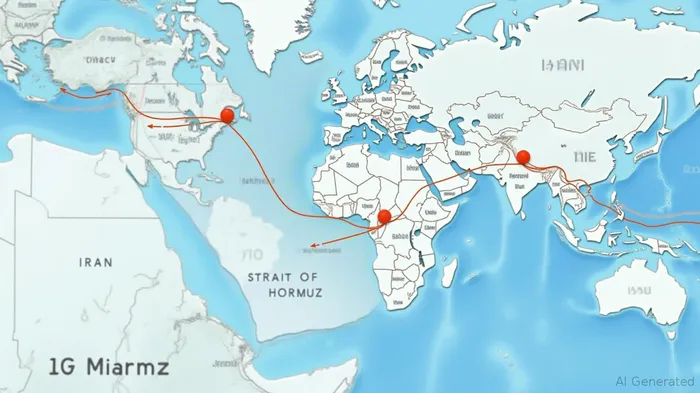
Strait of Hormuz: A Chokepoint, Not a Closure
Iran's threats to block the Strait of Hormuz—a passage for 20% of global oil and 30% of LNG—have sent oil prices spiking toward $85/barrel. Yet analysts dismiss a full closure as self-defeating: Iran relies on the strait for 98% of its oil exports, and China imports 5.4 million barrels/day of crude and LNG through it. Partial disruptions or harassment, however, remain plausible, creating urgency for buyers to reduce exposure.
This has fueled demand for LNG sourced outside the Strait. Qatar, the world's largest LNG exporter, is uniquely positioned but faces scrutiny: its shipments still transit Hormuz. Buyers are now prioritizing suppliers whose routes avoid the strait entirely—such as Australia (shipping westward) and U.S. Gulf Coast terminals—thereby reducing geopolitical risk.
Strategic Shifts and Investment Opportunities
Asian buyers, particularly Japan and South Korea, are accelerating diversification. Qatar's North Field East project, which will boost LNG capacity to 126 million tons/year by 2027, remains vital, but its reliance on Hormuz limits its “risk-free” appeal. Investors should instead focus on:
U.S. LNG Exporters: Firms like Cheniere Energy (CQP), which operates terminals in Louisiana and Texas, benefit from U.S. gas price discounts and a shipping route unaffected by Hormuz.
Australian Producers: Woodside Petroleum (WPL.AX) and Santos (STO.AX), with access to Australia's vast gas reserves and westward shipping routes, are poised to capture Asian demand. Australia's LNG exports are projected to rise 15% by 2026, avoiding Hormuz entirely.
Infrastructure Plays: Shipping firms like NYK Line (9104.T) and terminal operators such as Venture Global LNG (VGAS), which is expanding U.S. export capacity, stand to gain from rerouted trade.
Risks and Considerations
- Policy Volatility: U.S.-China trade talks could ease ethane restrictions, but LNG's geopolitical neutrality makes it less vulnerable.
- Strait of Hormuz Stability: While Iran's closure is unlikely, any disruption would temporarily boost prices for non-Hormuz LNG.
- Capacity Constraints: Qatar and Australia may struggle to meet sudden demand surges without new projects.
Conclusion: Reroute to Win
The confluence of U.S. ethane sanctions and Hormuz risks has reshaped Asian LNG procurement. Investors should prioritize firms with infrastructure to supply routes avoiding the strait. Cheniere (CQP) and Woodside (WPL.AX) are leading candidates, while Qatar's dominance underscores the need for a diversified portfolio. As Asian buyers rebalance their energy mix, the winners will be those who offer both reliability and risk mitigation.





Comentarios
Aún no hay comentarios