
The ETF Rotation: Why XRP and Solana Are Outperforming Bitcoin and Ethereum
The crypto market in 2025 is witnessing a seismic shift in institutional capital flows, with XRPXRP-- and SolanaSOL-- capturing the lion's share of new investment inflows while BitcoinBTC-- and EthereumETH-- face outflows. This reallocation reflects a broader recalibration of market sentiment, driven by evolving institutional strategies, regulatory clarity, and the pursuit of diversification. As the year draws to a close, the data paints a clear picture: investors are rotating into altcoins that offer tangible utility, scalability, and innovation-traits that XRP and Solana exemplify.
XRP: The Institutional Case for Utility and Liquidity
XRP's resurgence in 2025 is anchored by its role as a cross-border payment solution. Ripple's On-Demand Liquidity (ODL) processed $15 billion in transactions in 2024, demonstrating XRP's real-world utility in a sector where traditional financial systems remain fragmented and costly. This practical application has resonated with institutional investors, who are increasingly prioritizing assets with clear use cases over speculative narratives.
The launch of XRP-specific ETFs has further accelerated this trend. Products like Grayscale's GXRP, Franklin Templeton's XRPZ, and Bitwise's XRP ETFXRPI-- have collectively attracted over $941 million in inflows within two months, signaling confidence in XRP's market maturity. Notably, XRP's Q3 2025 performance outpaced Bitcoin, Ethereum, and Solana combined, with its market cap surging to $170.3 billion-a 29% quarter-over-quarter increase. This growth was underpinned by a 27% price rise to $2.85 and a 46% surge in new wallet addresses, highlighting growing adoption.
Solana: Scalability and Ecosystem Growth
Solana's appeal lies in its technical advantages: sub-second transaction times, low fees, and a rapidly expanding ecosystem of decentralized applications (dApps). Institutional inflows into Solana ETFs, including Bitwise's and Grayscale's offerings, have reached $739 million in 2025, with $382 million added in just three weeks. This momentum is driven by Solana's ability to attract developers and enterprises seeking a high-performance blockchain, as evidenced by its 32% price surge in Q3 2025.
Moreover, Solana's integration into tokenization and decentralized finance (DeFi) has positioned it as a viable alternative to Ethereum. While Ethereum's volatility and gas fees remain persistent challenges, Solana's infrastructure supports scalable, cost-effective solutions for institutional-grade applications as evidenced by its 32% price surge in Q3 2025. This has made it a favored asset for investors seeking exposure to innovation without sacrificing efficiency.
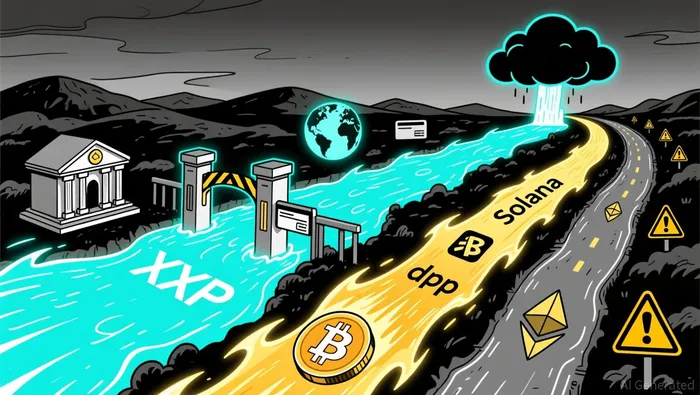
Bitcoin and Ethereum: The Outflow Conundrum
Bitcoin and Ethereum, once the uncontested pillars of institutional crypto portfolios, are now grappling with outflows. Between October 31 and November 14, 2025, US-based spot Bitcoin and Ethereum ETFs lost over $4.2 billion in combined assets under management. This exodus reflects a shift in risk appetite, as investors seek alternatives to the volatility and regulatory uncertainty that still linger around the two largest cryptocurrencies.
Bitcoin's narrative as "digital gold" remains intact, with its 50% compound annual return since 2017 making it a safe haven for conservative investors. However, Ethereum's recent turbulence-marked by a 65% price surge in Q3 2025 amid the GENIUS Act's regulatory clarity-has exposed divergent institutional strategies. While Ethereum's ETFs, like BlackRock's, briefly hit $10 billion in assets, they have since faced redemptions, underscoring the market's cautious approach to its more complex, DeFi-driven ecosystem as noted in market analysis.
The Role of Diversification and Index Funds
Institutional investors are increasingly adopting index-based strategies to mitigate risk. The Bitwise 10 Crypto Index ETFBITW-- (BITW), for instance, includes exposure to XRP and Solana alongside Bitcoin and Ethereum, reflecting a balanced approach to portfolio construction according to market analysis. This trend highlights a broader recognition that over-reliance on Bitcoin and Ethereum may no longer be optimal in a maturing market.
Furthermore, the Crypto Fear & Greed Index hitting "extreme fear" territory in late 2025 has amplified the appeal of altcoins with defensible fundamentals. Prediction markets, which assign only a 23% probability to Bitcoin surpassing $100,000 in 2025, reinforce this sentiment, pushing capital toward assets with clearer growth trajectories as market data indicates.
Conclusion: A New Era of Institutional Allocation
The 2025 ETF rotation underscores a fundamental shift in how institutions evaluate crypto assets. XRP and Solana are winning because they address real-world problems-cross-border payments and scalability-while offering the technical robustness and ecosystem growth that Bitcoin and Ethereum, for all their strengths, cannot yet match.
As regulatory frameworks solidify and tokenization gains traction, the institutional appetite for diversification will likely intensify. For investors, this means a strategic rebalancing: allocating capital to projects that combine utility, innovation, and market readiness. In this evolving landscape, XRP and Solana are not just outperforming-they are redefining the rules of the game.





Comentarios
Aún no hay comentarios