
ETF Regulatory Delays and Their Impact on Altcoin Market Sentiment: Strategic Investment Timing in the Crypto Asset Class
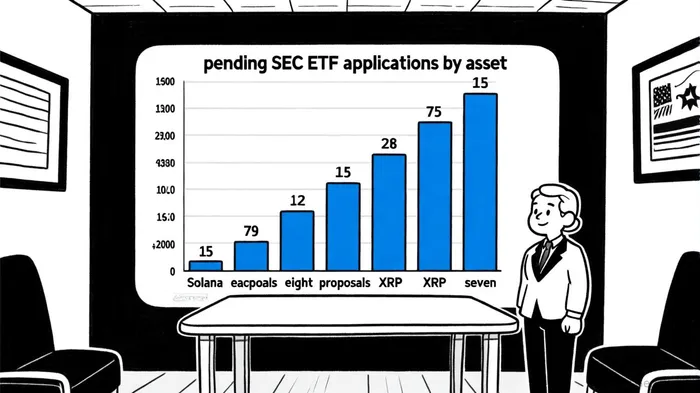
The U.S. Securities and Exchange Commission's (SEC) prolonged review of cryptocurrency ETF applications in 2025 has created a complex landscape for altcoin investors. With over 92 pending applications—including proposals for SolanaSOL-- (SOL), XRPXRP--, and Dogecoin—the agency's synchronized deadlines and methodical approach aim to mitigate market volatility but have introduced uncertainty for market participants[1]. This regulatory limbo has triggered mixed reactions in altcoin markets, with price fluctuations, speculative trading, and strategic shifts in investment timing becoming increasingly pronounced[2].
Regulatory Uncertainty and Market Volatility
The SEC's delays have amplified short-term volatility in altcoins like CardanoADA-- (ADA) and Solana (SOL). For instance, the postponement of Solana ETF decisions until October 16, 2025, coincided with sell-offs and reduced trading volumes across the broader crypto market[2]. Similarly, the delayed approval of the Grayscale HederaHBAR-- ETF and Franklin Templeton's Solana ETF has left investors in a holding pattern, with market analysts estimating a 90% probability of approvals by year-end[1]. This duality—uncertainty paired with anticipation—has created a tug-of-war between risk-averse investors and speculative traders.
The regulatory environment also reflects a broader shift in the SEC's approach. Under Chair Paul Atkins, the agency has signaled openness to crypto innovation while maintaining a cautious stance[1]. This balancing act has led to strategic delays, such as the synchronized November 12–15 deadlines for multiple ETF applications, to avoid a sudden influx of products that could destabilize markets[1].
Strategic Investment Timing in a Regulated Ecosystem
Investors navigating this landscape are adopting agile strategies. For example, the introduction of the Rex-Osprey DOJE ETF—the first U.S. DogecoinDOGE-- ETF—has provided a regulated avenue for exposure to meme coins, despite risks like tracking errors and price manipulation[2]. Meanwhile, institutional investors are increasingly prioritizing altcoins with strong fundamentals, such as Cardano's research-driven development and Solana's scalability upgrades[2].
Historical data from EthereumETH-- ETF approvals in 2024–2025 offers a blueprint for altcoin adoption. Ethereum ETFs recorded $2.9 billion in net inflows in July 2025, driven by in-kind redemption mechanisms that improved liquidity and reduced operational costs[3]. This trend suggests that altcoin ETFs, if approved, could attract billions in institutional capital, particularly for platforms like Solana, which has already secured $1.72 billion in institutional inflows in Q3 2025[3].
The Path Forward: Compliance and Institutional Adoption
Crypto companies and fintech startups are aligning with evolving SEC guidelines to reduce uncertainty. For example, Solana's technical upgrades—such as Alpenglow and Firedancer—have enhanced its throughput to 65,000 TPS, making it an attractive candidate for institutional adoption[3]. Similarly, Cardano's pending ETF application, with a 62% approval probability on Polymarket, is viewed as a binary catalyst that could unlock significant capital if approved[3].
For small and medium-sized enterprises (SMEs), the potential approval of altcoin ETFs may encourage the adoption of stablecoin treasury management, particularly on high-throughput blockchains like Solana[2]. This shift underscores the importance of regulatory clarity in bridging the gapGAP-- between crypto innovation and mainstream finance.
Conclusion
The SEC's regulatory delays have created a dual-edged sword for altcoin markets: while uncertainty dampens short-term confidence, the anticipation of approvals is fostering strategic investment timing and institutional interest. Investors must balance agility with caution, leveraging historical trends from Ethereum ETFs and aligning with projects that demonstrate regulatory compliance and technological resilience. As the SEC's synchronized deadlines approach, the coming months will likely determine whether altcoin ETFs become a cornerstone of institutional crypto portfolios.






Comentarios
Aún no hay comentarios