
ETF Outflows and the Rise of Blockchain Tokens: A New Era for Capital Efficiency in Alternative Assets
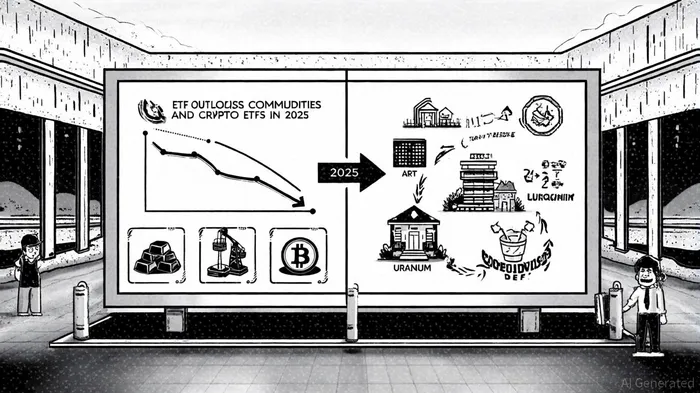
The investment landscape in 2025 is marked by a seismic shift in capital allocation, as ETF outflows in alternative assets reveal a growing appetite for blockchain-based tokens. This divergence underscores a broader structural realignment in how investors seek capital efficiency, innovation, and risk diversification.
ETF Outflows: A Signal of Shifting Preferences
The third quarter of 2025 has seen pronounced outflows from traditional alternative asset ETFs. Commodities ETFs, for instance, faced a $1.8 billion net outflow in May alone, with precious metals ETFs accounting for the lion's share at -$1.3 billion [1]. Similarly, crypto ETFs experienced a sharp correction in September, with EthereumETH-- ETFs recording $76 million in outflows and BitcoinBTC-- ETFs losing $227 million in a single day [2]. These trends reflect investor caution amid macroeconomic uncertainty and a reevaluation of risk-return profiles in volatile markets.
Meanwhile, the broader ETF market has seen a migration toward active strategies, particularly in fixed-income and liquid alternatives. Digital assets, derivative income strategies, and defined-outcome funds attracted $43 billion, $34 billion, and $10 billion respectively in 2024, driven by regulatory tailwinds and demand for customized volatility management [3]. Yet, the outflows in non-core segments highlight a critical question: Can traditional ETFs keep pace with the innovation offered by blockchain-based tokens?
Blockchain Tokens: Structural Advantages in Capital Efficiency
Blockchain tokens are redefining the parameters of capital efficiency and innovation. Unlike ETFs, which operate within centralized, regulated frameworks, tokenized assets leverage decentralized infrastructure to enable 24/7 trading, programmability, and seamless integration with DeFi ecosystems. For example, platforms like Backed Finance tokenize real-world equities, allowing investors to trade fractional ownership on decentralized exchanges and collateralize assets in DeFi protocols—a level of composability that ETFs cannot replicate [4].
Tokenized ETFs, such as BlackRock's BUIDL, further bridge the gap between traditional and decentralized finance. By tokenizing a money market fund, BUIDL offers instant settlement, reduced fees, and global accessibility while retaining the institutional safeguards of a traditional fund [5]. This hybrid model addresses a key limitation of pure blockchain tokens—regulatory ambiguity—while harnessing the speed and flexibility of blockchain technology.
Innovation in Alternative Assets: Real Estate, Art, and Uranium
The tokenization of non-traditional assets is particularly transformative. Tokenized real estate, for instance, enables fractional ownership in high-value properties, slashing entry barriers and enhancing liquidity. Unlike real estate ETFs, which rely on periodic disclosures and limited trading hours, tokenized real estate offers real-time transparency and 24/7 liquidity through smart contracts [6]. By 2030, the tokenized real estate market is projected to reach $3 trillion, driven by demand from high-net-worth and institutional investors [6].
Similarly, tokenized art and uranium assets are unlocking new avenues for diversification. Platforms like Ondo Finance and Superstate have demonstrated how tokenization can streamline settlement and increase liquidity in previously illiquid markets [7]. These innovations are not merely incremental; they represent a paradigm shift in how capital is allocated and managed.
Market Trends and the Great Convergence
The structural advantages of blockchain tokens are gaining traction as global AUM in asset management approaches $147 trillion by mid-2025 [3]. McKinsey predicts that tokenized financial assets could reach $2 trillion by 2030, mirroring the disruptive impact of ETFs in the 1990s [8]. This “great convergence” between traditional and alternative asset management is accelerating as investors seek differentiated returns in a fragmented market.
However, challenges remain. Regulatory uncertainty, technical complexity, and liquidity risks in secondary markets for tokens persist [7]. ETFs, with their established frameworks and tax efficiencies, continue to offer stability and broad adoption. Yet, the agility and innovation of blockchain tokens are increasingly difficult to ignore.
Conclusion: The Future of Capital Efficiency
ETF outflows in alternative assets signal a maturing market where investors are no longer content with passive diversification. Blockchain tokens, with their capacity for programmability, DeFi integration, and fractional ownership, are emerging as a compelling alternative. While ETFs retain their role in institutional finance, the rise of tokenized assets suggests a future where capital efficiency is no longer constrained by legacy systems.
As the $6–$10.5 trillion “money in motion” over the next five years reshapes the asset management landscape, the choice between ETFs and blockchain tokens will hinge on a delicate balance of innovation, regulation, and investor trust.





Comentarios
Aún no hay comentarios