
ETF Market Concentration and Systemic Risk: Navigating the Diversification Dilemma in 2025
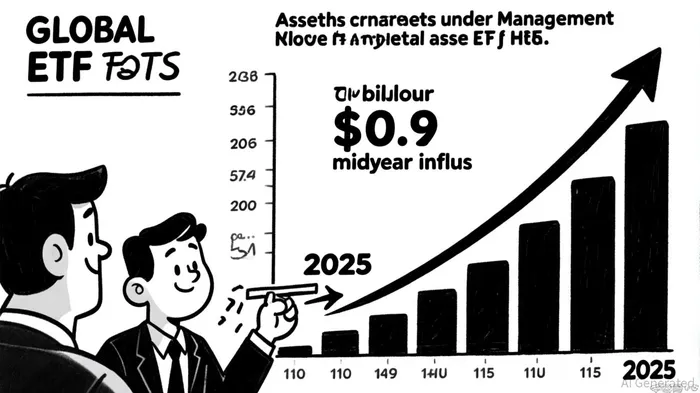
The explosive growth of exchange-traded funds (ETFs) has reshaped global capital markets, with midyear 2025 flows surpassing $0.9 trillion—a 25% increase from the midpoint of 2024 [2]. While this expansion reflects the allure of liquidity, low costs, and diversification, it has also amplified concerns about market concentration and systemic risk. As equity ETFs increasingly channel capital into a narrow subset of large-cap U.S. stocks—particularly in the technology sector—the financial system's vulnerability to shocks is rising.
The Rise of ETFs and the Concentration Conundrum
The ETF industry's trajectory is nothing short of meteoric. By 2025, global ETF assets are projected to reach $25 trillion by 2030, driven by innovations like active ETFs, buffer ETFs, and digital assetDAAQ-- ETPs [3]. However, this growth has coincided with a troubling trend: the overconcentration of capital in market-cap-weighted indices. For instance, the top 10 stocks in the S&P 500 now account for nearly 30% of its total market value, a figure that has surged since 2020 [2]. Passive ETFs, which track these indices, effectively amplify this concentration by mechanically allocating inflows to the same dominant names.
Academic research underscores the risks. A 2025 study in Finance Research Letters found that algorithm-driven trading in equity ETFs can exacerbate stock price crashes by encouraging herding behavior during market stress [1]. Similarly, a July 2025 analysis highlighted how market-cap-weighted ETFs create outsized exposure to a handful of tech stocks, undermining diversification and increasing portfolio volatility [2]. This dynamic is further compounded by the rise of retail investors, who have flocked to ETFs in record numbers, often favoring high-profile names.
Systemic Vulnerabilities and the Passive Investing Paradox
The concentration risks extend beyond individual portfolios. Passive investing's dominance has inflated stock prices relative to fundamentals, reducing expected returns for investors and distorting market signals [2]. As Vanguard's research notes, this “price inflation” can erode the informativeness of stock prices, making markets less efficient and more prone to abrupt corrections [1].
Moreover, the structural concentration of ETFs creates a feedback loop. When a large portion of capital is tied to a few stocks, any sell-off in those names can trigger cascading liquidity pressures. For example, a sudden decline in a major tech stock could force ETFs to rapidly liquidate holdings, exacerbating the downturn. This mechanism was observed during the 2022 market selloff and could become more pronounced as ETF assets grow.
Diversification Strategies in a Concentrated World
To mitigate these risks, investors must rethink diversification. Vanguard advocates shifting allocations to small- and mid-cap stocks and international equities, which are less crowded and offer more balanced exposure [1]. Active ETFs, which have gained traction in 2025, also present an alternative by allowing managers to avoid overexposure to dominant sectors [3]. Deloitte highlights that active ETFs now account for 15% of new ETF launches, driven by demand for strategies that adapt to market shifts [3].
Another approach is to leverage alternative asset classes, such as fixed income or real assets, which have seen robust ETF inflows in 2025 [2]. These sectors are less correlated with equity markets and can provide a buffer during downturns. Additionally, investors should scrutinize ETF holdings for hidden concentration. For instance, some “diversified” ETFs may still have significant exposure to a single sector due to index construction rules.
Regulatory and Market Considerations
Despite the growing risks, regulatory oversight has lagged. The 2025 FINRA Annual Regulatory Oversight Report focuses on third-party risk management and extended hours trading but omits ETF concentration [1]. Meanwhile, the CFA Institute's Systemic Risk Council warns that non-bank financial intermediaries—including ETF providers—are contributing to elevated systemic risks, alongside geopolitical uncertainties and relaxed capital standards for banks [1].
Conclusion
The ETF boom has democratized access to global markets but at the cost of heightened concentration risks. As investors, the challenge lies in balancing the benefits of ETFs with strategies to counteract their systemic vulnerabilities. Diversification is no longer a one-size-fits-all solution; it requires active management, alternative allocations, and a critical eye toward index construction. In a world where a handful of stocks can sway trillions of dollars in assets, the stakes for thoughtful investing have never been higher.







Comentarios
Aún no hay comentarios