
ETF Flows and Market Sentiment: A Strategic Indicator for 2025 Investors
In 2025, exchange-traded funds (ETFs) have emerged as both a mirror and a magnifier of global market sentiment. With record inflows exceeding $1 trillion year-to-date, ETF flows are no longer just a byproduct of investor behavior—they are a leading indicator of where capital is shifting in response to macroeconomic uncertainty, geopolitical tensions, and evolving risk appetites. For investors, real-time analysis of these flows offers a strategic lens to anticipate short-term market direction and optimize asset allocation.
The 2025 ETF Flow Landscape: A Tale of Two Sectors
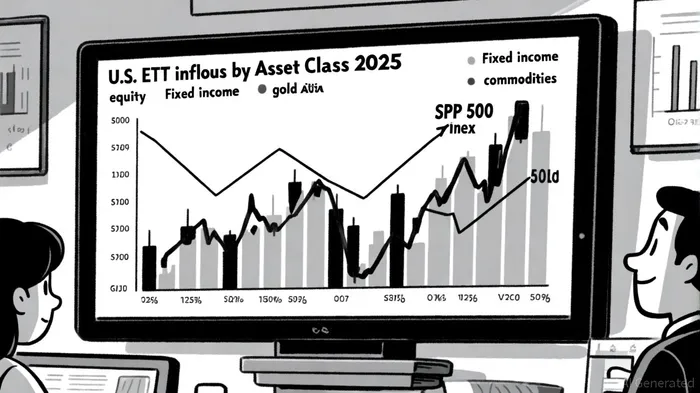
According to a report by Fidelity Institutional, U.S. equity ETFs have attracted $371 billion in net inflows year-to-date through Q3 2025, with technology and financials sectors dominating the narrative[1]. However, this trend has been far from uniform. While tech ETFs have seen cumulative inflows of $2.16 billion over three months[4], sectors like energy and materials have faced outflows of $1.64 billion and $2.67 billion, respectively[4]. This divergence underscores a broader shift in investor sentiment: a flight toward innovation and yield, paired with caution in cyclical and commodity-dependent industries.
Fixed-income ETFs, meanwhile, have become a haven for capital seeking stability. Data from Morningstar Direct reveals that taxable-bond funds experienced their largest monthly inflow since April 2021 in August 2025, with ultrashort bond ETFs and intermediate core categories leading the charge[2]. This aligns with a defensive positioning by investors amid uncertainty around Federal Reserve policy and bond yield volatility. Notably, gold ETFs have also drawn $6.23 billion in March and $3.7 billion in April 2025[5], reflecting a renewed appetite for safe-haven assets as inflationary pressures persist.
Market Sentiment: The Invisible Hand Behind ETF Flows
The interplay between investor psychology and capital allocation has never been more pronounced. A study published in ScienceDirect highlights a positive correlation between social media-driven sentiment and stock price indices like the CSI 300, with lagged effects amplifying during bullish phases[3]. In 2025, this dynamic has manifested in real-time: for instance, defensive positioning in real estate and consumer staples ETFs in September 2024 preceded a broader market correction, while outflows from tech and financials in Q2 signaled profit-taking amid AI-driven euphoria[5].
Geopolitical tensions, such as U.S. tariffs on Canadian exports, have further amplified sentiment-driven flows. As noted by Mackenzie Investments, investors have increasingly favored low-volatility and dividend-paying ETFs during periods of uncertainty[1]. This trend is echoed in the rise of active ETFs, which now account for 37% of total ETF flows in 2025[4]. J.P. Morgan Asset Management projects that active fixed-income ETFs could represent 30% of the market by 2030, driven by their flexibility in navigating yield-challenged environments[4].
Strategic Asset Allocation: Leveraging Real-Time Data
For investors, the key lies in translating these flows into actionable strategies. Modern Portfolio Theory (MPT) remains a cornerstone, but 2025's environment demands agility. A case in point: the traditional 60/40 equity-bond allocation has been reimagined, with many portfolios tilting toward ultrashort-duration bonds and commodities to hedge against inflation. As BlackRockBLK-- notes, the negative correlation between stocks and bonds has weakened, prompting investors to explore alternatives like gold, BitcoinBTC-- ETFs, and liquid alternatives[4].
Real-time data tools, such as ETF.com's Fund Flows Tool, enable investors to track inflows into specific ETFs like the Vanguard S&P 500 ETF (VOO), which saw $2.02 billion in inflows on September 3, 2025[2], versus the SPDR S&P 500 ETF Trust (SPY), which experienced $3.75 billion in outflows on the same day[2]. Such granular insights allow for tactical rebalancing, particularly in volatile sectors. For example, the industrials sector's $407 million inflow in late September 2025[4] suggests renewed confidence in infrastructure and manufacturing, while energy's $1.64 billion outflow signals caution in energy transition narratives.
The Road Ahead: Navigating Uncertainty with ETF Flows
As 2025 enters its final quarter, the strategic value of ETF flows lies in their ability to synthesize macroeconomic signals and investor sentiment. For instance, the surge in gold ETF inflows and the resilience of active fixed-income strategies highlight a market prioritizing safety and yield over growth. Meanwhile, the rise of AI-driven ETFs and Bitcoin exposure reflects a parallel appetite for innovation.
Investors must remain vigilant, however. The rapid shifts in flows—such as the $9.55 billion net inflow on September 3, 2025[2], versus the $624.54 million outflow from digital asset ETFs[1]—underscore the importance of diversification and periodic rebalancing. By integrating real-time ETF flow data with sentiment analysis, investors can not only gauge short-term market direction but also position portfolios to capitalize on emerging opportunities.
In the end, ETF flows are more than numbers—they are a language of the market. Those who learn to read it will find themselves ahead of the curve.







Comentarios
Aún no hay comentarios