
ETF Closure Risk: How Investors Can Proactively Mitigate Portfolio Vulnerability
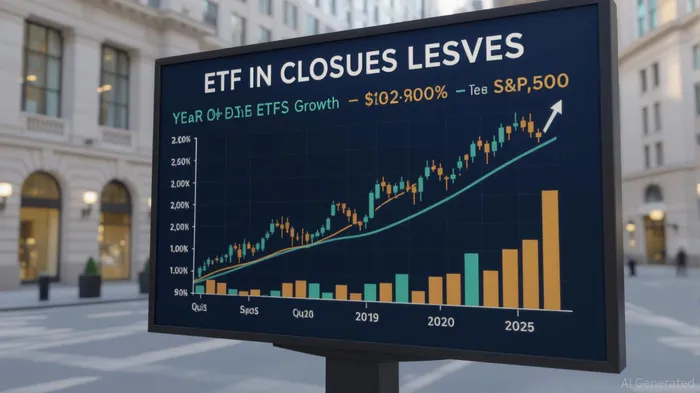
The ETF industry is undergoing a period of rapid transformation. While the global market has seen the launch of 1,308 new funds in the first half of 2025, the same period witnessed the closure of 266 ETFs—a trend that accelerated sharply in Q2, with 61 liquidations in just three months [2]. June alone marked the busiest month for closures in 2025, with 27 funds shuttered. This volatility reflects broader macroeconomic and political uncertainties, but it also underscores a critical question for investors: How can one navigate the growing risk of ETF closures while maintaining portfolio resilience?
The Forces Behind the Surge in Closures
The spike in ETF closures is not a random occurrence. It is driven by a confluence of factors:
- Market Volatility: The S&P 500 has experienced intraday fluctuations and drawdowns reminiscent of the 2008 financial crisis and 2020 pandemic sell-offs [1]. Such turbulence has eroded investor confidence in niche or leveraged products, leading to outflows that make these funds unsustainable.
- Regulatory and Political Uncertainty: The Trump administration's challenges to Federal Reserve autonomy and potential trade policy shifts have heightened macroeconomic risks, pushing investors toward safer assets [3].
- Sector-Specific Pressures: Clean energy, tech, and commodities ETFs—often tied to speculative trends—have been disproportionately affected. Funds with low assets under management (AUM) and high expense ratios struggle to survive in a zero-sum environment [2].
Strategic ETF Selection: A Framework for Mitigating Closure Risk
To avoid exposure to vulnerable ETFs, investors must adopt a disciplined approach. Four key criteria stand out:
1. Prioritize Funds with Substantial AUM
Funds with low AUM are inherently more prone to closure. Schwab's analysis highlights that ETFs with significant assets are less likely to liquidate due to profitability constraints [4]. For example, equity-focused active ETFs have surged in popularity, with U.S. active ETF AUM nearing $1 trillion as of February 2025 [2]. Investors should set AUM thresholds—such as $500 million or higher—to filter out underperforming products.
2. Evaluate Fund Lifespan and Track Record
Morningstar data reveals that the average age of closed ETFs in 2023 was 5.4 years [4]. Newer funds, particularly those launched during speculative booms, face higher risks of early failure. Investors should favor ETFs with a proven track record of at least five years, especially in volatile sectors like leveraged loans or commodities.
3. Avoid Leveraged and Inverse Products
Leveraged and inverse ETFs are structurally fragile. These products often rely on complex derivatives that decay over time due to compounding effects, leading to persistent underperformance [4]. For instance, leveraged loan activity has stalled in 2025, reflecting investor caution [1]. Short-term traders may still use these funds, but long-term holders face elevated closure risks.
4. Favor Low-Volatility Strategies
ETFs with less-volatile strategies—such as those tracking broad market indices or defensive sectors—tend to attract consistent inflows. This stability reduces the likelihood of closure. The recent outperformance of gold and silver ETFs, up 31.38% year-to-date, illustrates how safe-haven assets can thrive amid uncertainty [3].
Risk Management: Beyond Selection
Strategic selection alone is insufficient. Investors must also implement proactive risk management practices:
- Liquidity Metrics: Liquid ETFs with high trading volumes are less susceptible to closure. Schwab notes that liquidity directly impacts fee structures and short-term inflows [4]. Tools like bid-ask spreads and average daily volume should be scrutinized.
- Provider Stability: ETFs from established providers with robust balance sheets are preferable. For example, U.S. open-end funds often maintain credit lines to manage liquidity stress, a practice that indirectly signals provider resilience [3].
- Diversification: Overconcentration in niche ETFs—such as those focused on single commodities or leveraged sectors—increases vulnerability. A diversified portfolio spreads risk across asset classes and strategies.
Conclusion
ETF closures are not an anomaly but a symptom of a market grappling with volatility, regulatory shifts, and investor behavior. While the global ETF market continues to expand, the risk of liquidation demands a strategic, data-driven approach. By prioritizing AUM, fund age, and low-volatility strategies—and by rigorously managing liquidity and provider risk—investors can shield their portfolios from the turbulence of 2025 and beyond.







Comentarios
Aún no hay comentarios