
The Escalating Tariff Surge and Its Impact on Global Supply Chains
The U.S. Tariff Strategy: From Retaliation to Resilience
The U.S. has moved beyond traditional trade remedies, using tariffs to engineer long-term industrial shifts. A 100% tariff on Chinese rare earths, for instance, has forced companies like Renault to pivot to cheaper Chinese suppliers for rare-earth-free motors, despite China's dominance in 70% of global mining and 85% of refining, according to a Yahoo Finance report. Similarly, a 50% copper tariff has disrupted manufacturing sectors, though some firms-like Sony-have mitigated impacts through diversified operations, raising profit forecasts by 8% in 2026, as reported by Marketscreener and The Star.
The U.S. is also targeting its closest ally, Canada, with an additional 10% tariff on top of existing 35% levies, signaling a broader strategy to prioritize domestic production. This aligns with incentives like the five-year "import-adjustment offset," which rewards U.S. truck manufacturers for assembling goods domestically, as noted in a Reuters report.
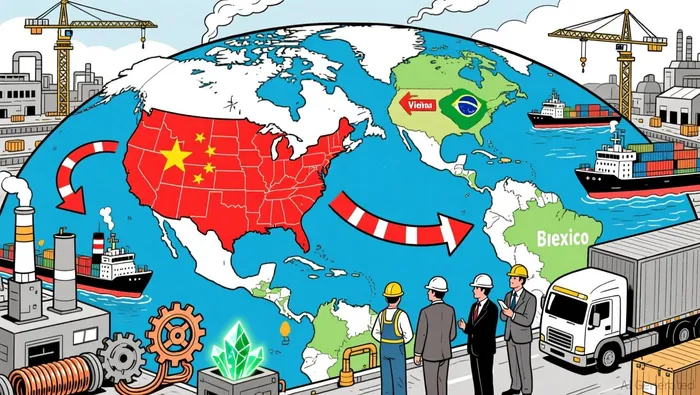
Corporate Responses: Diversification, Nearshoring, and Tech Adoption
Multinational corporations are recalibrating their strategies to survive the tariff storm. Apple, for example, has shifted 15–20% of production to India and Vietnam, though bottlenecks in Vietnam have increased lead times by 10%, according to a Supply Chain Brain article. Ford has similarly nearshored production to Mexico, adding $500–$1,000 to the cost of each U.S.-assembled vehicle, as the same article notes.
In the energy sector, the U.S. is investing $465 million in Brazil's Serra Verde rare earths project, aiming to secure 5% of global demand by 2027. This move counters China's refining monopoly and supports clean energy and defense sectors, according to a DiscoveryAlert report. Meanwhile, Canadian aerospace firm StandardAero is expanding its Winnipeg MRO facility, betting on long-term supply chain stability, as noted in a Seeking Alpha article.
Country Adjustments: Canada's Infrastructure Push and Vietnam's Tech Pivot
Canada is countering U.S. tariffs with infrastructure upgrades. StandardAero's $1B annual revenue target for LEAP engines reflects confidence in its supply chain resilience, as the Seeking Alpha article notes. Similarly, Vietnam has become a tech manufacturing hub, with Apple and Samsung relocating parts of production to avoid U.S. tariffs on Chinese components, according to a Verget Products article.
China, meanwhile, has weaponized its rare earths dominance, imposing export controls to push U.S. firms toward domestic alternatives like MP Materials and General Motors' U.S. partnerships, as reported by Forbes. These moves highlight how countries are leveraging technology and geopolitical leverage to reshape supply chains.
Strategic Implications for Investors
For investors, the tariff surge creates both risks and opportunities. Sectors like rare earths and copper face volatility, but companies investing in supply chain resilience-such as those adopting AI-driven logistics software or diversifying suppliers-stand to outperform. The global supply chain management software market, projected to reach $22.9 billion by 2030, is a prime example, as noted in a Yahoo Finance report.
Investors should also watch firms like SonySONY--, which has navigated tariffs through diversified operations, and Renault, which is pivoting to cost-effective suppliers. Additionally, countries like Brazil and Vietnam offer exposure to emerging supply chain hubs.
Conclusion
The U.S. tariff surge is more than a trade policy-it's a catalyst for a new era of supply chain strategy. As companies and countries adapt, the winners will be those that embrace diversification, technology, and geopolitical agility. For investors, the key is to identify firms and regions positioned to thrive in this reshaped world.







Comentarios
Aún no hay comentarios