
Escalating U.S. Sanctions Enforcement: Implications for Real Estate and Private Equity Investments
The U.S. Department of the Treasury's Office of Foreign Assets Control () has intensified its scrutiny of cross-border real estate and private equity transactions in 2025, imposing record penalties on firms and individuals found to have violated sanctions targeting Russia, Iran, and other sanctioned jurisdictions. Recent enforcement actions underscore a clear trend: OFAC is prioritizing strict liability for sanctions violations, with no leniency for claims of ignorance or reliance on external legal advice. For investors and gatekeepers in high-value, cross-border transactions, the stakes have never been higher.
A New Era of Enforcement
In early 2025, OFAC penalized Family International Realty LLC $1.076 million for facilitating the transfer of luxury condominiums from sanctioned to their non-sanctioned family members and shell companies. The case highlights how real estate transactions can be weaponized to evade sanctions, with OFAC emphasizing that "gatekeepers" like real estate agents and private equity managers bear responsibility for due diligence failures according to OFAC's guidance. Similarly, IPI Partners, LLC, a Chicago-based private equity firm, agreed to pay $11.485 million for managing a $50 million investment linked to Russian oligarch , who was designated under U.S. sanctions in 2018. OFAC noted the firm's "egregious" failure to conduct adequate due diligence, despite repeated public warnings about Kerimov's blocked status as reported in enforcement updates.
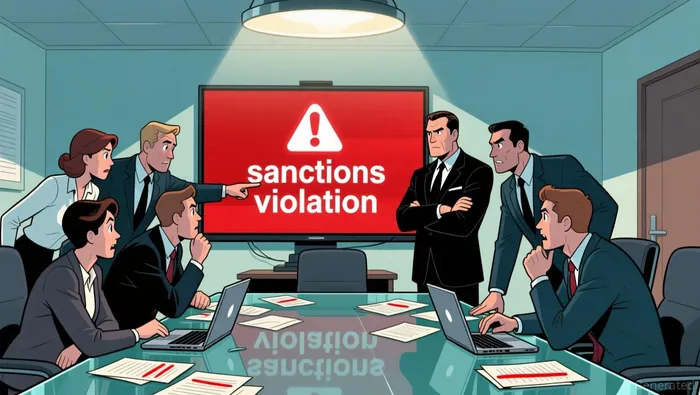 The agency's enforcement focus has only sharpened in late 2025. A San Francisco-based firm settled for $11.4 million over alleged Russia-related violations, while an individual for renovating real estate owned by a sanctioned Russian individual. These cases reflect OFAC's growing willingness to target both corporate actors and individual investors, with penalties reaching statutory maximums in egregious cases as highlighted in recent enforcement summaries.
Compliance Risks in High-Value Transactions
Cross-border real estate and private equity investments are particularly vulnerable to sanctions risks due to their complexity and the opacity of ownership structures. OFAC's 2025 enforcement actions reveal recurring compliance gaps:
1. Overreliance on External Legal Advice: In the IPI Partners case, the firm claimed it relied on external counsel for sanctions compliance, but OFAC rejected this defense, stating that "due diligence cannot be outsourced" according to OFAC's 2025 guidance.
2. Failure to Screen Indirect Ownership: The 50% Rule, which blocks U.S. persons with 50% or more ownership in a non-U.S. entity linked to sanctioned parties, has become a focal point. For example, OFAC penalized GVA Capital, Ltd. for managing investments tied to a sanctioned Russian oligarch, emphasizing that indirect ownership triggers liability.
3. Neglecting Post-Acquisition Monitoring: OFAC has criticized firms for failing to reassess compliance risks after transactions close. The November 2025 case against a San Francisco firm, for instance, involved ongoing violations four years after the initial investment.
Best Practices for Due Diligence
To mitigate risks, industry experts and regulators recommend a multi-layered compliance strategy:
- : OFAC has stressed that compliance must be embedded in transaction planning, not an afterthought. This includes screening all parties against the SDN List, assessing indirect ownership, and evaluating the risk profile of target jurisdictions according to Morgan Lewis analysis.
- Board Oversight and Documentation: Firms should ensure board-level review of compliance risks, with documented responses to red flags. OFAC's 2025 guidance highlights the importance of "proactive oversight" in private equity transactions as emphasized in compliance reports.
- : While OFAC penalizes egregious violations harshly, it offers credit for voluntary disclosures. For example, Unicat Catalyst Technologies, LLC received a reduced penalty after self-disclosing Iran and Venezuela sanctions violations.
- AML and KYC Alignment: Cross-border transactions must align with anti-money laundering (AML) and know-your-customer (KYC) standards, particularly under the EU's 6th Anti-Money Laundering Directive (6AMLD) and the SEC's 2026 examination priorities as outlined in industry compliance updates.
The Road Ahead
As geopolitical tensions persist, OFAC's enforcement agenda is likely to expand. The SEC's proposed reforms to foreign private issuer rules and the EU's Travel Rule mandates further complicate compliance for cross-border investors as noted in legal analysis. For real estate and private equity firms, the message is clear: robust due diligence is not just a regulatory requirement but a strategic imperative.
In this environment, firms that proactively adapt to evolving sanctions frameworks-by investing in compliance technology, training gatekeepers, and fostering a culture of accountability-will gain a competitive edge. Conversely, those that treat compliance as a checkbox risk facing the same penalties as IPI Partners or GVA Capital: financial ruin and reputational damage in an era where OFAC's scrutiny shows no signs of abating.







Comentarios
Aún no hay comentarios