
The Escalating US Insurance Affordability Crisis: A Systemic Risk to Household and Market Stability
The U.S. insurance affordability crisis has reached a critical inflection point, with rising premiums, coverage gaps, and policy shifts threatening to destabilize both households and the broader economy. By 2026, ACA marketplace users face average premium hikes of up to 59% due to the expiration of enhanced tax credits, while the One Big Beautiful Bill Act (OBBBA) of 2025 is projected to leave 16 million Americans uninsured by 2034. These trends are exacerbating financial strain, with four in ten adults already burdened by healthcare debt, disproportionately affecting Black, Hispanic, and low-income populations according to KFF data. For investors, this crisis represents not just a moral imperative but a systemic risk to market stability-and a unique opportunity to channel capital into innovative solutions.
The Systemic Risks of a Fractured Insurance Landscape
The OBBBA's Medicaid work requirements and ACA Marketplace restrictions are accelerating the unraveling of coverage. The Congressional Budget Office estimates that the law will increase the uninsured rate by 3 percentage points or more in 20 states, with Louisiana, Florida, and Arizona facing the largest jumps. California alone could see 1.7 million additional uninsured residents by 2034. These shifts are compounding existing vulnerabilities: rural populations, for instance, face premium increases of 90% or more, while urban areas grapple with rising deductibles and narrow provider networks according to health research.
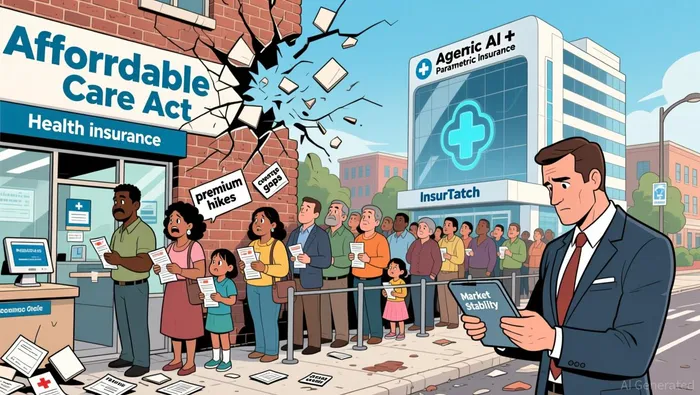
The economic fallout is already evident. Families are forced to choose between health insurance and essentials like rent and food according to Johns Hopkins public health research, while healthcare providers face revenue volatility as patients delay care. For the broader economy, the CBO warns that these trends could reduce GDP growth by 0.3% annually through 2034.
The Role of InsurTech and Alternative Risk-Transfer Solutions
Amid this crisis, InsurTech and alternative risk-transfer solutions are emerging as critical tools to restore affordability and resilience. Two innovations stand out: agentic AI systems and parametric insurance.
Agentic AI systems are revolutionizing insurance operations by automating underwriting, claims processing, and customer service. These systems leverage predictive analytics to refine risk assessment, enabling more precise pricing and reducing administrative costs. For example, AI-driven fraud detection has cut fraudulent claims by 20% in some markets, while chatbots and virtual assistants are improving customer retention by 15%.
Parametric insurance, meanwhile, offers a paradigm shift in risk management. By paying out based on predefined triggers-such as rainfall levels or wind speeds-this model bypasses traditional claims processes, delivering rapid, transparent payouts according to industry analysis. For high-risk sectors like agriculture and coastal real estate, parametric insurance is proving to be both scalable and cost-effective. In 2024, Arbol's parametric structures issued $10 million in payouts to Centauri Insurance within three weeks of Hurricane Ian, a speed unmatched by traditional insurers. Similarly, IBISA's satellite-based microinsurance for small farmers in India and sub-Saharan Africa has reduced administrative costs by 40% while ensuring payouts within days of crop-damaging weather events.
Case Studies and Investment Trends
The financial viability of these solutions is underscored by robust investment trends. U.S. InsurTech funding reached $1.1 billion quarterly in 2025, with AI capturing 74.8% of all insurtech capital. Startups like Arbol and IBISA have attracted significant backing: Arbol raised $60 million in Series B funding to scale its hurricane insurance offerings, while IBISA secured $3 million to expand climate microinsurance in Asia and Africa.
Parametric insurance's market potential is equally compelling. The sector is projected to grow from $11.32 billion in 2025 to $18.56 billion by 2029, driven by smart contracts and blockchain technology. In the U.S., New York's 2025 parametric insurance law has already spurred adoption, recognizing these products as authorized personal line coverage.
Strategic Investment Opportunities
For investors, the path forward lies in targeting InsurTechs and alternative risk-transfer platforms that address both affordability and systemic risk. Key opportunities include:
1. AI-Driven Platforms: Companies leveraging agentic AI for underwriting and fraud detection, such as Cytora and DigitalOwl, which were recently acquired for their operational efficiency according to market analysis.
2. Parametric InsurTechs: Startups like Arbol and IBISA, which are scaling solutions for climate-related and systemic risks.
3. Alternative Capital Models: Catastrophe bonds and insurance-linked securities, which are gaining traction as insurers seek to hedge against volatility according to Deloitte industry outlook.
The U.S. InsurTech market, valued at $11.7 billion in 2025, is projected to grow at a 26.2% CAGR, reaching $95 billion by 2034 according to market research. This growth is fueled by collaboration between traditional insurers and agile startups, as well as regulatory shifts like New York's parametric insurance law according to industry analysis.
Conclusion
The U.S. insurance affordability crisis is a ticking time bomb for household and market stability. Yet, it also presents a golden opportunity for investors to deploy capital in solutions that are not only financially sound but socially transformative. By prioritizing InsurTech and alternative risk-transfer innovations, investors can help rebuild a system that is resilient, equitable, and capable of weathering the storms ahead.







Comentarios
Aún no hay comentarios