
The Escalating Impact of U.S. Tariffs on Global Supply Chains and Inflation in 2026
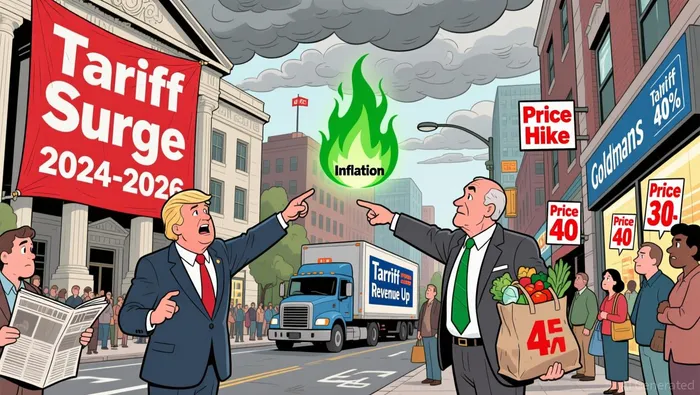
The U.S. tariff landscape in 2026 has reached a critical inflection point, with average applied rates surging to 15.8% by year-end 2025 and effective rates for consumers estimated at 16.8%-the highest in at least 80 years. This divergence between announced and effective rates, coupled with a 200% year-over-year increase in tariff revenue to $187 billion in 2025, signals a structural shift in global trade dynamics. As businesses delay passing costs to consumers in 2025 through inventory stockpiling, the inflationary pressures are now crystallizing in 2026, with Goldman Sachs projecting a 0.3 percentage point rise in inflation by midyear. For investors, the imperative is clear: reallocate capital to tariff-resistant sectors and prioritize supply chain resilience to mitigate risks in an increasingly fragmented trade environment.
Tariff Divergence and Inflationary Pressures
The Trump administration's broad-based tariff regime has created a stark gap between announced and effective rates. While the average applied rate stabilized near 15% in 2026, the effective rate-accounting for substitution effects and sectoral impacts-remains higher. The Yale Budget Lab estimates the effective rate at 17.9%, the highest since 1934, while the Tax Policy Center projects a 17% average tariff rate. This divergence reflects the complexity of global supply chains, where businesses initially absorbed 80% of tariff costs in 2025 but are now shifting 80% of these costs to consumers in 2026.
The inflationary consequences are accelerating. As stockpiled inventories deplete, businesses face thin profit margins-particularly in sectors like groceries-that limit their ability to absorb costs. The Tax Foundation estimates households will bear a $1,400 burden per unit in 2026, while the Tax Policy Center projects a $2,100 burden. These pressures are compounded by foreign retaliatory measures, which could reduce U.S. GDP by 0.7% in the long run.
Strategic Sector Reallocation: Tariff-Resistant Opportunities
Amid this volatility, certain sectors exhibit resilience to tariff shocks. J.P. Morgan highlights infrastructure, energy, and defense as key areas for investment, driven by AI-driven capital expenditures and geopolitical imperatives. The firm forecasts that nearly half of the S&P 500's weight will be tied to AI-related sectors in 2026, underscoring the role of technology in offsetting trade frictions.
Paweł Skrzypczyński of the Harvard Pricing Lab emphasizes the need for productivity-driven strategies to counteract tariff-driven market destabilization. His analysis suggests that sectors with high domestic input shares-such as manufacturing-will outperform, as they face lower exposure to import tariffs. Conversely, industries like apparel, electronics, and automotive-where tariffs have triggered 40% short-term price spikes-require hedging through regionalized supply chains.
The Yale Budget Lab further identifies energy security and AI adoption as critical for long-term resilience. Sectors like data centers and renewable energy infrastructure are poised to benefit from U.S. policy tailwinds, including the Inflation Reduction Act and defense spending increases.
Supply Chain Resilience: Mitigating Risk in a Fragmented World
The Harvard Pricing Lab's 2026 Global Trade Report underscores that 72% of trade professionals view U.S. tariff volatility as the top regulatory risk. To address this, companies are adopting three key strategies:
1. Regionalization: Shifting production closer to end markets to reduce exposure to cross-border tariffs.
2. Technology Adoption: Leveraging AI and blockchain for predictive analytics and compliance optimization.
3. Shorter Planning Horizons: Prioritizing flexibility over long-term commitments in volatile tariff environments.
J.P. Morgan recommends diversifying into alternative assets and emerging markets to hedge against trade tensions, while the Yale Budget Lab advises stress-testing suppliers for financial viability. For investors, this translates to overweighting sectors with embedded resilience-such as AI-driven logistics and domestic manufacturing-and underweighting import-dependent industries like textiles and automotive.
Legal Uncertainty and the Path Forward
The Supreme Court's pending decision on the legality of IEEPA tariffs introduces short-term uncertainty. If invalidated, the administration could invoke Section 122 to maintain 15% tariffs for 150 days, mitigating abrupt rate reductions. However, long-term investors should focus on structural trends: tariffs are here to stay, and their economic impact will deepen as global supply chains reconfigure.
Conclusion
The 2026 tariff environment demands a dual focus on sector reallocation and supply chain agility. By prioritizing tariff-resistant sectors like infrastructure, energy, and AI-driven manufacturing, and adopting regionalized, technology-enabled supply chains, investors can navigate inflationary pressures and geopolitical fragmentation. As Paweł Skrzypczyński notes, "Productivity growth and strategic resilience will define the winners in 2026".The time to act is now.







Comentarios
Aún no hay comentarios