
Escalating Economic Pressure on Russia: Strategic Implications for Global Markets and Investment Opportunities
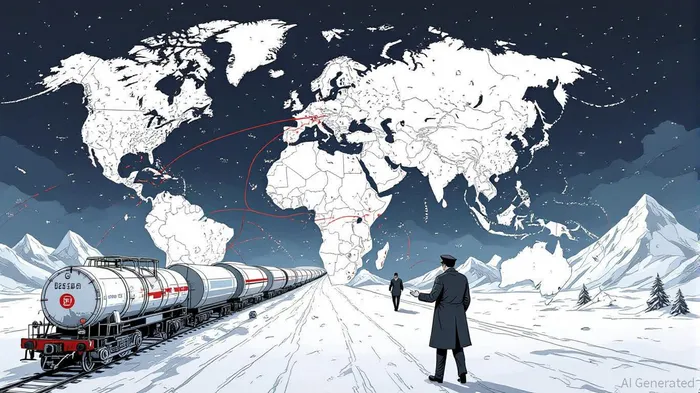
The economic pressure on Russia has intensified in 2025, reshaping global markets and creating complex investment dynamics. Western sanctions, now in their third year, have forced Moscow to reallocate fiscal resources toward defense and energy sectors while deepening its economic isolation. For investors, this geopolitical-driven shift presents both risks and opportunities, particularly in energy infrastructure, defense manufacturing, and emerging markets.
Sanctions and Structural Stagflation
According to a report by Chatham House, Russia’s real GDP in 2025 is estimated to be 12 percent lower than it would have been without sanctions, with cumulative losses exceeding $1 trillion in U.S. dollar terms [1]. The war in Ukraine and Western sanctions have crippled Russia’s financial infrastructure, with 80 percent of its banking system restricted from global networks [2]. Meanwhile, stagflation has taken root: Q2 2025 GDP growth slowed to 1.1 percent, the weakest since Q2 2023, while inflation hit 8.8 percent in July 2025 [3]. The Central Bank’s 21 percent key rate, aimed at curbing inflation, has further burdened the civilian economy, exacerbating structural imbalances [1].
Energy revenues, a cornerstone of Russia’s fiscal model, have declined by 30 percent year-on-year due to G7+ price caps and logistical disruptions [6]. The EU’s 18th sanctions package, including a dynamic oil price cap, has constrained Russia’s ability to monetize exports, forcing a pivot to domestic debt financing and eroding fiscal flexibility [1].
Fiscal Reallocation and Military Prioritization
To sustain the war effort, Russia has reallocated 33 percent of its 2025 federal budget to defense, with spending reaching 10.7 trillion rubles ($120.8 billion)—the highest since the Soviet era [4]. This militarization of the economy has come at the expense of civilian sectors, which have seen production declines in machinery (-3.8 percent monthly) and electrical equipment (-5.4 percent monthly) [1]. The government has also nationalized foreign assets, such as the Sakhalin-2 project, and imposed aggressive subsidies on energy and agriculture, draining fiscal reserves [1].
By July 2025, Russia’s budget deficit had ballooned to 4.88 trillion rubles ($61.1 billion), driven by falling oil prices and sanctions-related revenue losses [6]. The Ministry of Finance revised its oil price forecast from $69.70 to $56 per barrel, signaling growing fiscal strain [1].
Global Market Implications and Investment Opportunities
The sanctions-driven reallocation of Russian resources has created ripple effects in global markets. Energy markets, in particular, face volatility as Russia redirects exports to China and India. The Power of Siberia 2 pipeline, a key infrastructure project, has gained strategic importance despite economic hurdles [4]. For investors, this shift highlights opportunities in Asian energy infrastructure and LNG terminals, though risks remain tied to geopolitical tensions and U.S. tariff threats against India [5].
Defense stocks in Europe and the U.S. have also gained traction as Russia escalates attacks on critical energy infrastructure. NATO allies are formalizing trade agreements with partners like Japan to bolster resilience, signaling long-term growth in defense manufacturing [2].
Emerging markets, particularly in Southeast Asia, are emerging as beneficiaries of global supply chain diversification. Countries like Vietnam and Thailand are attracting investment as alternative manufacturing hubs, reducing reliance on China and mitigating risks from concentrated supply chains [2].
Strategic Risks and the Path Forward
While opportunities exist, investors must navigate significant risks. Russia’s economy is projected to grow at only 1 percent annually, with structural stagnation and labor shortages compounding challenges [4]. The Trump-Putin summit in August 2025 briefly eased sanctions, causing oil prices to drop 12 percent and destabilizing markets [5]. Such geopolitical volatility underscores the need for caution.
For Russia, the path forward hinges on balancing military spending with economic sustainability. The government’s reliance on domestic debt and national reserves is unsustainable long-term, and further oil price declines could trigger a mild recession [6].
Conclusion
The escalating economic pressure on Russia has redefined global market dynamics, creating a landscape where energy infrastructure, defense, and emerging markets offer high-reward opportunities. However, these gains come with systemic risks tied to geopolitical instability and Russia’s structural economic challenges. Investors must adopt a nuanced approach, leveraging data-driven insights while hedging against the uncertainties of a rapidly shifting geopolitical order.
Source:
[1] Assessing Russia's Economic Resilience Amid Stagnation [https://www.ainvest.com/news/assessing-russia-economic-resilience-stagnation-concerns-high-interest-rates-2509/]
[2] Global Markets Brace for Turbulence Amid Escalating Trade Wars and Geopolitical Storms [https://markets.financialcontent.com/wral/article/marketminute-2025-9-5-global-markets-brace-for-turbulence-amid-escalating-trade-wars-and-geopolitical-storms]
[3] Budget on the Brink: Where Is Russia's Economy Headed in 2025? [https://www.bakunetwork.org/en/news/analytics/14047]
[4] Militarizing the Economy: Russia's Next Budget Allocates [https://meduza.io/en/feature/2023/11/24/militarizing-the-economy]
[5] Assessing the Geopolitical and Economic Implications of Trump-Putin Diplomacy [https://www.ainvest.com/news/assessing-geopolitical-economic-implications-trump-putin-diplomacy-global-markets-2509/]
[6] Assessing the Fiscal and Strategic Risks to Russia's Energy-Dependent Budget [https://www.ainvest.com/news/assessing-fiscal-strategic-risks-russia-energy-dependent-budget-oil-price-slumps-sanctions-2508/]







Comentarios
Aún no hay comentarios