
Escalating US-China Trade Tensions: Implications for Emerging Markets and Supply Chain Reconfiguration
The escalating trade tensions between the United States and China have triggered a seismic shift in global trade dynamics, with emerging markets and strategic diversification in supply chains emerging as pivotal focal points. As President Donald Trump's Iran-linked tariff threats and China's aggressive investments in alternative energy and mineral supply chains reshape economic landscapes, investors must navigate a complex interplay of geopolitical risks and opportunities. This analysis examines how these developments are redefining global trade corridors and highlights investment prospects in regions poised to benefit from this realignment.
Trump's Iran-Linked Tariffs: A Catalyst for Supply Chain Fragmentation
President Trump's 2025 announcement of a 25% tariff on countries conducting business with Iran has exacerbated global trade uncertainty, fragmenting supply chains and elevating costs for emerging markets. According to a report, these tariffs-part-of-a-broader-"reciprocal"-trade-strategy-have-pushed-average-U.S.-import-tariffs-to-24–27%, the highest in over a century. The automotive sector, for instance, faces a 25% tariff on foreign-made vehicles and parts, projected to incur $100 billion in annual costs and drive vehicle prices up by $5,000–$15,000. Similarly, the technology industry experiences mixed effects, with hardware and semiconductors benefiting from temporary exemptions, while consumer electronics face declining sentiment and potential price hikes.
Emerging markets, particularly in the Middle East and North Africa, bear the brunt of these tariffs, with elevated rates ranging from 17% to 41% depending on trade profiles. Retaliatory measures from China and the EU have further strained global trade dynamics, compounding inflationary pressures and prompting central banks to adjust interest rates. While short-term negotiations-such as the U.S.-Japan trade agreement-have eased tensions, ongoing disputes underscore the fragility of the current system.
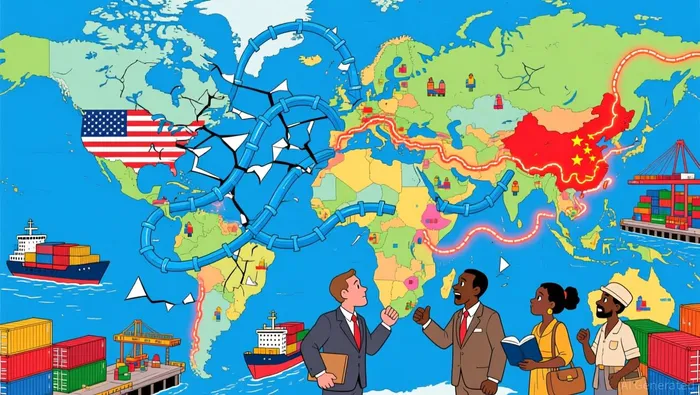
China's Critical Mineral Dominance and the Belt and Road Initiative
China's strategic investments in critical minerals and alternative energy infrastructure are central to its global economic ambitions. By 2023, China had secured first-place rankings in consumption for 36 of its 45 major mineral resources, including cobalt, lithium, and rare earth elements essential for clean energy technologies. Under the Belt and Road Initiative (BRI), Chinese firms have acquired key assets in Africa, such as Mali's Goulamina Lithium Mine and Tanzania's Ngualla Rare Earth Mine, ensuring long-term access to resources. These investments are not limited to mining; China controls 85–90% of global rare earth element refining and dominates downstream manufacturing, such as battery production and solar panel assembly.
The scale of China's involvement is staggering: in 2025 alone, Chinese policy banks issued $24.9 billion in BRI-linked mining loans, solidifying its influence in Africa's mineral sector. This vertical integration allows Beijing to exert control over both supply and processing, positioning it as a linchpin in the global energy transition. However, U.S. and EU initiatives like the Lobito Corridor and Minerals Security Partnership aim to counterbalance China's dominance by promoting sustainable development and diversifying supply chains.
Supply Chain Reconfiguration: Southeast Asia and Africa as Beneficiaries
The U.S.-China trade war has catalyzed a reconfiguration of global supply chains, with Southeast Asia and Africa emerging as key beneficiaries. Southeast Asian nations like Vietnam, Malaysia, and Thailand have attracted significant foreign direct investment (FDI) due to their competitive labor markets and strategic trade agreements. For example, Vietnam's Cat Lai port has seen a 30% surge in cargo volumes, driven by manufacturing relocations from China. The U.S. has deepened trade frameworks with these countries, such as the U.S.-Vietnam agreement, which introduces a 20% reciprocal tariff and expands market access for U.S. exports.
In Africa, China's BRI projects are reshaping infrastructure and trade corridors. The Lobito Corridor, a U.S.-supported rail and port initiative in Angola, aims to counter China's influence by enhancing connectivity to mineral-rich regions. Meanwhile, African nations like the Democratic Republic of the Congo (DRC)-which produces 70% of the world's cobalt-are becoming focal points in the global race for critical minerals. The 2025 G20 Africa Critical Minerals Summit in Johannesburg underscores the continent's growing role in mineral governance, with calls for industrialization and value addition to capture more economic returns.
Investment Opportunities in a Reconfigured World
Investors seeking to capitalize on these shifts should prioritize regions and sectors aligned with strategic diversification. In Southeast Asia, Vietnam's manufacturing and logistics hubs, supported by U.S. trade agreements, offer robust growth potential. Malaysia and Thailand's electronics and automotive industries are also attractive, given their proximity to U.S. markets and infrastructure upgrades.
In Africa, critical mineral projects under the BRI-such as Zambia's Lubambe Copper Mine and Mali's Goulamina Lithium Project-present high-yield opportunities, particularly as global demand for electric vehicle components surges. Additionally, the U.S.-DRC trilateral agreement to develop an integrated battery value chain highlights the continent's strategic importance in the energy transition.
Conclusion
The interplay of Trump's Iran-linked tariffs and China's mineral supply chain strategies is redefining global trade corridors, creating both challenges and opportunities. Emerging markets in Southeast Asia and Africa are uniquely positioned to benefit from this realignment, provided they address infrastructure bottlenecks and geopolitical risks. For investors, the key lies in aligning portfolios with regions and sectors that leverage strategic diversification, ensuring resilience in an increasingly fragmented global economy.







Comentarios
Aún no hay comentarios