
The Erosion of Nvidia's Dominance in AI Hardware
Google's TPU Strategy: A Credible Challenge to Nvidia
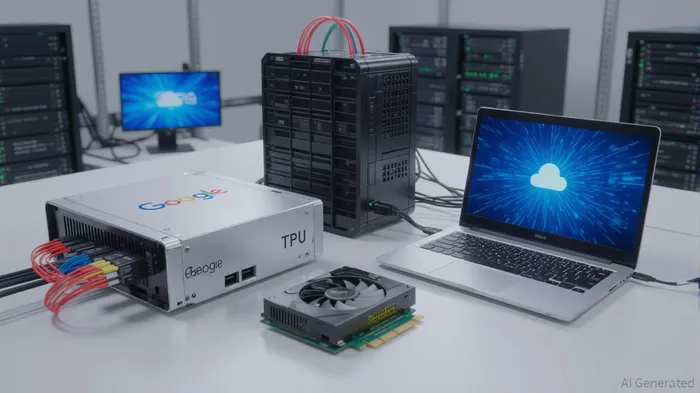
Google's TPUs, now in their seventh generation (Ironwood), have demonstrated superior efficiency for AI inference workloads, particularly in operations per joule and cost per inference. This has attracted major tech players like Meta, which is reportedly in early talks to adopt TPUs in its data centers by 2027. , another key player, plans to train its large language model on up to 1 million TPUs, signaling a potential $10s of billions in revenue for GoogleGOOGL--.
Nvidia has responded defensively, emphasizing the versatility of its Blackwell architecture and the ability of GPUs to run any AI model across cloud, on-premise, and edge environments. However, TPUs' application-specific design allows them to outperform GPUs in repetitive mathematical computations, a critical factor for large-scale inference tasks. This niche advantage has enabled Google to reduce dependency on Nvidia while optimizing costs for internal and external workloads.
Broader Semiconductor Market Trends
The AI hardware rivalry is fueling explosive growth in the semiconductor industry. Deloitte projects 2025 global chip sales , driven by generative AI and data center expansion. , . This growth is underpinned by investments in advanced manufacturing processes, such as 3nm and 2nm nodes, and high-bandwidth memory (HBM) solutions.
UBS has upgraded its outlook for wafer fab equipment (WFE) spending, , driven by memory demand and potential underestimation of China's WFE needs. Logic ICs and memory ICs are projected , respectively, in 2025, reflecting the sector's broad-based upswing.
Implications for Semiconductor Stocks
The TPUs vs. GPUs competition is rippling beyond Alphabet and NvidiaNVDA--, influencing stocks of companies traditionally outside the AI chip spotlight. Broadcom, for instance, has benefited from Alphabet's AI-driven growth, securing its role as a major supplier of AI accelerators and networking components. Similarly, IsuPetasys, which supplies components to Alphabet, has seen its stock surge in response to TPU-related developments.
This shift toward application-specific integrated circuits (ASICs) like TPUs could pressure other chipmakers, such as AMD, to adapt more aggressively to changing market dynamics. While Google is not seeking to fully replace Nvidia GPUs-acknowledging their flexibility for varied workloads-it is leveraging TPUs to reduce costs and gain leverage in negotiations. This dual-strategy approach could redefine AI economics and influence the broader semiconductor industry in the long term.
Conclusion
The erosion of Nvidia's dominance in AI hardware underscores a broader industry trend: the rise of vertical integration and application-specific solutions. As Google's TPUs gain traction, the semiconductor landscape is becoming more fragmented, with implications for both established players and emerging suppliers. Investors must monitor these dynamics closely, as the competition between TPUs and GPUs is not just a battle for market share but a catalyst for innovation and growth across the semiconductor ecosystem.







Comentarios
Aún no hay comentarios