
The Eroding Confidence of Small Business Owners: A Warning Signal for 2025's Economic Momentum
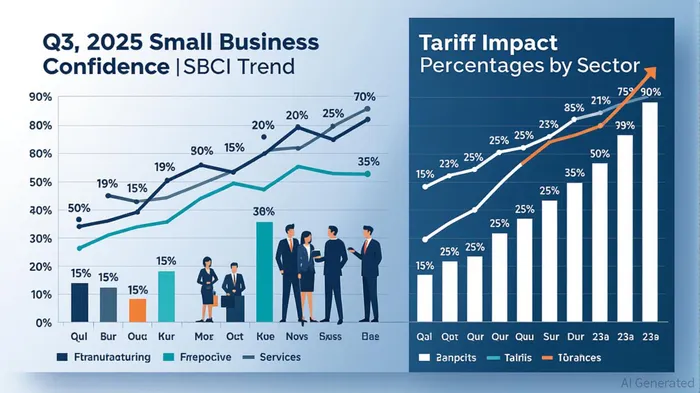
The small business sector, long a cornerstone of economic resilience, is sending mixed signals in 2025. While the Q3 2025 Small Business Confidence Index (SBCI) rose to 56—up from 51 in Q2—indicating a rebound in optimism, underlying vulnerabilities persist[1]. According to a report by CNBC|SurveyMonkey, 46% of small business owners now describe the economy as “excellent” or “good,” a jump from 30% in the previous quarter. Yet this optimism is tempered by persistent concerns over tariffs, inflation, and supply chain fragility. For investors, these dynamics present a paradox: a cautiously hopeful small business community coexisting with structural risks that could erode long-term growth.
The Fragile Rebound: Sector-Specific Challenges
The SBCI's uptick masks stark sectoral divides. Manufacturing firms, buoyed by improved sales expectations and stable input costs, lead the optimism charge[1]. Conversely, retail businesses report the lowest confidence, with 26% noting declining earnings compared to the previous quarter[1]. Tariffs, in particular, have created a rift. A survey by Revenue.com reveals that 78% of manufacturing and construction firms face rising material costs due to tariffs on steel and lumber, while 68% of retailers absorb these costs, squeezing profit margins[1]. Coastal states, reliant on imports, report 72% of small businesses experiencing tariff-related delays, compared to 58% inland[1].
Inflation remains another shadow. While 66% of small businesses now expect rising prices (down from 72% in Q2), 80% fear a resurgence of inflationary pressures[1][3]. This hesitancy to pass costs to consumers has created a lagging inflationary effect, as noted by Principal Asset Management: small businesses have delayed price hikes despite trade policy pressures, risking future margin compression[5].
Investor Responses: Diversification and Defensive Strategies
Investors are recalibrating portfolios to navigate this uncertainty. The Q3 2025 Asset Allocation Outlook highlights a shift toward non-U.S. equities, fixed income, and alternatives like private credit and infrastructure to hedge against U.S. trade policy volatility[3]. For example, Highland Associates and Confluence Investment have reduced exposure to small-cap equities, favoring large and mid-cap stocks for their resilience[4]. Similarly, European and Asian sectors—less entangled in U.S. tariff regimes—are gaining traction as stable growth avenues[5].
Capital allocation strategies are also leaning defensive. A BlackRockBLK-- analysis recommends a 50/50 growth-value equity tilt to balance upside potential with valuation risks[5]. Meanwhile, small business owners are adopting hybrid approaches: 37% have integrated AI tools into operations, with 75% reporting positive impacts[1]. These investments in technology and efficiency aim to offset labor shortages (46% of businesses report hiring challenges) and capital access issues (64% cite tighter bank lending)[1].
Strategic Risk Frameworks: Mitigating Uncertainty
To address these challenges, investors and businesses are deploying structured risk assessment frameworks. The ISO 31000 standard and Failure Mode and Effects Analysis (FMEA) are being used to identify vulnerabilities in supply chains and operational processes[3]. For instance, a manufacturer applied FMEA to reduce production bottlenecks, improving efficiency by 15%[5]. Financial institutionsFISI-- are also leveraging predictive analytics to enhance risk-adjusted returns, as seen in BlackRock's 67% Sharpe ratio improvement in portfolio management[5].
Small businesses, meanwhile, are prioritizing liquidity and diversification. Walmart's driver-based forecasting model, which links operational metrics to financial outcomes, has improved forecast accuracy by 10%[4]. Similarly, Dell's just-in-time inventory system has created a negative cash conversion cycle, freeing capital for reinvestment[4]. For smaller firms, alternatives like SBA loans, revenue-based financing, and government incentives (e.g., the CHIPS Act) are critical to maintaining flexibility[4].
A Warning for Economic Momentum
Despite these adaptive measures, the data suggests a fragile equilibrium. The SBCI's rise is driven by short-term optimism, but long-term risks—such as unresolved trade policies and global protectionism—loom large. A Morgan StanleyMS-- report warns that small business-dependent sectors could face margin compression until trade policies stabilize[5]. For investors, this means maintaining a disciplined approach: balancing sector rotation, diversifying geographically, and prioritizing businesses with strong unit economics[3].
Conclusion
The small business sector's cautious optimism in 2025 reflects both resilience and vulnerability. While strategic risk frameworks and adaptive capital allocation are mitigating immediate threats, unresolved macroeconomic headwinds—particularly in trade policy—pose a risk to sustained growth. For investors, the lesson is clear: confidence in small businesses must be paired with disciplined diversification and a focus on operational resilience. As the economy navigates this crossroads, the actions taken today will shape whether small businesses remain a driver of momentum or become a drag on recovery.







Comentarios
Aún no hay comentarios