
Ericsson's Q4 Catalyst: Is the 5G Infrastructure Boom Already Priced In?
The market's bullish thesis on Ericsson's 5G-driven turnaround is about to face its first major test. The company will publish its Q4 2025 financial report at approximately 7:00 AM CET on January 23, 2026, followed by a live analyst webcast at 9:00 AM CET. This event is critical because the stock has already surged over 20% to multiyear highs, indicating that much of the anticipated good news is likely priced in.
The setup is clear. After a stellar third quarter that saw earnings nearly triple and the stock pop, the bar for a clean Q4 beat is exceptionally high. The market has rewarded the narrative of a sustained margin recovery and software-driven growth. Now, the Q4 report must prove that this momentum is sustainable, not speculative. Any stumble in sales, guidance, or margin trajectory could quickly deflate the current optimismOP--. The upcoming webcast, where CEO Börje Ekholm and CFO Lars Sandström will comment, will be the key moment for investors to assess the durability of the story.
The 5G Infrastructure Tailwind: Is the Growth Real?
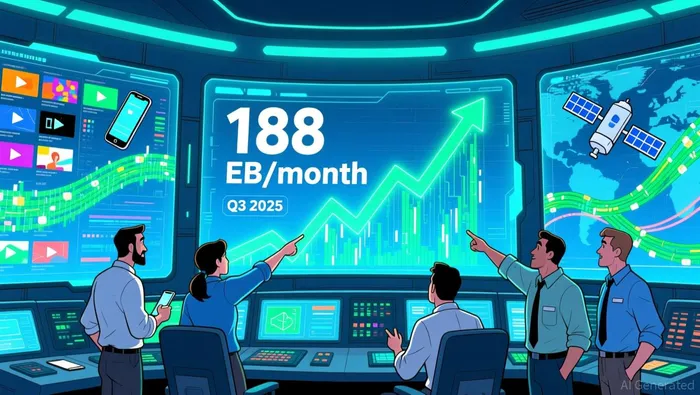
The bullish case for EricssonERIC-- rests on a powerful, quantifiable trend: insatiable demand for mobile data is forcing a global network build-out. The numbers show this isn't a distant promise but an accelerating reality. In the third quarter of 2025, global mobile network data traffic hit 188 exabytes per month, growing at a 20% year-over-year pace. This growth is overwhelmingly driven by video, which is expected to account for ~76% of mobile data traffic by the end of 2025. For a network equipment supplier, this is the fundamental tailwind.
The shift to 5G is the primary mechanism for handling this surge. The penetration of 5G is moving fast. Its share of mobile data traffic is projected to rise from 34% at the end of 2024 to 43% by the end of 2025. This isn't just a percentage increase; it represents a massive transfer of traffic load from older, less efficient networks to the new infrastructure that Ericsson provides. The company's business is directly tied to this transition.
Yet, the demand picture is far from uniform. The need for infrastructure is intensely localized. Traffic demands in dense urban areas can be up to 1,000 times larger than in rural areas. This stark disparity is the core driver behind the industry's focus on network densification-a strategy of adding more small cells, mid-band spectrum, and fiber deep into neighborhoods. It's a costly, labor-intensive build-out that requires constant investment in new equipment and upgrades. This is the "day-to-day deliverables" that Ericsson's customers are executing in 2025.
The bottom line is that the growth story is real and accelerating. The projected 20% traffic growth and the rapid 5G adoption curve create a sustained, multi-year need for the kind of network upgrades Ericsson sells. The company's recent stock surge reflects this macro tailwind. The upcoming Q4 report will test whether its financial performance is keeping pace with this fundamental infrastructure boom.
Financial Impact and Valuation Setup
The macro 5G trend is translating into tangible financial results, but the path has been bumpy. The company's most recent quarterly report, for Q2 2025, showed a clear divergence: revenue fell 6.2% year-over-year to $5.84 billion, missing consensus, while EPS of $0.14 topped estimates by $0.02. This pattern of top-line pressure alongside bottom-line beats is the hallmark of a business undergoing a structural shift, where software and services are lifting margins even as traditional hardware sales face cyclical headwinds.
This financial reality is reflected in the stock's valuation. Ericsson trades at a trailing P/E ratio of 16.48, with analysts projecting earnings to grow 10.42% next year. On the surface, that's a reasonable multiple for a company in a growth industry. However, the market's recent action tells a different story. The stock has soared over 20% to multiyear highs, a move that suggests investors are pricing in a successful, sustained monetization of the 5G infrastructure boom. This creates a high-wire act for the upcoming Q4 report.
The setup is now one of elevated expectations. The valuation already embeds the optimistic narrative of margin recovery and software-driven growth. For the stock to sustain or extend its rally, the Q4 results must not only meet but exceed the already-high bar set by the Q3 beat. Any sign that the 5G build-out is stalling, or that the company's cost structure is eroding the margin gains, could quickly deflate this priced-in optimism. The current valuation leaves little room for disappointment; it demands flawless execution of the growth story.
Catalysts and Risks: What Could Move the Stock
The upcoming Q4 report and webcast will be a high-stakes test of the 5G narrative. The market will scrutinize three specific catalysts to see if the bullish setup holds.
First, the key watchpoint is revenue guidance for 2026 and any updates on the pace of 5G standalone (SA) deployment. The macro tailwind is clear: mobile data demand is accelerating, with traffic hitting 188 exabytes per month in Q3. This growth is driving the industry's "day-to-day deliverables," including densification and mid-band expansion. For Ericsson, the critical question is whether this fundamental infrastructure need is translating into sustained revenue growth. The company must provide a forward view that aligns with the projected 20% annual traffic growth and the rapid adoption of 5G, which is set to account for 43% of mobile data traffic by the end of 2025. Any guidance that suggests the build-out is slowing would directly challenge the core growth thesis.
Second, the primary risk is continued pressure on pricing and margins. Carriers are under intense pressure to monetize standalone 5G without raising consumer prices, which could squeeze Ericsson's profitability. The company's recent financials show a pattern of revenue falling while EPS beats, a sign of margin recovery from software and services. The market has priced in this recovery. If the Q4 report reveals that pricing discipline is eroding or that cost inflation is undermining those margin gains, it would signal that the "differentiated connectivity" monetization story is harder to execute than hoped. This would be a direct hit to the stock's valuation, which already reflects a successful margin story.
Finally, the specific catalyst is confirmation of market share gains in mid-band spectrum and fixed wireless access (FWA) deployments. These are the concrete areas where the densification trend is playing out. The evidence shows FWA is scaling rapidly, with ~35 million CPE shipments in 2025 and 14.6 million connections in the U.S. alone. Mid-band expansion is the backbone of densification. If Ericsson can point to wins in these specific, high-growth segments, it would validate its ability to capture the day-to-day infrastructure build-out. Conversely, a lack of clear share gains here would suggest the company is getting left behind in the very projects that are driving the industry's growth.
The bottom line is that the stock's recent rally prices in a smooth execution of this story. The Q4 report must deliver proof that the fundamental traffic growth and densification needs are being converted into solid revenue and market share, all while protecting margins. Any stumble on guidance, pricing, or share gains could quickly deflate the optimism that has already lifted the shares.





Comentarios
Aún no hay comentarios