
Ericsson's 4.5 GHz Massive MIMO AIR 3255: A Strategic Catalyst for 5G Infrastructure Growth
Ericsson's 4.5 GHz Massive MIMO AIR 3255 represents a pivotal advancement in 5G infrastructure, blending cutting-edge technology with sustainability to address the escalating demands of global telecom networks. As the rollout of 5G accelerates, Ericsson's ability to innovate in radio access networks (RAN) and align with industry trends like Open RAN and energy efficiency positions it as a formidable player in the $1.5 trillion telecom infrastructure market. This analysis evaluates the AIR 3255's technical merits, Ericsson's competitive advantages, and the company's investment potential in the context of the 2025 global 5G landscape.
Technical Innovation and Market Positioning
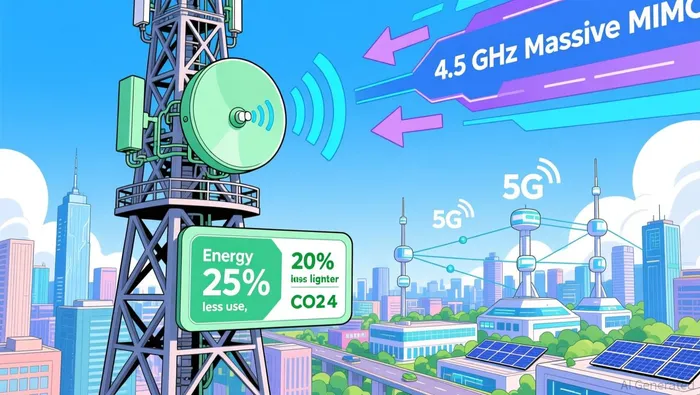
The AIR 3255, deployed in NTT DOCOMO's 5G network, exemplifies Ericsson's focus on high-performance, energy-efficient solutions. Operating at 4.5 GHz, the radios leverage multi-user MIMO to enhance throughput even in congested environments, a critical feature as global data traffic is projected to grow 15-fold by 2028. The product's 25% reduction in energy use and 20% lighter design compared to prior generations align with the industry's push for sustainable infrastructure, a trend underscored by the International Energy Agency's emphasis on decarbonizing telecom networks.
Ericsson's proprietary Silicon (System on a Chip) technology further differentiates the AIR 3255. By integrating advanced receiver processing and passive cooling on a single printed circuit board, the radios achieve industry-leading energy efficiency while supporting scalable deployment across TDD sub-6GHz bands. This flexibility is crucial for carriers like DOCOMO, which must balance capacity demands with cost constraints in high-traffic urban areas.
Strategic Alignment with 5G Trends
 Ericsson's broader portfolio reinforces the AIR 3255's strategic value. The company's commitment to Open RAN-evidenced by its AI-native, hardware-agnostic software architecture-enables seamless integration with third-party components, reducing dependency on proprietary ecosystems. This approach resonates with carriers seeking to diversify supply chains and avoid vendor lock-in, particularly in markets like the UK and Japan, where Ericsson has secured long-term partnerships with VodafoneThree and SoftBank.
Sustainability is another cornerstone of Ericsson's strategy. The AIR 3255's 20% reduction in embodied CO2 complements Ericsson's pledge to achieve net-zero operations by 2030. As regulators and consumers increasingly prioritize environmental impact, Ericsson's green credentials could translate into a competitive edge over rivals like Nokia and Huawei, which face scrutiny over energy consumption and supply chain ethics.
Financial and Market Performance
Ericsson's Q3 2025 financial results highlight its resilience in a competitive market. Despite a 2% organic sales decline, the company reported a 28.1% adjusted EBITA margin, driven by cost efficiencies and a SEK 7.6 billion capital gain from the Iconectiv divestment. This profitability, coupled with a strengthened net cash position of SEK 51.9 billion, underscores Ericsson's ability to reinvest in R&D and reward shareholders through dividends or buybacks.
Market share data further validates Ericsson's dominance. The company holds a 36% share outside China in 2024, bolstered by its leadership in 5G standardization (80,000+ 3GPP contributions since 2001) and a cloud-native 5G Core portfolio. Analysts at Gartner and Omdia have consistently ranked EricssonERIC-- as a top performer in 5G RAN and core infrastructure, citing its "Ability to Execute" and "Business Performance." These accolades reflect Ericsson's ability to deliver scalable, future-proof solutions in an era of rapid technological change.
Competitive Advantages and Investment Potential
Ericsson's competitive moat is built on three pillars: technical innovation, sustainability, and ecosystem partnerships. The AIR 3255's role in DOCOMO's network and Ericsson's Open RAN-ready portfolio demonstrate its capacity to meet diverse carrier needs, from dense urban deployments to rural coverage. Meanwhile, its intellectual property (IP) portfolio-over 80,000 3GPP contributions-ensures long-term relevance in 5G and 6G development.
From an investment perspective, Ericsson's strategic positioning offers both defensive and growth characteristics. The company's recurring revenue model, driven by multi-year contracts like the 8-year VodafoneThree deal, provides stability. At the same time, its focus on AI/ML-driven automation and cloud-native solutions positions it to capitalize on next-generation use cases, such as industrial IoT and autonomous systems.
Risks and Mitigants
While Ericsson's prospects are strong, risks persist. Intense competition from Huawei and Nokia could pressure margins, particularly in price-sensitive markets. Regulatory shifts, such as U.S. restrictions on Chinese vendors, may also disrupt supply chains. However, Ericsson's diversified global footprint, robust IP portfolio, and emphasis on sustainability mitigate these risks. Its recent focus on Open RAN and partnerships with CSPs further insulates it from vendor-specific vulnerabilities.
Conclusion
Ericsson's 4.5 GHz Massive MIMO AIR 3255 is more than a product-it is a strategic lever for 5G growth. By combining technical excellence, sustainability, and Open RAN readiness, Ericsson addresses the core challenges of modern telecom networks. With a 36% market share outside China, strong financials, and a leadership position in industry rankings, the company is well-positioned to benefit from the $1.2 trillion 5G infrastructure market expected to expand through 2030. For investors, Ericsson represents a compelling blend of innovation and stability in the high-stakes race to power the next decade of connectivity.





Comentarios
Aún no hay comentarios