
Erdogan's Economic Policies and Their Impact on Turkey's September Inflation Rate
Turkey's economic landscape in September 2025 reflects a complex interplay between President Recep Tayyip Erdoğan's policy priorities and the Central Bank of the Republic of Turkey's (CBRT) efforts to stabilize inflation. The official inflation rate rose to 33.29% year-on-year in September 2025, marking the first increase in 16 months and defying expectations, according to Turkish Minute. This surge, driven by sharp price hikes in education (66.1%), housing (51.36%), and food (36.06%), underscores the fragility of Turkey's macroeconomic stability amid political and monetary policy clashes, according to Anadolu Agency.
The Clash Between Political and Monetary Priorities
Erdoğan's long-standing advocacy for low interest rates to stimulate growth has historically clashed with the CBRT's inflation-fighting mandates. In 2025, this tension persists despite the CBRT's aggressive rate hikes-raising the benchmark rate to 50% in March 2024 and further to 46% in April 2025, as noted in a State Department report. Finance Minister Mehmet Şimşek attributed the September inflation spike to external shocks, including agricultural frost and drought, but analysts argue that structural factors, such as currency depreciation and supply-side bottlenecks, remain unaddressed, according to Anadolu Agency. The CBRT's September 2025 rate cut (to 40.5%)-the second consecutive reduction-has raised concerns about policy inconsistency, with critics warning that easing monetary conditions could reignite inflationary pressures, according to Turkish Minute.
Discrepancies in Inflation Data and Investor Sentiment
The government's official inflation figures face skepticism from independent analysts. The Inflation Research Group (ENAG) estimates the real annual inflation rate at 63.23% for September 2025, nearly double the TurkStat figure, according to Turkish Minute. This divergence highlights a lack of transparency in data collection, eroding trust among foreign investors. Meanwhile, the Turkish lira's volatility-losing 37% of its value against the dollar in 2023-has compounded uncertainties, with the country's risk premium remaining elevated at 255.8 basis points as of September 2025, per the State Department report.
Assessing the Investment Climate
Turkey's 2025-2027 Medium-Term Programme (MTP) aims to attract foreign direct investment (FDI) through green energy incentives, streamlined permitting, and reconstruction efforts in earthquake-affected regions, according to GIS Reports. However, FDI inflows in 2023 totaled $5.6 billion, below pre-2015 levels, as investors remain wary of political risks and opaque regulatory processes, according to GIS Reports. The OECD projects GDP growth of 2.9% in 2025 and 3.3% in 2026, contingent on sustained fiscal consolidation and structural reforms, in the OECD Economic Outlook. Yet, the budget deficit-projected at 3.3% of GDP in 2025-remains a concern, with further tax reforms needed to close revenue gaps, according to GIS Reports.
Long-Term Viability and Structural Challenges
While the CBRT's orthodox policies have stabilized the lira and reduced inflation expectations, long-term sustainability hinges on resolving political-economic tensions. Erdoğan's insistence on low rates for growth clashes with the CBRT's inflation-targeting framework, creating policy uncertainty. Structural reforms, such as labor market flexibility and green technology investments, are critical for attracting FDI and achieving net-zero emissions by 2053, according to Ideal Estates. However, the government's ability to balance social equity with economic modernization remains untested, particularly as high interest rates strain vulnerable populations, according to Ideal Estates.
Conclusion
Turkey's investment climate in 2025 is a double-edged sword. While strategic location, demographic advantages, and green energy ambitions offer opportunities, political interference in monetary policy, inflationary stickiness, and data credibility issues pose significant risks. For foreign investors, the key will be monitoring policy coherence, transparency in governance, and the CBRT's independence. As Erdoğan's economic agenda evolves, the world will watch to see whether Turkey can reconcile its populist instincts with the demands of a globalized, inflation-conscious economy.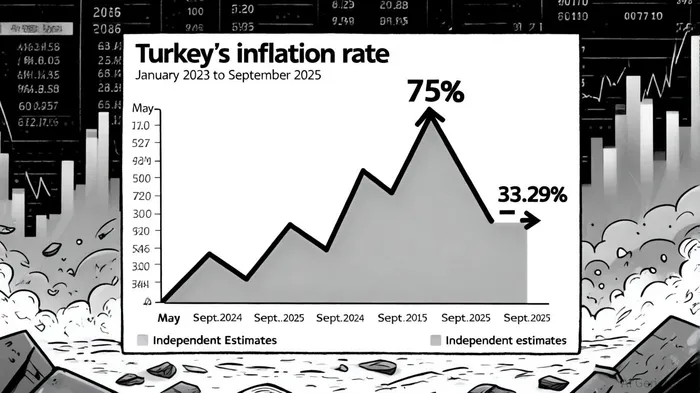







Comentarios
Aún no hay comentarios