
ERCOT's RTC+B: A Market Revolution for Energy Buyers and Battery Investors
Grid Modernization as a Cost-Cutting Engine
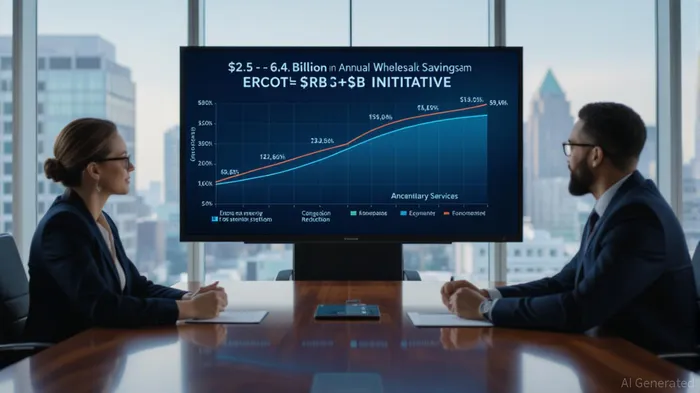
ERCOT's RTC+B design is projected to deliver $2.5–6.4 billion in annual wholesale market savings by co-optimizing energy and ancillary services in real time, a feat enabled by advanced modeling of battery state-of-charge (SoC) dynamics. These savings stem from three pillars:
1. Improved resource utilization: By integrating battery storage as a single, SoC-aware resource, the system avoids the inefficiencies of treating batteries as separate charging and discharging assets.
2. Reduced transmission congestion: Real-time co-optimization minimizes costly grid bottlenecks by dynamically balancing supply and demand according to ERCOT.
3. Efficient ancillary service procurement: The replacement of the static Operating Reserve Demand Curve (ORDC) with Ancillary Service Demand Curves (ASDCs) ensures pricing reflects real-time scarcity, incentivizing cost-effective grid stability.
According to ERCOT's Independent Market Monitor, these efficiencies will directly lower energy costs for consumers while creating a more predictable environment for long-term investments. For energy buyers, this means a structural reduction in procurement risk and a clearer path to decarbonization without sacrificing affordability.
Batteries in Real-Time Pricing: A First-Time Opportunity
The most groundbreaking aspect of RTC+B is its first-time inclusion of batteries in real-time pricing mechanisms. Prior to this update, batteries were excluded from real-time markets due to the complexity of modeling their SoC constraints. Now, under RTC+B, batteries are treated as a single device with a defined SoC, enabling them to bid into both energy and ancillary services markets simultaneously.
This change unlocks two critical revenue streams:
- Energy arbitrage: Batteries can now profit from price volatility by charging during low-price periods and discharging during peaks, with real-time pricing ensuring optimal dispatch.
- Ancillary services: By participating in frequency regulation and other grid services, batteries can generate additional income streams, particularly during periods of high renewable penetration when grid stability is most challenged according to Enverus.
However, success in this new paradigm requires advanced forecasting and optimization tools. As noted by Ascend Analytics, static bidding strategies will underperform in the RTC+B environment, where dynamic SoC constraints and ASDCs demand real-time adaptability. For battery operators, this means a shift from passive asset management to active, data-driven participation-a challenge that also represents a significant competitive advantage for those who adapt quickly.
Hybrid Projects: The New Gold Standard
The integration of batteries into real-time markets also redefines the economics of hybrid projects, which combine generation (e.g., solar, wind) with storage. Under RTC+B, these projects gain unprecedented flexibility:
- Dynamic re-dispatch: Hybrid systems can shift between energy production, storage, and ancillary services based on real-time grid needs, maximizing asset utilization.
- Reduced curtailment: By absorbing surplus renewable generation during mid-day "cliff" events, batteries mitigate the need for costly curtailment, enhancing the profitability of solar and wind assets.
For investors, hybrid projects now offer a dual-income model-energy sales plus ancillary service payments-that significantly improves return profiles. According to Enverus, this flexibility could drive a wave of new hybrid developments in Texas, particularly in regions with high solar penetration and transmission constraints.
Challenges and the Path Forward
While the benefits of RTC+B are clear, its implementation is not without hurdles. Battery operators must navigate stricter ancillary service qualification requirements, and the transition to ASDCs demands a cultural shift in how market participants value grid services. Additionally, the long-term impact on battery revenue remains uncertain, as the market adjusts to the new pricing signals.
Yet, these challenges are surmountable. The Real-Time Co-Optimization Plus Batteries Task Force (RTCBTF) has already laid the groundwork for a smooth transition through extensive testing and stakeholder engagement according to ERCOT. For investors, the key is to prioritize projects with robust forecasting capabilities and partnerships with market optimization platforms.
Conclusion: A Market Revolution in Motion
ERCOT's RTC+B is more than a technical upgrade-it is a market revolution. By integrating batteries into real-time pricing and co-optimizing energy and ancillary services, the initiative is poised to slash costs for energy buyers while creating a fertile ground for battery and hybrid project investments. With $2.5–6.4 billion in annual savings and a reimagined role for storage, Texas is setting a blueprint for grid modernization that other regions will likely follow.
For investors, the message is clear: the future of energy markets is here, and those who embrace the RTC+B paradigm will reap the rewards of a more efficient, resilient, and profitable grid.







Comentarios
Aún no hay comentarios