
ERCOT's RTC+B Market Reform and Its Impact on Energy Storage Valuation
Economic Impact and Grid Reliability
According to ERCOT's Independent Market Monitor, the RTC+B model will reduce wholesale energy costs through optimized resource utilization and efficient dispatch. By co-optimizing energy and ancillary services, the reform minimizes manual interventions by operators, curtails transmission congestion, and accelerates responses to renewable intermittency-key challenges as solar and wind generation expand according to ERCOT. For instance, the replacement of the Operating Reserve Demand Curve (ORDC) with Ancillary Service Demand Curves (ASDCs) allows for granular pricing of specific ancillary services, such as frequency regulation and contingency reserves, directly integrating battery capabilities into market operations. This shift is expected to reduce clean energy curtailment and lower system costs, aligning with Texas's decarbonization goals.
Transforming Risk and Revenue Models
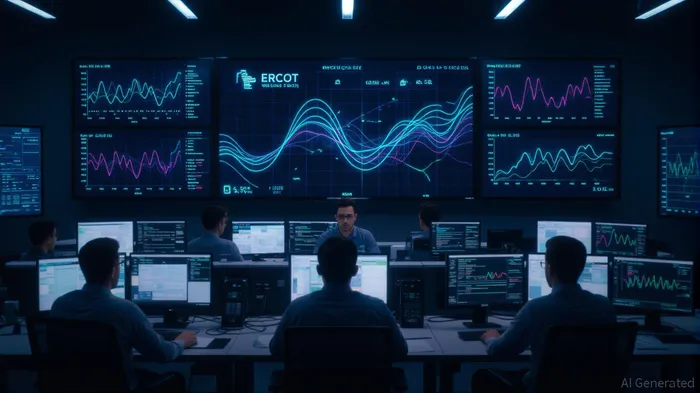 The RTC+B model fundamentally alters risk and revenue profiles for battery storage assets. Traditionally, BESS operators relied on volatility in energy prices and scarcity adders under the ORDC framework to generate ancillary service revenues. However, the ASDC system de-emphasizes scarcity pricing, instead valuing services based on real-time demand and technical performance. While this reduces exposure to price spikes, it also introduces uncertainty for asset owners who must now navigate a market where revenue streams are more predictable but less tied to extreme events.
For example, the eligibility criteria for ERCOT Contingency Reserve Service (ECRS) have tightened, requiring batteries to meet a 1-hour dispatch duration instead of 2 hours. This change increases the amount of dispatchable capacity but may compress margins for operators in scenarios where real-time conditions deviate from day-ahead forecasts. Investors must now prioritize assets with high telemetry accuracy and flexible dispatch capabilities to maximize returns in this co-optimized environment.
Strategic Investment Considerations
The RTC+B reform creates both challenges and opportunities for investors. On one hand, the reduction in market volatility could lower the premium for ancillary services, pressuring revenue margins. On the other, the enhanced grid flexibility and reduced energy costs position Texas as a leader in renewable integration, attracting capital to storage and grid infrastructure. According to a report by Resurety, the reform's $2.5–$6.4 billion annual savings mechanism is a "multi-billion-dollar upgrade" for energy buyers, indirectly boosting demand for storage solutions that stabilize the grid.
Strategic investors should focus on three key areas:
1. Technology Adaptation: Assets equipped with advanced telemetry and real-time data analytics will thrive in the RTC+B framework, enabling precise dispatch and compliance with ASDC requirements.
2. Duration Optimization: With ECRS eligibility tied to 1-hour dispatch, developers must prioritize projects with shorter-duration capabilities to align with market incentives according to Camelot Energy Group.
3. Grid Synergy: Investments in infrastructure that complements battery storage-such as transmission upgrades and smart inverters-will capitalize on the reform's emphasis on congestion management and renewable integration according to ERCOT.
Is Now the Time to Reposition?
The RTC+B model's implementation in late 2025 has already begun to reshape market dynamics, but its full impact will unfold over the next 12–18 months. For investors, the current window offers a unique opportunity to reposition in a market poised for growth. While the transition to ASDCs may initially reduce ancillary service revenues, the long-term benefits of a more stable, low-cost grid-coupled with Texas's aggressive renewable targets-suggest that storage valuation will stabilize and expand.
However, success hinges on adaptability. As noted by Camelot Energy Group, "The key to thriving in RTC+B lies in understanding how evolving duration thresholds and procurement dynamics affect revenue potential." Investors who align their portfolios with these shifts-prioritizing flexibility, data-driven operations, and grid resilience-will be well-positioned to capitalize on the $2.5–$6.4 billion annual savings and the broader transformation of Texas's energy ecosystem.







Comentarios
Aún no hay comentarios