
ERCOT's RTC+B Launch: A Game-Changer for Grid Stability and Renewable Energy Buyers
Grid Stability and Cost Efficiency: A New Baseline
ERCOT's RTC+B replaces the outdated Operating Reserve Demand Curve (ORDC) with Ancillary Service Demand Curves (ASDCs), enabling granular pricing for specific grid services like frequency regulation and voltage support according to a report by Resurety. This shift ensures resources are compensated based on their actual value to reliability, reducing inefficiencies in reserve markets. According to a report by Resurety, the program's co-optimization of energy and ancillary services in real-time is projected to cut wholesale market costs by up to $6.4 billion annually. These savings stem from reduced manual interventions by operators and the elimination of redundant reserve markets, which previously inflated costs during periods of high demand or renewable intermittency.
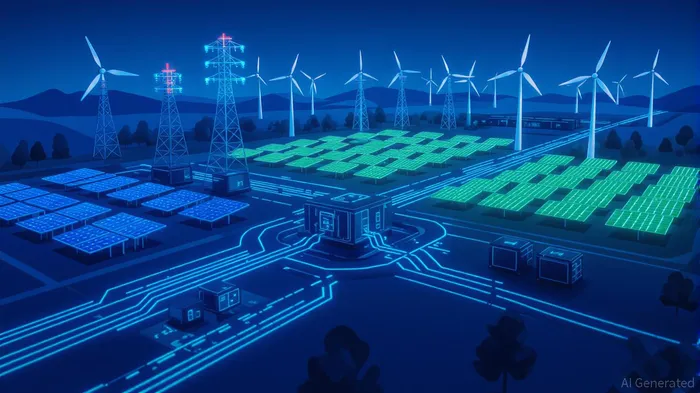 For renewable energy buyers, RTC+B's real-time battery integration is a game-changer. By modeling batteries as a single device with a state of charge (SoC), the program allows for dynamic dispatch that balances surplus solar and wind generation with grid needs according to ERCOT. This capability not only mitigates curtailment risks but also enhances the economic viability of renewable portfolios, particularly in a market where solar and wind now account for over 40% of generation capacity as noted by industry analysts.
Battery Integration: Unlocking Decentralized Storage Value
The RTC+B framework explicitly recognizes batteries as flexible assets, a first in U.S. wholesale markets according to ERCOT. This recognition is critical for decentralized storage, which has seen deployment surge to over 5 GW in Texas in 2025 according to Gridbeyond. By allowing batteries to bid into real-time markets based on their SoC, ERCOT enables storage operators to capture arbitrage opportunities across price spikes and lulls, while simultaneously providing grid services. As noted by Enverus, this dual-market participation-energy and ancillary services-creates a "value stack" that could increase revenue streams for storage assets by 20–30%.
For investors, this means prioritizing technologies that optimize battery performance in real-time environments. Advanced software platforms capable of SoC tracking, predictive load-shifting, and dynamic bidding are now essential for competitive returns according to Gridbeyond. The demand for such tools is already driving acquisitions and partnerships among grid-adjacent tech firms, signaling a maturing ecosystem for decentralized storage.
Evolving Market Dynamics: Strategic Implications for Investors
The RTC+B rollout has redefined the Day-Ahead Market (DAM) as a primarily financial instrument, with real-time co-optimization becoming the operational backbone according to Gulf Coast Power. This dual-market structure requires traders and developers to rethink risk management frameworks. For instance, energy contracts must now account for real-time price volatility amplified by battery arbitrage and renewable variability. As Gulf Coast Power highlights, successful market participants are those who integrate real-time data analytics into their portfolio optimization strategies, hedging against both energy price swings and ancillary service demand fluctuations.
Moreover, the program's emphasis on liquidity and competition in the DAM is attracting new entrants, including virtual power plant (VPP) operators and community microgrid developers according to industry reports. These entities leverage aggregated decentralized resources-solar, storage, and demand response-to bid into markets as a single entity, a strategy now more viable under RTC+B's streamlined data requirements according to ERCOT. For infrastructure investors, this trend underscores the importance of funding projects that combine hardware (e.g., modular batteries) with software (e.g., VPP controllers) to capture the full value of grid flexibility.
Investment Opportunities: Where to Focus in 2026
The RTC+B era favors three key investment themes:
1. Decentralized Storage with AI-Driven Dispatch: Batteries paired with machine learning algorithms for SoC optimization are poised to dominate the $12 billion Texas storage market by 2027 according to Gridbeyond.
2. Grid-Edge Technologies: Innovations in smart inverters, distributed energy resource management systems (DERMS), and blockchain-based peer-to-peer trading platforms are gaining traction as ERCOT's real-time markets demand faster response times according to Enverus.
3. Ancillary Services Specialization: Firms that develop niche capabilities in frequency regulation or voltage support-services now priced under ASDCs-stand to capture a growing share of the $2.1 billion annual ancillary services market according to industry analysis.
However, investors must also navigate challenges. The complexity of managing assets in a fast-moving market requires robust cybersecurity and regulatory compliance frameworks according to Gridbeyond. Additionally, the transition to RTC+B has exposed gaps in workforce expertise, creating opportunities for training platforms and consulting firms specializing in market design according to ERCOT.
Conclusion
ERCOT's RTC+B initiative is more than a technical upgrade-it is a catalyst for a new energy paradigm where grid stability and renewable integration are no longer mutually exclusive. For infrastructure investors, the program's $2.5–6.4 billion in projected savings according to Resurety, coupled with its emphasis on battery flexibility and real-time co-optimization, offers a roadmap to capitalize on the decarbonization transition. As Texas leads the nation in energy innovation, the strategic deployment of decentralized storage and grid-adjacent technologies will define the next decade of returns in the sector.







Comentarios
Aún no hay comentarios