
ERCOT's RTC+B and the Future of Energy Storage: Market Design Changes Reshape Valuation and Grid Reliability
Economic Implications: Efficiency Gains and Valuation Uncertainty
According to ERCOT's Independent Market Monitor, RTC+B could deliver annual wholesale market savings of $2.5–$6.4 billion, driven by smarter scarcity pricing, reduced manual interventions, and more efficient dispatch of resources. For energy storage, the ability to bid into both energy and ancillary services (AS) markets simultaneously-while being modeled as a single device with a state-of-charge-has unlocked new revenue streams. Hybrid projects, which combine solar/wind with storage, now benefit from co-optimized dispatch, maximizing utilization and reducing curtailment risks.
However, the long-term valuation of storage assets remains uncertain. While increased participation in real-time markets may boost revenues, the same efficiency gains that reduce system costs could also dampen price volatility, a key driver of arbitrage opportunities for batteries. As noted by Resurety, "the availability of batteries as a less scarce resource" might limit the premium prices they previously commanded. This duality-enhanced flexibility versus reduced market premiums-requires investors to recalibrate valuation models to account for evolving revenue profiles.
Operational Innovations: Precision Pricing and Grid Resilience
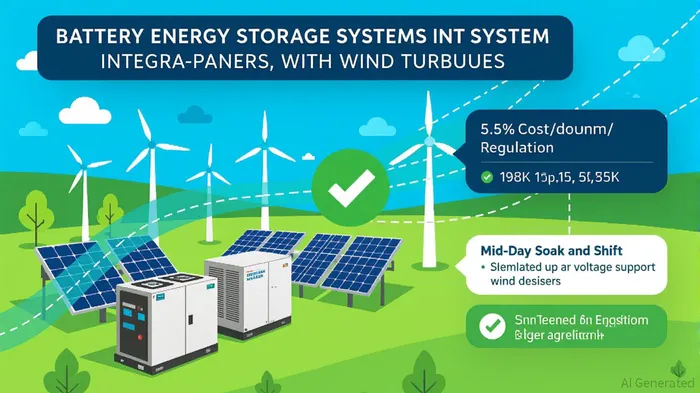 RTC+B replaces the traditional Operating Reserve Demand Curve (ORDC) with Ancillary Service Demand Curves (ASDCs), enabling granular pricing for each type of grid support service. This change is particularly impactful for batteries, which can now provide regulation up/down, frequency response, and voltage support in real time. For example, in a simulated "Swap the Reg" scenario, a battery supplied 50 MW of regulation up services during peak demand, allowing a more efficient Combined Cycle Gas Turbine (CCGT) to focus on energy production, reducing system costs by 2.7%.
The program also enhances grid reliability by addressing intermittency from renewables. In the "Solar Cliff" case study, unexpected solar generation shortfalls were mitigated by dispatching a Combustion Turbine (CT) earlier, avoiding ancillary service price spikes. Similarly, the "Mid-Day Soak and Shift" case demonstrated how batteries stored excess solar energy, avoiding curtailment and reducing total system costs by 5.5%. These examples underscore how RTC+B's dynamic dispatch capabilities improve resilience while optimizing resource use.
Technical Evolution: SCED Enhancements and Pricing Dynamics
The Security Constrained Economic Dispatch (SCED) engine now co-optimizes energy and ancillary services every five minutes, a critical upgrade for managing the rapid response capabilities of batteries. The retirement of the Updated Desired Base Point (UDBP) in favor of the Updated Desired Set Point (UDSP) introduces resource-specific signals for regulation deployment, refining system control. Additionally, the replacement of a flat $5,000/MWh system-wide offer cap with separate day-ahead and real-time caps (DASWCAP and RTSWCAP) introduces new pricing volatility and opportunities for strategic bidding.
These technical changes, while complex, position batteries as more versatile assets. As Voltus notes, the ability to adjust state-of-charge dynamically increases revenue potential while reducing operational risk. However, market participants must now navigate a more intricate bidding landscape, requiring advanced analytics and adaptive strategies.
Future Outlook: Strategic Adaptation for Investors
The success of RTC+B hinges on its ability to balance efficiency gains with the financial sustainability of storage assets. While the program's first year has shown promising results-such as a 5.5% reduction in system costs during mid-day solar surges-investors must remain vigilant about evolving market conditions. Key considerations include:
1. Hybrid Project Optimization: Projects combining generation and storage will likely outperform standalone assets, as co-optimized dispatch maximizes utilization.
2. Ancillary Service Revenue Streams: With ASDCs enabling precise pricing, batteries can capture higher margins in niche services like regulation and voltage support as per ERCOT's release.
3. Regulatory and Market Evolution: Ongoing adjustments to offer caps and pricing mechanisms may create new volatility, requiring agile risk management.
Conclusion
ERCOT's RTC+B represents a foundational shift in Texas's energy market, redefining the role of batteries as both energy arbitrageurs and grid stabilizers. While the program's economic and reliability benefits are clear, its long-term impact on storage valuation will depend on how well market participants adapt to its complexities. For investors, the key takeaway is that RTC+B is not merely a technical upgrade but a strategic inflection point-one that demands a nuanced understanding of evolving market dynamics to unlock the full potential of energy storage.







Comentarios
Aún no hay comentarios